

¿Por qué los sistemas industriales necesitan anticongelante/refrigerante en verano?
1405/03/02
Pasos para la limpieza química de torres de refrigeración: guía de implementación
1405/02/07
Tipos de sedimentos en sistemas de ósmosis inversa y métodos para identificarlos.
1405/02/05
Beneficios de utilizar soluciones especializadas de Abrizan Company para MED
1404/12/09
Stress corrosion

Introduction:
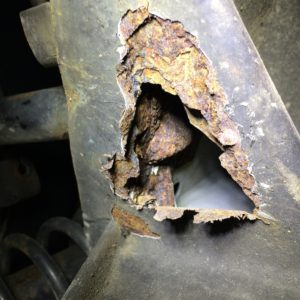
If a part is simultaneously exposed to a corrosive environment and tensile stresses, its corrosion (in terms of speed and extent) is intensified compared to normal conditions (in the absence of stress), which is called stress corrosion. In fact, stress corrosion is the deterioration of a metal or alloy that is in a corrosive environment and is under relatively small but continuous tensile stresses.
Corrosion combined with mechanical stresses causes metals to fail in various ways and creates many problems in industrial equipment. Since the effects of this destruction lead to the creation of cracks in the part in question, it is called stress corrosion cracking. This phenomenon is the cause of about 25% of failures resulting from corrosion and stress in the chemical industry.
This type of corrosion is one of the common corrosions for which the simultaneous presence of three factors is necessary for its occurrence: a corrosive environment, the presence of a metal or alloy sensitive to this type of cracking, and the presence of tensile stress on the metal or alloy. Stress corrosion cracking is a mechanical-chemical process that leads to cracking of some metals and alloys at stresses below their yield strength.
The type of stresses effective in this destruction are tensile stresses and compressive stresses do not interfere. It is noted that these stresses may be in the form of residual stresses in the metal that have been with the part from the manufacturing and production stages or may have been added to the part during subsequent operations and for various reasons. Residual stresses arise for various reasons, including: drilling, punching, rolling, riveting, welding, bending, etc. These stresses remain with the parts unless they are subjected to annealing heat treatment, which of course is not always practical.
Although the destruction of the part due to corrosive agents and tensile stresses alone is minor, the simultaneous effect of these two factors is dangerous and causes microscopic cracks that spread rapidly and cause the part to be destroyed. Microscopic cracks are often not detectable by conventional testing, but can be detected by special methods. As the cracks advance and penetrate further into the metal, their effective cross-sectional area decreases, ultimately leading to metal failure.
It should be noted that the cracks are small, branched, and often filled with corrosion products, and are formed almost perpendicular to the applied stress, and their type is a function of the environment and alloy structure. Stress corrosion cracking usually occurs in two ways. In the grain boundary type, cracks penetrate the grain boundaries of the metal. This type of stress corrosion cracking often occurs in aluminum alloys and low-fracture steels, which are called intergranular cracks. This type of crack occurs in austenitic stainless steels in hot solutions containing chlorine ions.
In fact, intergranular SCC is a form of localized subsurface corrosion in which a random narrow path is corroded between grains without any significant effect on the direction of the crack due to the presence of grain boundaries. Intergranular SCC starts on the surface and spreads inward. Sometimes both types of cracks (boundary and intergranular) may occur in an alloy, the type of crack depends on the corrosive environment and the alloy structure.
Most metals used in industry are affected by stress corrosion cracking in certain environments (such as ordinary steels, low alloy steels, brasses, stainless steels, magnesium, nickel alloys, etc.). It is also not necessary that the environment is highly corrosive, but stress corrosion cracking also occurs in weakly corrosive environments.
Usually, each type of alloy cracks only in a few specific environments. For example, copper alloys do not crack in alkaline environments and steels do not crack in the presence of ammonia vapor.
Factors affecting stress corrosion
- Stress factor:To cause SCC, the stresses must be tensile, and increasing the stress reduces the time to failure. For each alloy, there is a certain stress below which failure will not occur. In addition, the sources of stress in the part may be applied stress, thermal residue, welding, or cold work.
- Time factor:Usually, due to the creation of initial cracks, the effective surface of the metal decreases over time, and with increasing stress, the crack grows, and finally failure occurs. In the final moments, due to stress concentration, the stress limit becomes equal to or greater than the final tensile stress of the metal.
- Environmental factors:The occurrence of stress corrosion depends on the type of metal and the corrosive environment. Of course, a comprehensive model for the environments that cause SCC in different alloys has not been presented. Before selecting and using any metal in a corrosive environment, the necessary tests must be carefully performed. Of course, the physical state of the corrosive environment also has an effect on SCC, so that destruction in an environment that is alternately wet and dry is faster than in a uniform environment. Steam and condensation environments also exacerbate SCC. To better understand the issue, the following examples can be cited: Example 1) Austenitic stainless steel cracks in chlorine-containing environments but not in ammonia environments. Example 2) Stainless steels do not undergo SCC in sulfuric acid, nitric acid, acetic acid, and pure water.
- Metallurgical factors:The chemical composition of the metal, the preferential growth of crystals, the composition and distribution of precipitates within the metal, and the reaction of dislocations with each other affect SCC. Although SCC occurs less frequently in pure metals, this is not a general rule; for example, pure commercial copper undergoes SCC in ammonia solution.
- Other factors:The amount of oxidizing agents and temperature are other effective parameters on SCC, such that the presence of oxidizing agents and an increase in temperature exacerbate SCC.
Methods of reducing or preventing:
In general, to combat stress corrosion cracking (SCC), it is necessary to eliminate one of the three basic factors that play a major role in the occurrence of this type of corrosion. These three factors are:
The corrosive environment, alloys susceptible to SCC, tensile stresses on the metal or alloy (in the form of externally applied stresses) or residual stresses in the material.
In some cases, externally applied stresses (and not internal residual stresses of the object) can be eliminated by redesigning.
In summary, cracking caused by this type of SCC corrosion can be reduced in the following ways:
- Reducing the existing stress below the allowable limit (by reducing the load applied to the metal or increasing the thickness of the part), for example by performing shot peening operations on the metal or alloy to create a suitable layer on metals and alloys under certain conditions.
- Changing the conditions of the corrosive environment (if possible) to reduce oxidizing components such as dissolved oxygen and also to remove or remove harmful environmental factors, which can be done in various ways, including gas removal, mineral removal, or distillation.
- Using heat treatment to eliminate residual stress inside the part. For example, ordinary steels are annealed and stress relieved at 560-650 ° C and austenitic stainless steels are annealed and stressed at about 830-930 ° C.
- Cathodic protection: The use of cathodic protection can stop stress corrosion cracking (SCC). In the application of cathodic protection, it must be ensured that the cause of damage over time is SCC, and if the cause of corrosion is hydrogen embrittlement, cathodic protection has the opposite effect.
- Changing the alloy type: Changing the alloy elements and metallurgical structure can increase the resistance to stress corrosion cracking (SCC). Usually, the obvious solution is to use an alloy that is resistant to stress corrosion cracking in a particular environment and replace it with an alloy that is susceptible to stress corrosion cracking in the same environment. For example, when 304 stainless steel is affected by stress corrosion cracking in a corrosive environment, Inconel is used instead.
compartir :
¿Por qué los sistemas industriales necesitan anticongelante/refrigerante en verano?
1405/03/02Pasos para la limpieza química de torres de refrigeración: guía de implementación
1405/02/07Tipos de sedimentos en sistemas de ósmosis inversa y métodos para identificarlos.
1405/02/05Beneficios de utilizar soluciones especializadas de Abrizan Company para MED
1404/12/09
Artículos relacionados
Effect of chlorine ions on stainless steels
The effect of chlorine and chloride parameters on the corrosion of stainless steels and the parameters affecting their corrosion rate, as well as the acceptable limits of chlorine ion levels in water and the differences in the effects of free chlorine and chloride on the corrosion of corrosion-resistant steels, are stated.
Caustic corrosion
Localized corrosion caused by the concentration of caustic or alkaline salts, which usually occurs under conditions of high evaporation or heat transfer. Caustic salt or caustic soda is one of the most widely used ionic compounds and is used in various industries including water treatment, cardboard and paper production, oil and refinery industries, aluminum production industries, food industries, alcohol production and glass.
Corrosion and deposition of cooling water based on API 571
It refers to general or localized corrosion of carbon steels and other metals caused by dissolved salts, gases, organic compounds, or microbiological activity.
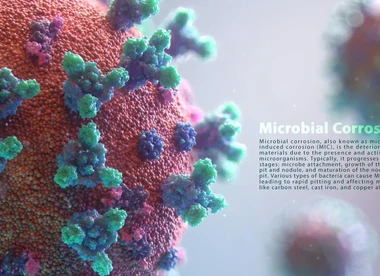
Microbial corrosion based on API 571
Microbial corrosion is a type of corrosion caused by living organisms such as bacteria, algae, or fungi. This type of corrosion is often associated with tubercles or slimy organic materials.
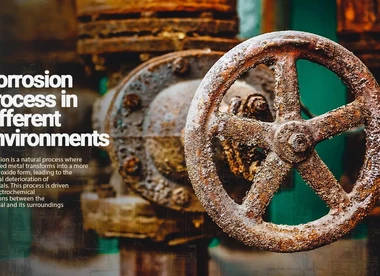
Corrosion process in different environments
Corrosion processes are divided into three groups in a more comprehensive classification: corrosion in aqueous solutions or environments, corrosion in molten salts and liquid metals, and corrosion in gases.
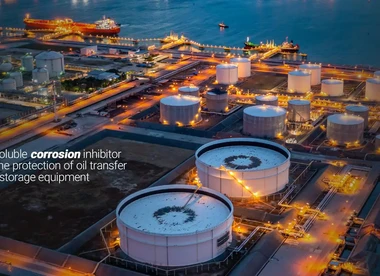
Oil-soluble corrosion inhibitor for the protection of oil transfer and storage equipment
Corrosion is a natural phenomenon that occurs as a result of the electrochemical reaction of metal with the surrounding environment. In the oil and gas industry, corrosion is one of the major problems that accounts for a huge amount of money annually. Part of these amounts are related to the corrosion of pipes or oil transmission lines. Effective ways to prevent corrosion of oil transmission and storage equipment are divided into two categories: physical and chemical solutions.

couponing
The coupon method or corrosion coupons is the simplest method of corrosion monitoring. Coupons are the oldest corrosion monitoring tool. Corrosion coupons are small pieces of metal or alloy of the material of interest that are immersed in the process medium and removed after a specified period of time and their weight or dimension loss is evaluated and examined.
Deaerators
Deaerators are mechanical devices that remove dissolved gases from the boiler feedwater. By reducing the concentration of oxygen and carbon dioxide in the solution, they minimize corrosion and protect the boiler from the effects of corrosive gases.
Envía tu opinión
Tu dirección de correo electrónico no será publicada.