

¿Por qué los sistemas industriales necesitan anticongelante/refrigerante en verano?
1405/03/02
Pasos para la limpieza química de torres de refrigeración: guía de implementación
1405/02/07
Tipos de sedimentos en sistemas de ósmosis inversa y métodos para identificarlos.
1405/02/05
Beneficios de utilizar soluciones especializadas de Abrizan Company para MED
1404/12/09
Anodic protection

Introduction
Anodic protection was first introduced by Adelino in 1954. In short, the transfer of the metal attacked by corrosion to the rust zone with the help of an external current is called anodic protection.
In anodic protection, the electric current applied is usually equal to the amount of corrosion of the structure under protection. Therefore, it is not only a protection method but also a method of measuring the instantaneous corrosion rate.
In this type of protection, unlike cathodic protection, the attempt is made to corrode the metal to an acceptable extent and then form a rust oxide protective layer on the metal surface. In this way, after the rust layer is formed, the corrosion protection will be performed by this layer. It should be noted that, by applying anodic protection, the corrosion rate is greatly reduced (even up to 100,000 times) by the formation of the protective layer.
Possibility of using the method:
The basic point about the possibility of using anodic protection for a structure is that the material to be protected must show electrochemically active-rust behavior and at the same time the rust potential range must be sufficiently wide and the rust current must be at least ten times lower than the corrosion current of the metal in normal conditions. In practice, a small number of metals or metal alloys meet the aforementioned conditions, but fortunately, iron and many of its alloys, which are widely used in industry, are included in this category.
This method is mostly used for metals that rust easily or have a lower rust current intensity. Therefore, it is only used for metals such as zinc, magnesium, cadmium, silver, copper and their alloys, stainless steel that follow active-rust conditions.
Anodic protection is less important from a practical point of view than cathodic protection due to its high sensitivity and maintaining the potential in the rust range.
For example, a steel tank containing acid cannot be protected by cathodic protection because the applied current will be consumed for the evolution of hydrogen. Therefore, one of the important applications of the anodic protection method is for such tanks.
For anodic protection of steel tanks containing sulfuric acid, a carbon electrode is used as the cathode and the metal body as the anode. Therefore, the protected current must reach all parts of the metal. For anodic protection, a device called a potentiostat is required. A potentiostat is an electronic device that keeps the metal at a constant potential with respect to a reference electrode. The potentiostat has three terminals. One is connected to the steel tank, the other to an auxiliary electrode as the cathode, and the third to a reference electrode. The potential required for electrochemical measurements is determined in advance. This method greatly reduces the corrosion rate. The main advantage of the method is its ability to be used in highly corrosive environments and the need for low electric current.
Comparing cathodic and anodic protection, we find the following points:
- In cathodic protection, all anodic areas on a metal become cathodes, so that corrosion stops. But in anodic protection, the entire metal surface becomes anodes to the extent that the metal is completely corroded. Therefore, it is clear that this method is applicable to metals that are capable of forming protective rust layers. Since rusted metals still corrode at a low rate, anodic protection often does not completely stop corrosion.
- Anodic protection is used in very weak to highly corrosive environments. While cathodic protection is related to moderate environments, because with the increase in the intensity of the corrosive environment, the electric currents required for cathodic protection become much higher and will not be economical. Therefore, cathodic protection of metals is not practical in highly corrosive environments.
- In anodic protection, very low currents are used, and for this reason it can be used in highly corrosive environments.
- Cathodic protection is economically viable because the components are simple and easy to install. However, anodic protection requires complex devices such as potentiostats, reference electrodes, etc. Therefore, its installation and maintenance costs are higher.
- In a cathodic protection system, the protected area or the ejection power is small. Therefore, to establish a uniform current, multiple electrodes are required at close distances from each other. Anodic protection systems have high ejection power. Therefore, a long pipeline can be protected with a single auxiliary electrode.
- In cathodic protection, the metal is thermodynamically stable, but in anodic reaction (anodic protection), the metal itself is not thermodynamically stable.
- The conditions required for anodic protection can be accurately determined using polarization curves. However, these conditions in the case of cathodic protection are obtained by trial, error, and estimation.
compartir :
¿Por qué los sistemas industriales necesitan anticongelante/refrigerante en verano?
1405/03/02Pasos para la limpieza química de torres de refrigeración: guía de implementación
1405/02/07Tipos de sedimentos en sistemas de ósmosis inversa y métodos para identificarlos.
1405/02/05Beneficios de utilizar soluciones especializadas de Abrizan Company para MED
1404/12/09
Artículos relacionados

Effect of chlorine ions on stainless steels
The effect of chlorine and chloride parameters on the corrosion of stainless steels and the parameters affecting their corrosion rate, as well as the acceptable limits of chlorine ion levels in water and the differences in the effects of free chlorine and chloride on the corrosion of corrosion-resistant steels, are stated.
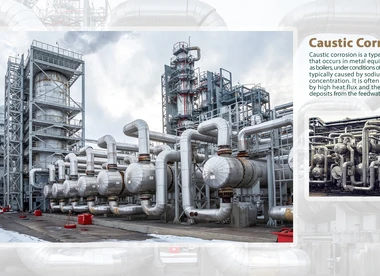
Caustic corrosion
Localized corrosion caused by the concentration of caustic or alkaline salts, which usually occurs under conditions of high evaporation or heat transfer. Caustic salt or caustic soda is one of the most widely used ionic compounds and is used in various industries including water treatment, cardboard and paper production, oil and refinery industries, aluminum production industries, food industries, alcohol production and glass.
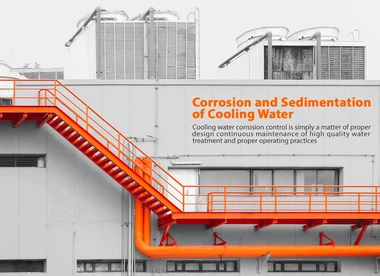
Corrosion and deposition of cooling water based on API 571
It refers to general or localized corrosion of carbon steels and other metals caused by dissolved salts, gases, organic compounds, or microbiological activity.

Microbial corrosion based on API 571
Microbial corrosion is a type of corrosion caused by living organisms such as bacteria, algae, or fungi. This type of corrosion is often associated with tubercles or slimy organic materials.
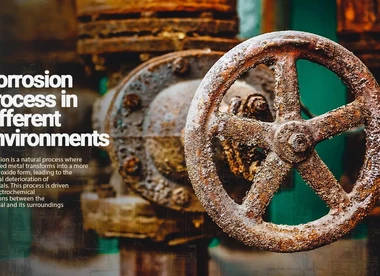
Corrosion process in different environments
Corrosion processes are divided into three groups in a more comprehensive classification: corrosion in aqueous solutions or environments, corrosion in molten salts and liquid metals, and corrosion in gases.

Oil-soluble corrosion inhibitor for the protection of oil transfer and storage equipment
Corrosion is a natural phenomenon that occurs as a result of the electrochemical reaction of metal with the surrounding environment. In the oil and gas industry, corrosion is one of the major problems that accounts for a huge amount of money annually. Part of these amounts are related to the corrosion of pipes or oil transmission lines. Effective ways to prevent corrosion of oil transmission and storage equipment are divided into two categories: physical and chemical solutions.

couponing
The coupon method or corrosion coupons is the simplest method of corrosion monitoring. Coupons are the oldest corrosion monitoring tool. Corrosion coupons are small pieces of metal or alloy of the material of interest that are immersed in the process medium and removed after a specified period of time and their weight or dimension loss is evaluated and examined.

Deaerators
Deaerators are mechanical devices that remove dissolved gases from the boiler feedwater. By reducing the concentration of oxygen and carbon dioxide in the solution, they minimize corrosion and protect the boiler from the effects of corrosive gases.
Envía tu opinión
Tu dirección de correo electrónico no será publicada.