

¿Por qué los sistemas industriales necesitan anticongelante/refrigerante en verano?
1405/03/02
Pasos para la limpieza química de torres de refrigeración: guía de implementación
1405/02/07
Tipos de sedimentos en sistemas de ósmosis inversa y métodos para identificarlos.
1405/02/05
Beneficios de utilizar soluciones especializadas de Abrizan Company para MED
1404/12/09
Cathodic protection

Introduction:
In 1824, Humphry Davy in London first used cathodic protection to protect copper sheets used for metal plating of ship hulls.
Davy realized that he could preserve copper in seawater by combining small amounts of iron or zinc. The chemical reaction that took place between iron and copper slowed down the rate of copper corrosion, and in this way the copper metal was protected from corrosion. In order to prevent corrosion of ships, this scientist suggested that iron pieces be installed as sacrificial anodes on the copper hulls of ships. So that the surface ratio of iron to copper is 1:100.
As mentioned in the previous discussions, in the corrosion process, the metal loses electrons and becomes a metal ion, and thus corrodes.
In the cathodic protection method, by applying a direct electric current to the metal or by contacting it with a sacrificial anode, the corrosion rate is reduced and in this case, on the metal surface where both cathodic and anodic regions exist, the anodic regions become cathodes and as a result the desired system or equipment becomes completely cathodic. The cathodic protection method is related to the external current, as a result of which the cathode elements of the local cells are polarized to the anode open circuit potential, that is, in this case the entire metal surface is equipotentialized (the anode and cathode potentials are equal) and the corrosion currents are stopped.
Or in other words, cathodic protection means that the desired part is placed in the cathode position of an electrochemical cell and then the metal potential is shifted towards more negative values, in such a way that the applied potential is more negative than the corrosion potential of the metal in an aqueous environment. In this way, the dissolution of the metal is prevented.
One of the methods of preventing corrosion is to apply a coating to industrial parts and equipment. If the coatings (conversion, metallic, organic and inorganic) were permanent and not damaged during installation or operation, metal pipes would never corrode. The occurrence of defects in the protective layers with holes, even if accidental, requires us to consider the second type of protection for metals buried in the soil. The cathodic protection method can be used alone, but this method requires a large amount of current. Therefore, to protect a part from corrosion, it is better to first coat the part properly and then strengthen it with cathodic protection. A proper protection of buried structures is a combination of coating and cathodic protection as follows:
80% coatings + 20% cathodic protection = proper protection
Cathodic protection prevents both uniform corrosion and localized corrosion (such as pitting corrosion, intergranular corrosion and selective delamination corrosion). Cathodic protection can be used to reduce stress corrosion cracking (SCC). Of course, hydrogen intrusion cracking (HIC) cannot be stopped by this method. Fatigue corrosion can also be reduced by cathodic protection.
Corrosion in the upper parts of the tank that are not in contact with water cannot be prevented by applying cathodic protection. This is because the applied current cannot enter areas of the metal that are not in contact with the electrolyte (such as the inner surface of the pipes), in which case auxiliary anodes must be installed inside the pipes or corrosion inhibitors must be used.
The most important application of cathodic protection is the protection of steel structures buried in soil or immersed in water, where water or soil act as the electrolyte. Using this method, the external surfaces of pipelines, ship hulls, docks, platforms in seawater and steel embedded in concrete can be protected from corrosion.
Principles of Cathodic Protection
If we look at the reactions related to metal corrosion such as M in an acidic environment, it is seen that in the anodic reaction (metal dissolution), the dissolution reaction can be stopped by giving electrons to the system.
Anodic reaction M2++2e→M
Cathodic reaction H2→ 2H++2e
Corrosion in aqueous solutions occurs through an electrochemical process and the anodic and cathodic electrochemical reactions occur simultaneously. Given that the rates of the anodic and cathodic reactions are equal, no charge is accumulated on the metal lattice.
By taking electrons from the metal part, the rate of the anodic reaction increases and the dissolution of the metal will be greater, while the rate of the cathodic reaction decreases. Of course, the opposite is also true. That is, if we transfer excess electrons from an external source to the metal part, in this case, the rate of the anodic reaction decreases and the rate of the cathodic reaction increases.
To prevent corrosion, the continuous transfer of electrons from an external power source causes the corroding metal to become cathodic and the metal is protected. The above principle can be shown by plotting the metal potential in terms of the logarithm of the anodic and cathodic reaction rates.
The presence of anodic and cathodic regions is necessary for corrosion reactions to occur. If the electrons of the structure are supplied from an external source, the rate of movement of positive ions from the metal surface decreases and the rate of cathodic reaction increases. And if the metal potential is reduced from the corrosion potential of the metal in the natural state to the protective potential of the metal after applying cathodic protection by applying external electrons, as a result, the anodic current and the corrosion process stop and cathodic protection occurs. This source is a direct current voltage source or a metal anode (sacrificial anode).
Note: In hydrogen embrittlement, since the reaction itself is cathodic, corrosion is not reduced but increased if cathodic protection is applied, but in stress corrosion, since corrosion results from metal dissolution, we can apply cathodic protection.
Methods of applying cathodic protection
Cathodic protection can be done in two ways:
- Applied current method
- Sacrificial anode method
Applied current method
For example, to protect steel pipes buried in the soil, we connect these pipes to a direct current generator and then the electric current is transferred to the pipe through a neutral auxiliary electrode located under the soil. In this case, the entire main pipe, the cathode and the auxiliary electrode, become the anode.
In other words, sufficient electrons are delivered to the entire surface of the pipe to reduce Fe2+ ions, as a result of which no anodic zone will be formed on the pipe.
In the mentioned cathodic protection systems, materials such as scrap iron, magnetite, granite, persilicon iron, lead and platinum alloys are used as auxiliary electrodes.
The most commonly used anodes in the applied current method are as follows:
- DSA anode
- High-silica cast iron anode (silicon)
- Durikel alloy anode
- High-silica cast iron anode with chromium
- Platinum anode
- High-silica cast iron anode with molybdenum
- Graphite anode
- Tantalum oxides
Note 1: DSA anodes are very expensive due to their long life and high efficiency.
Note 2: High-silica anodes are not used today due to environmental pollution.
In the applied current cathodic protection system, all communication systems have electrical insulation and even their connection to the auxiliary electrode or the protected pipe is completely insulated.
Usually, the anode is covered with a backing, which includes coke, gypsum or bentonite powder, to make it easier to establish an electric current between the ground and the anode. The electric current from the ground (electrolyte) enters the pipe and reduces its corrosion.
Sacrificial Anode Method
To better understand how sacrificial anodes work for cathodic protection, we first recall the galvanic series of metals. The galvanic series for a limited number of selected metals in seawater are shown in the table below.
Platinum |
Titanium |
Stainless steel |
Monel alloy |
Copper |
Lead |
Iron, cast iron or steel |
Cadmium |
Zinc |
Aluminum |
Magnesium |
By using metals whose voltage is more negative than the voltage of the metal to be protected, it is possible to protect the structures in seawater without using a direct current generator.
Creating protective currents by forming a galvanic cell and using a metal that is more anodic than the equipment exposed to corrosion causes the said metal to become the anode and the equipment to become the cathode. In this method, the anode metal is consumed and for this reason this anode is called a sacrificial anode. Because by sacrificing itself, it protects the other metal (cathode).
Care must be taken in selecting the consumable anode, because this anode must be more active than the metal to be protected so that when it corrodes, it provides the current necessary to protect the other metal. Usually, three metals, zinc, aluminum and magnesium, are used as sacrificial anodes. Depending on the electrical resistance of the environment in which the protection is to be performed, each of these consumable anodes is used with different sizes and weights. Sometimes it is necessary to use multiple consumable anodes to protect a buried pipe.
Note: In applied current cathodic protection, the anode is the positive pole, but in sacrificial anode cathodic protection, the anode is the negative pole.
compartir :
¿Por qué los sistemas industriales necesitan anticongelante/refrigerante en verano?
1405/03/02Pasos para la limpieza química de torres de refrigeración: guía de implementación
1405/02/07Tipos de sedimentos en sistemas de ósmosis inversa y métodos para identificarlos.
1405/02/05Beneficios de utilizar soluciones especializadas de Abrizan Company para MED
1404/12/09
Artículos relacionados
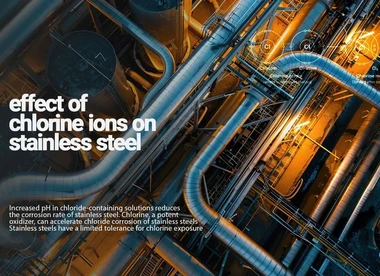
Effect of chlorine ions on stainless steels
The effect of chlorine and chloride parameters on the corrosion of stainless steels and the parameters affecting their corrosion rate, as well as the acceptable limits of chlorine ion levels in water and the differences in the effects of free chlorine and chloride on the corrosion of corrosion-resistant steels, are stated.
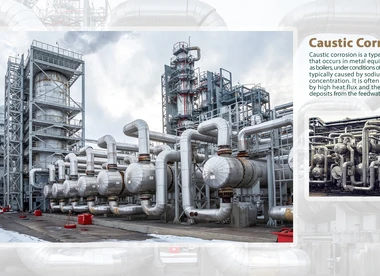
Caustic corrosion
Localized corrosion caused by the concentration of caustic or alkaline salts, which usually occurs under conditions of high evaporation or heat transfer. Caustic salt or caustic soda is one of the most widely used ionic compounds and is used in various industries including water treatment, cardboard and paper production, oil and refinery industries, aluminum production industries, food industries, alcohol production and glass.
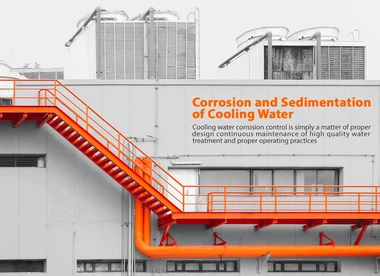
Corrosion and deposition of cooling water based on API 571
It refers to general or localized corrosion of carbon steels and other metals caused by dissolved salts, gases, organic compounds, or microbiological activity.

Microbial corrosion based on API 571
Microbial corrosion is a type of corrosion caused by living organisms such as bacteria, algae, or fungi. This type of corrosion is often associated with tubercles or slimy organic materials.
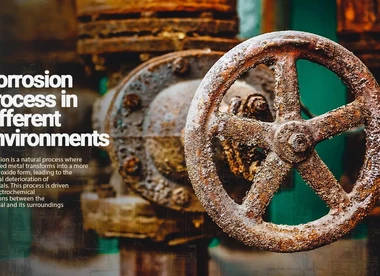
Corrosion process in different environments
Corrosion processes are divided into three groups in a more comprehensive classification: corrosion in aqueous solutions or environments, corrosion in molten salts and liquid metals, and corrosion in gases.
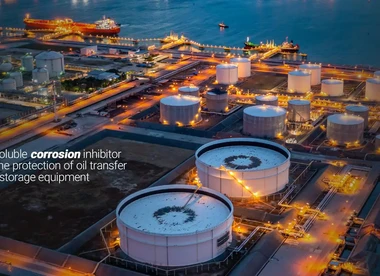
Oil-soluble corrosion inhibitor for the protection of oil transfer and storage equipment
Corrosion is a natural phenomenon that occurs as a result of the electrochemical reaction of metal with the surrounding environment. In the oil and gas industry, corrosion is one of the major problems that accounts for a huge amount of money annually. Part of these amounts are related to the corrosion of pipes or oil transmission lines. Effective ways to prevent corrosion of oil transmission and storage equipment are divided into two categories: physical and chemical solutions.

couponing
The coupon method or corrosion coupons is the simplest method of corrosion monitoring. Coupons are the oldest corrosion monitoring tool. Corrosion coupons are small pieces of metal or alloy of the material of interest that are immersed in the process medium and removed after a specified period of time and their weight or dimension loss is evaluated and examined.

Deaerators
Deaerators are mechanical devices that remove dissolved gases from the boiler feedwater. By reducing the concentration of oxygen and carbon dioxide in the solution, they minimize corrosion and protect the boiler from the effects of corrosive gases.
Envía tu opinión
Tu dirección de correo electrónico no será publicada.