

¿Por qué los sistemas industriales necesitan anticongelante/refrigerante en verano?
1405/03/02
Pasos para la limpieza química de torres de refrigeración: guía de implementación
1405/02/07
Tipos de sedimentos en sistemas de ósmosis inversa y métodos para identificarlos.
1405/02/05
Beneficios de utilizar soluciones especializadas de Abrizan Company para MED
1404/12/09
groove corrosion

Introduction
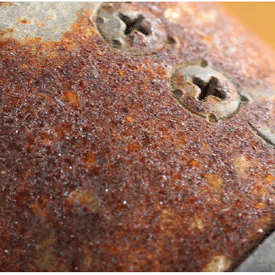
Gritting corrosion occurs in grooves, narrow gaps under screws, under deposits, and points in the system where the solution (electrolyte) is stagnant or dead. Due to the corrosive liquid being trapped between the grooves, the corrosion reaction in the groove is accelerated and severe localized corrosion will occur.
This type of corrosion usually occurs at the point of contact of metal or alloy with non-metallic materials such as rubber, plastic, wood, glass, concrete, fibers, etc.
Grouting corrosion is one of the most common types of localized corrosion in industrial equipment. Areas susceptible to this type of corrosion are grooves created under rivets, screws, and weld seams.
The likelihood of crevice corrosion occurring is higher on surfaces covered with living organisms (such as algae, moss in marine environments), under coatings applied to metal surfaces, and corrosion deposits, and ultimately, pressure difference cells are formed on these surfaces, which leads to crevice corrosion.
Influencing factors:
Deposits from corrosion products can create a suitable environment for the occurrence of crevice corrosion, so that under these deposits, there is a suitable environment for the occurrence of crevice corrosion. The main environmental deposits include sand, contaminated layers and other solids.
The effect of destructive ions in crevice corrosion is also important, so that any type of solution or neutral water containing chloride ions can cause the development of this type of corrosion in crevices. Of course, factors such as the concentration of the corrosive solution in the crevices and the amount of oxygen dissolved in the corrosive solutions can play an important role in the severity of crevice corrosion.
Crevice corrosion is very common in stainless steel, even if stainless steel does not have a heterogeneous nucleus on its surface, crevice corrosion can occur in it, because this type of corrosion does not require an initial nucleus to start corrosion.
For crevice corrosion to occur, the groove must be open enough for the electrolyte to penetrate (0.1 to 0.25 mm), but it must also be narrow enough to hold the electrolyte stationary. The geometry and dimensions of the groove are important in the severity of crevice corrosion; narrow grooves are usually more susceptible to severe crevice corrosion. Crevices formed between a metal and a polymeric material are much more susceptible to crevice corrosion than grooves formed between two metals.
Given the wide application of 316 stainless steel in industry, this type of steel has been extensively studied for its crevice corrosion resistance, including the effects of parameters such as temperature, potential, pH, and the concentration of chloride ions in the solution on the resistance of this alloy to crevice corrosion.
Mechanism:
The initial idea about the main origin of crevice corrosion was the difference in concentration of metal ions and oxygen inside and outside the crevice. Hence the term concentration cell corrosion has also been used for this type of corrosion. Research has shown that although there is a difference in concentration of metal ions and oxygen in the crevice and its adjacent surfaces in crevice corrosion, this is not the main reason for crevice corrosion.
In order to investigate the corrosion mechanism, two metal rods riveted together in an aerated seawater solution with neutral pH should be considered.
First, corrosion occurs uniformly over the entire surface of the metal and the surfaces inside and outside the crevice. In this way, ion and charge exchange occurs between the electrolyte and the metal. The main cathodic and anodic reactions include the reduction of oxygen to hydroxide ions and the dissolution of the metal to its ions.
Anodic reaction: M → Mn++ne–
Cathodic reaction: O2+2H2O+4e– → 4OH–
As the reactions continue, the oxygen in the groove is consumed and due to poor exchange with the environment, the oxygen reduction reaction (cathodic reaction) in the groove decreases and eventually stops. This does not change the corrosion behavior of the metal, since the groove surface is much smaller compared to the adjacent metal surfaces, there is no significant change in the rate of the reduction reaction and corrosion continues at its previous rate. However, when the oxygen in the groove runs out, the oxygen reduction reaction no longer occurs and the metal dissolution will continue.
This phenomenon causes an accumulation of excess positive charges (metal ions) to form inside the groove and other negative ions (such as chloride ions) are drawn from the solution into the groove to establish an electrical charge balance. In this way, chloride ions enter the groove. Usually, metal chloride and sulfate salts are hydrolyzed in water according to the following reaction.
M+Cl–+H2O → MOH↓+H+Cl–
The above reaction shows that the dissolution of metal chloride in aqueous solution produces insoluble hydroxide and acid, so the presence of chloride and hydrogen ions increases the corrosion rate of metals, thus increasing the concentration of chloride and hydrogen ions inside the groove, the corrosion rate of the metal inside the groove intensifies.
Simultaneously with the progress of the corrosion reaction (increase in metal ions) and the production of corrosion products, the migration of chloride ions into the groove accelerates and finally, the corrosion rate in the groove increases significantly. This type of corrosion is called an autocatalytic process.
When crevice corrosion occurs, corrosion occurs concentrated in the groove and its adjacent surfaces are cathodically protected.
A relatively long time of six months, one year or even more is required for the onset of crevice corrosion attacks. But once pitting corrosion has begun, it progresses at an increasing rate.
Metals and alloys that use passive layers and oxide layers to protect themselves in corrosive environments are more susceptible to pitting corrosion. The reason for this is the destruction of oxide layers and rutile layers due to the presence of chloride and hydrogen ions, which, when these layers are broken, create a small anode against a large cathode, and ultimately the corrosion rate increases sharply.
One of the important factors in determining the resistance to pitting corrosion is the width of the pit. If the width of the pit is small enough, most metals and alloys will be susceptible to pitting corrosion. To help select engineering materials with regard to pitting corrosion resistance, Stryker introduced an index called the pitting corrosion index. This index is defined as the number of corroded surfaces (S) multiplied by the maximum depth of corrosion (D):
CCI=S×D
The smaller the upper index, the greater the resistance of the metal or alloy to pitting corrosion.
Methods to Reduce and Prevent Crevice Corrosion
In general, by reducing the corrosion rate of the environment or increasing the resistance of the metal and alloy, the development of crevice corrosion can be prevented.
In order to reduce the corrosiveness of the environment, the concentration of chloride ions, the acidity of the environment, or the temperature can be reduced. The presence of a stagnant corrosive solution can cause the formation of deposits, the hydrolysis of which will lead to a decrease in pH. Also, the production of deposits is another disadvantage of systems containing a stagnant solution. Therefore, in order to reduce the possibility of crevice corrosion, it is possible to prevent the solution from remaining stagnant in the corners of the system and grooves. To reduce deposits, the solution can be filtered first and then injected into the system. This will reduce the solid particles suspended in the solution and the possibility of the production and formation of deposits will also be less.
Also, the design of parts and equipment should be such that the emergence of sharp, angular areas and grooves that cause the solution to stagnate.
Methods of controlling pitting corrosion
- Using complete and flawless welding (continuous welding) instead of rivets or bolts.
- Filling gaps between connections.
- Enable complete emptying of containers and tanks.
- Removing sediments and preventing the entry of impurities and suspended particles into the environment.
- Removing moisture-absorbing materials when the system is put into storage.
Using gaskets that do not absorb moisture. (Such as rubber gaskets, Teflon, and putty sealants, etc.)
compartir :
¿Por qué los sistemas industriales necesitan anticongelante/refrigerante en verano?
1405/03/02Pasos para la limpieza química de torres de refrigeración: guía de implementación
1405/02/07Tipos de sedimentos en sistemas de ósmosis inversa y métodos para identificarlos.
1405/02/05Beneficios de utilizar soluciones especializadas de Abrizan Company para MED
1404/12/09
Artículos relacionados
Effect of chlorine ions on stainless steels
The effect of chlorine and chloride parameters on the corrosion of stainless steels and the parameters affecting their corrosion rate, as well as the acceptable limits of chlorine ion levels in water and the differences in the effects of free chlorine and chloride on the corrosion of corrosion-resistant steels, are stated.
Caustic corrosion
Localized corrosion caused by the concentration of caustic or alkaline salts, which usually occurs under conditions of high evaporation or heat transfer. Caustic salt or caustic soda is one of the most widely used ionic compounds and is used in various industries including water treatment, cardboard and paper production, oil and refinery industries, aluminum production industries, food industries, alcohol production and glass.
Corrosion and deposition of cooling water based on API 571
It refers to general or localized corrosion of carbon steels and other metals caused by dissolved salts, gases, organic compounds, or microbiological activity.
Microbial corrosion based on API 571
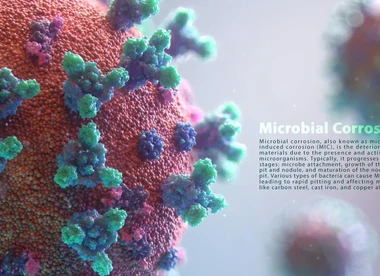
Microbial corrosion is a type of corrosion caused by living organisms such as bacteria, algae, or fungi. This type of corrosion is often associated with tubercles or slimy organic materials.
Corrosion process in different environments
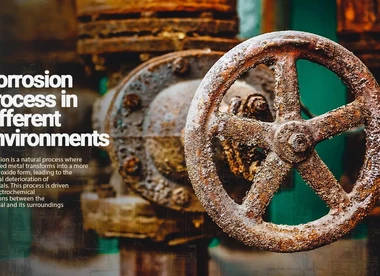
Corrosion processes are divided into three groups in a more comprehensive classification: corrosion in aqueous solutions or environments, corrosion in molten salts and liquid metals, and corrosion in gases.
Oil-soluble corrosion inhibitor for the protection of oil transfer and storage equipment
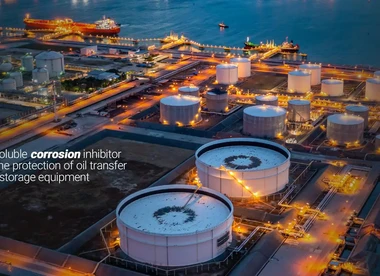
Corrosion is a natural phenomenon that occurs as a result of the electrochemical reaction of metal with the surrounding environment. In the oil and gas industry, corrosion is one of the major problems that accounts for a huge amount of money annually. Part of these amounts are related to the corrosion of pipes or oil transmission lines. Effective ways to prevent corrosion of oil transmission and storage equipment are divided into two categories: physical and chemical solutions.

couponing
The coupon method or corrosion coupons is the simplest method of corrosion monitoring. Coupons are the oldest corrosion monitoring tool. Corrosion coupons are small pieces of metal or alloy of the material of interest that are immersed in the process medium and removed after a specified period of time and their weight or dimension loss is evaluated and examined.
Deaerators
Deaerators are mechanical devices that remove dissolved gases from the boiler feedwater. By reducing the concentration of oxygen and carbon dioxide in the solution, they minimize corrosion and protect the boiler from the effects of corrosive gases.
Envía tu opinión
Tu dirección de correo electrónico no será publicada.