

¿Por qué los sistemas industriales necesitan anticongelante/refrigerante en verano?
1405/03/02
Pasos para la limpieza química de torres de refrigeración: guía de implementación
1405/02/07
Tipos de sedimentos en sistemas de ósmosis inversa y métodos para identificarlos.
1405/02/05
Beneficios de utilizar soluciones especializadas de Abrizan Company para MED
1404/12/09
Working method of lithium bromide absorption chillers

Introduction
Lithium bromide absorption chiller is one of the most common types of absorption chillers in which lithium bromide material plays the role of absorbing water vapor to reduce the pressure of the evaporator chamber. The most important issue that arises is what is a lithium bromide absorption chiller and how does it cool water, which according to the figure and explanations given in the rest of this text, we will explain everything about the lithium bromide absorption refrigeration cycle in a simple and understandable way.
In short, the operation of the absorption refrigeration cycle is as follows. The property of absorbing water vapor by the lithium bromide solution at normal temperatures and the output of water vapor from it at high temperatures is the basis of the work of lithium bromide absorption chillers. Consider two containers of the following shape that are connected by a pipe. In one of the two containers, called the absorber, there is a lithium bromide solution, and in the other, called the evaporator, there is water. Inside the evaporator there is also a coil through which the building's cold water passes.
If the pressure inside the two containers and their connecting pipe is reduced by a vacuum pump (in absorption chillers to about 0.01 atmosphere), the water inside the evaporator begins to evaporate and, by taking its latent heat from the environment, including the coil and the water inside it, causes it to cool. The water vapor produced in the evaporator goes to the absorber through the connecting pipe and absorbs the lithium bromide solution. To increase the efficiency of the evaporation and absorption processes, two pumps are used, called the refrigerant pump and the absorber pump, as shown in the figure.
Since lithium bromide is continuously diluted by absorbing water and its water vapor absorption capacity decreases, and on the other hand, the amount of water in the operator continuously decreases, in order to continue the chiller operation, it is necessary to separate the water absorbed by lithium bromide from it and return it to the evaporator. The process of separating water from lithium bromide takes place in the chiller generator, where the dilute lithium bromide solution is heated by steam (or hot water with a direct flame).
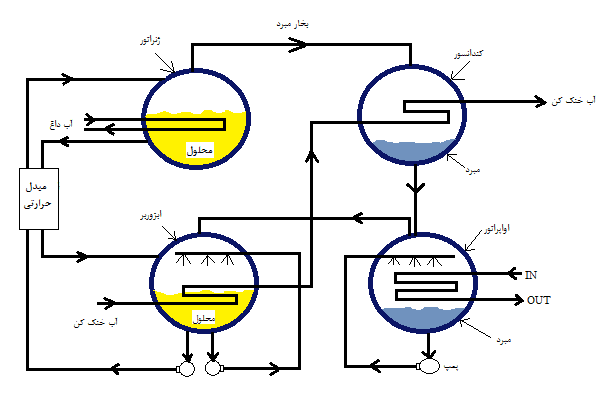
Simple diagram of lithium bromide absorption chiller components
The remaining concentrated lithium bromide is returned to the absorber after passing through a heat exchanger. The water vapor produced in the generator is distilled by passing through a condenser and then returned to the evaporator. The amount of water vapor in circulation for each ton of refrigeration is about 8 kilograms. The heat exchanger between the absorber causes the dilute and cold lithium bromide solution to be preheated on its way to the generator and the concentrated and hot lithium bromide solution to be cooled somewhat on its way back to the absorber. Since the temperature of the lithium bromide solution needs to be reduced again in order for water to be absorbed by it, this is done by passing cold water returned from the cooling tower through the absorber. Absorption chillers are made in two-cylinder and one-cylinder forms.
In the two-cylinder type, the evaporator and absorber, which have very low pressure, are located in one cylinder and the generator and condenser in the other. In the single-cylinder type, the cylinder is internally divided into two parts, with the evaporator and absorber in one half and the generator and condenser in the other.
Characteristics of the absorber and refrigerant
(In an absorption chiller, the absorber is lithium bromide and the refrigerant is water)
The pairs of absorber (lithium bromide) and refrigerant (water) must have the following characteristics:
The boiling point temperature of the refrigerant or water must be much lower than the boiling point temperature of the absorber or lithium bromide. As a result, the steam generator only raises the temperature of the solution to the boiling point temperature of the refrigerant or water, so that only the refrigerant or water evaporates. This difference in boiling point temperature ensures that only water is going to the condenser and evaporator. The absorbent or lithium bromide must also have a strong adsorption tendency to dissolve the refrigerant or water in it at the unit pressure of the absorbent or lithium bromide. This property of lithium bromide causes a smaller amount of lithium bromide to circulate in the cycle (we need a smaller amount of absorbent) and also the size and dimensions of the heat exchanger become smaller.
The absorbent solution (lithium bromide) or refrigerant (water) must not crystallize within the temperature and pressure operating range of the cycle, crystallization will prevent the flow of the solution and lead to the failure of the absorption refrigeration device.
Both the absorbent (lithium bromide) and the refrigerant (water) must be chemically stable in the low pressure and temperature range of the device's operation. Chemical instability can cause the formation of undesirable solids, gases, or corrosive substances, given the operation of these materials for long periods and relatively harsh conditions.
In the case of the water-lithium bromide couple, it can be said that due to the high volatility ratio, stability, and latent heat of water, high safety, and also the high cycle efficiency compared to the ammonia absorption refrigeration cycle, water is widely used. Since in the water-lithium bromide couple, water is used as a refrigerant and, as you know, water freezes at zero degrees Celsius. This adsorbent-refrigerant pair cannot be used for low temperatures and the chilled water leaving the chiller cannot be brought below 7°C, but it is very suitable for conventional ventilation applications and ammonia systems are used for subzero cooling.
Another point that should be noted regarding the lithium bromide-water pair is the issue of crystallization of the adsorbent solution. The adsorbent solution may crystallize at medium concentrations and low temperatures, so the solution should be kept away from these conditions. Another issue is the corrosiveness of the adsorbent solution, for which measures have also been devised and will be discussed in a separate article.
Conclusion
To control these corrosion conditions in absorption chillers, absorption chiller operators can obtain information about the concentration of various substances in the solution by sampling the lithium bromide solution and sending it to the laboratory. Sampling must be done carefully so that the sample obtained is representative of the entire solution. The chiller manufacturer's instructions can be used for this. It is also better to send the sample to the laboratory immediately after receipt because the substances in the sample are not in equilibrium and their concentrations may change over time.
compartir :
¿Por qué los sistemas industriales necesitan anticongelante/refrigerante en verano?
1405/03/02Pasos para la limpieza química de torres de refrigeración: guía de implementación
1405/02/07Tipos de sedimentos en sistemas de ósmosis inversa y métodos para identificarlos.
1405/02/05Beneficios de utilizar soluciones especializadas de Abrizan Company para MED
1404/12/09
Artículos relacionados
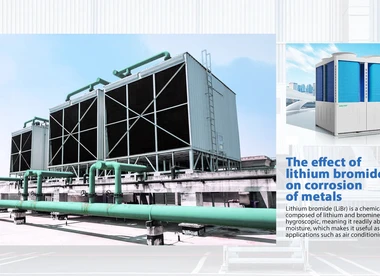
The effect of lithium bromide on corrosion of metals
The concentration of LiBr in solution can significantly affect the rate and severity of corrosion in metals. The concentration of lithium bromide can increase the corrosion rate, affect the pH of the solution, the formation of corrosion products, the solubility of oxygen, the effects of temperature, and also cause specific metal reactions.

Refrigeration cycles
As a refrigerant circulates through a system, it goes through a number of changes of state or conditions, each of which is called a transformation. The refrigerant starts from an initial state and returns to its initial state after going through a series of transformations called a cycle. Various refrigeration cycles are used to produce refrigeration, the most important of which are the compression refrigeration cycle, the absorption refrigeration cycle, and the thermoelectric refrigeration cycle.

Refrigeration and refrigerants
Any process in which heat is absorbed is called refrigeration. In general terms, a refrigerant is a substance that acts as a cooling agent by absorbing heat from a substance.
Chemical analysis of lithium bromide solution
Lithium bromide is a chemical widely used in absorption chillers. This chemical has a high moisture absorption capacity. Therefore, it is able to absorb the vapors in the system and thus return them to the liquid phase. However, lithium bromide is highly corrosive.
Envía tu opinión
Tu dirección de correo electrónico no será publicada.