

¿Por qué los sistemas industriales necesitan anticongelante/refrigerante en verano?
23/05/2026
Pasos para la limpieza química de torres de refrigeración: guía de implementación
27/04/2026
Tipos de sedimentos en sistemas de ósmosis inversa y métodos para identificarlos.
25/04/2026
Beneficios de utilizar soluciones especializadas de Abrizan Company para MED
28/02/2026
Intergranular corrosion

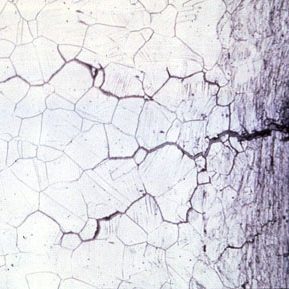
Grain boundary corrosion is a type of localized corrosion. The grain boundary has a higher energy level than the grain itself and is therefore more chemically active and more susceptible to corrosion. In this case, the materials present at the grain boundaries act as the anode (with a smaller surface area) and the grains themselves (with a larger surface area) act as the cathode.
In grain boundary corrosion, attacks are concentrated at the grain boundaries and, along with relatively minor grain corrosion, cause the grains to separate from each other, which ultimately reduces the strength, flexibility and ductility of the metal.
The most important causes of grain boundary corrosion can be considered to be the accumulation of impurities at the grain boundaries of the metal and the depletion of the boundary from some alloying elements.
To better understand intergranular corrosion, consider the following examples:
- Depletion of the grain boundaries of stainless steel from the alloying element chromium facilitates the deposition of chromium carbide (Cr23C6) at the boundaries, thus making the boundaries susceptible to intergranular corrosion.
- Zinc separation in brass alloys in the boundary areas exacerbates intergranular corrosion.
Stainless steels have a high chromium content. In these types of steels, the chromium metal prevents corrosion of the rest of the metal by forming a protective layer, but at the grain boundaries, carbon may form chromium carbide with chromium. The deposition of chromium carbide at the grain boundary causes the chromium around the grain boundary to become depleted. If this deposition and depletion is relatively continuous, it makes stainless steel susceptible to intergranular corrosion. In this case, the corrosion attack will start and continue at the grain boundary.
Intergranular corrosion reduces the ability of a metal or alloy to undergo plastic deformation before failure. This type of corrosion, in more severe cases, also significantly reduces the tensile properties of the metal.
Intergranular corrosion occurs in two forms:
Weld line corrosion
One of the welding problems of stainless steels that we often encounter during welding operations is intergranular corrosion, which occurs more in the heat-affected zone and the weld zone, and this has caused a lot of damage.
When 8-18 stainless steel is heated for a period of time in the temperature range of 450-950 degrees Celsius, chromium carbide precipitates at the grain boundaries, and thus the grain boundaries are depleted of chromium. This phenomenon causes stainless steel to become sensitive.
Destruction and damage to welded steel structures along and near the weld line is called weld line corrosion.
Methods for preventing sensitization of austenitic steels
a) Reducing the carbon content in the steel to less than 0.03%, this will prevent the formation of sufficient carbides to cause intergranular corrosion.
b) Using temperature-time sensitization curves, it is possible to prevent sensitization and observe the effect of carbon content on this phenomenon. The amount of carbon can affect the degree of sensitization. Sensitization in 304 stainless steel occurs much faster with increasing carbon content. Studies show that under a given welding energy and speed, weld corrosion in 304 stainless steel increases with increasing carbon content.
c) Using stable steels. These stainless steels contain titanium or niobium, which tend to combine with carbon and easily form carbides, which allows chromium to remain in the solvent even when exposed to sensitization temperatures for a long time, minimizing the formation of chromium-rich grain boundary carbides.
The only solution to repair sensitized austenitic stainless steels is to anneal them.
Pitting Corrosion
Although stable austenitic stainless steels are not susceptible to weld pitting, they can be susceptible to a different type of intergranular corrosion attack called pitting. Like weld pitting, pitting corrosion is caused by the deposition of chromium carbide at grain boundaries. This type of corrosion is different from pitting corrosion. The differences are:
- Pitting corrosion occurs in a narrow zone very close to the weld metal.
- Pitting corrosion occurs in stable stainless steels.
Methods for preventing pitting corrosion
a) Post-weld heat treatment in the temperature range of 1000 to 1100°C causes the dissolution of chromium carbide.
b) The use of low-carbon alloy steels reduces the likelihood of chromium carbide precipitation.
c) Sometimes pitting attack can be prevented by modifying the welding procedure or program.
compartir :
¿Por qué los sistemas industriales necesitan anticongelante/refrigerante en verano?
23/05/2026Pasos para la limpieza química de torres de refrigeración: guía de implementación
27/04/2026Tipos de sedimentos en sistemas de ósmosis inversa y métodos para identificarlos.
25/04/2026Beneficios de utilizar soluciones especializadas de Abrizan Company para MED
28/02/2026
Artículos relacionados
Efecto de los iones cloruro en los aceros inoxidables
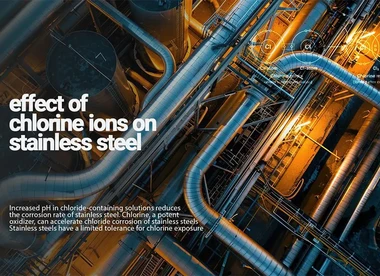
Se expone el efecto del cloro y de los cloruros en la corrosión de los aceros inoxidables, así como los factores que influyen en su velocidad de corrosión; asimismo, se abordan los límites admisibles de las concentraciones de iones cloruro en el agua y las diferencias entre los efectos del cloro libre y de los cloruros en la corrosión de los aceros resistentes a la corrosión.
Corrosión cáustica
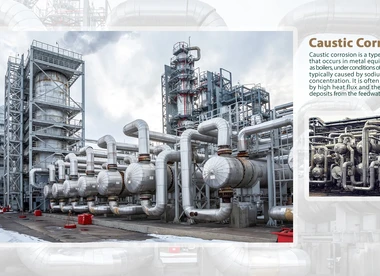
Corrosión localizada provocada por la concentración de sales cáusticas o alcalinas, la cual suele producirse en condiciones de alta evaporación o transferencia de calor. Las sales cáusticas —o la sosa cáustica— constituyen uno de los compuestos iónicos más utilizados; se emplean en diversos sectores, tales como el tratamiento de aguas, la producción de cartón y papel, la industria petrolera y de refinación, la fabricación de aluminio, la industria alimentaria, la producción de alcohol y la industria del vidrio.
Corrosión y formación de depósitos en sistemas de agua de refrigeración, según la norma API 571
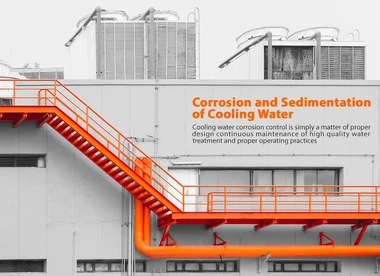
Se refiere a la corrosión general o localizada de los aceros al carbono y otros metales, causada por sales disueltas, gases, compuestos orgánicos o actividad microbiológica.

Corrosión microbiana según API 571
La corrosión microbiana es un tipo de corrosión causada por organismos vivos, tales como bacterias, algas u hongos. Este tipo de corrosión suele estar asociado a tubérculos o a materiales orgánicos viscosos.
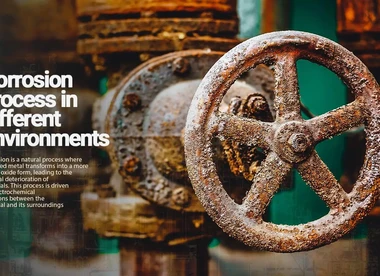
Proceso de corrosión en diferentes entornos
En una clasificación más exhaustiva, los procesos de corrosión se dividen en tres grupos: corrosión en soluciones o medios acuosos, corrosión en sales fundidas y metales líquidos, y corrosión en gases.
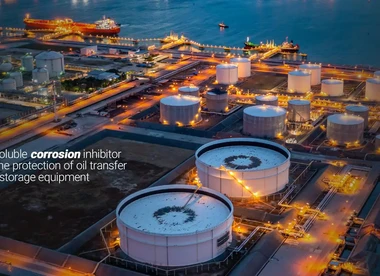
Inhibidor de corrosión soluble en aceite para la protección de equipos de transferencia y almacenamiento de petróleo
La corrosión es un fenómeno natural que se produce como resultado de la reacción electroquímica de un metal con el entorno que lo rodea. En la industria del petróleo y el gas, la corrosión constituye uno de los principales problemas, lo que supone un coste económico enorme cada año. Parte de estos costes se debe a la corrosión de tuberías o líneas de transporte de petróleo. Los métodos eficaces para prevenir la corrosión en los equipos de transporte y almacenamiento de petróleo se dividen en dos categorías: soluciones físicas y soluciones químicas.

uso de cupones
El método de cupones —o uso de cupones de corrosión— es la técnica más sencilla para el monitoreo de la corrosión. Los cupones constituyen la herramienta de monitoreo de la corrosión más antigua. Consisten en pequeñas piezas de metal o aleación —del mismo material que se desea analizar— que se sumergen en el medio del proceso; tras un periodo de tiempo determinado, se retiran para evaluar y examinar la pérdida de peso o de dimensiones que hayan experimentado.

Deaerators
Deaerators are mechanical devices that remove dissolved gases from the boiler feedwater. By reducing the concentration of oxygen and carbon dioxide in the solution, they minimize corrosion and protect the boiler from the effects of corrosive gases.
Envía tu opinión
Tu dirección de correo electrónico no será publicada.