

¿Por qué los sistemas industriales necesitan anticongelante/refrigerante en verano?
1405/03/02
Pasos para la limpieza química de torres de refrigeración: guía de implementación
1405/02/07
Tipos de sedimentos en sistemas de ósmosis inversa y métodos para identificarlos.
1405/02/05
Beneficios de utilizar soluciones especializadas de Abrizan Company para MED
1404/12/09
¿Cuáles son las señales de que una torre de refrigeración necesita una limpieza química?

Introducción: ¿Por qué no deberías esperar a sufrir un "colapso total"?
Muchos ingenieros y gerentes de planta piensan:
«Mientras la máquina funcione, todo está bien».
Sin embargo, en el caso de las torres de refrigeración, esta mentalidad constituye el error más peligroso.
Las torres de refrigeración actúan como los «pulmones de la industria». Si su funcionamiento se ve alterado, todo el sistema fallará, el consumo de energía aumentará y, finalmente, se producirá una parada repentina.
La limpieza química de las torres de refrigeración no debe ser una «reacción ante un fallo», sino parte de un programa de mantenimiento preventivo. No obstante, si aún no lo ha planificado, detectar a tiempo las señales de alerta puede evitar desastres.
En este artículo, conocerá 10 indicadores técnicos, prácticos y medibles que señalan que:
Su torre de refrigeración necesita una limpieza química inmediata.
10 señales claras de que se requiere una limpieza química de la torre de refrigeración
1. Aumento de la temperatura del agua de salida de la torre de refrigeración
¿Por qué es importante?
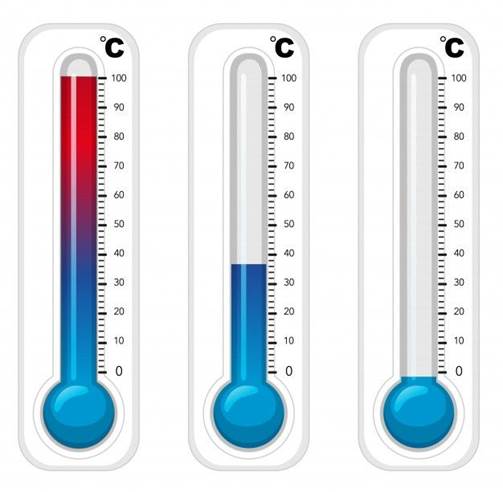
La torre de refrigeración se encarga de devolver el agua caliente a una temperatura determinada (p. ej., 32 °C). Si la temperatura de salida alcanza los 36-40 °C, significa que la transferencia de calor se ha visto gravemente afectada.
Causa principal:
Capas de incrustaciones minerales (carbonato de calcio, sulfatos) en las superficies de transferencia de calor, como aletas y tubos, que actúan como aislante.
Límite de advertencia:
Un aumento superior a 3 °C respecto a la temperatura de diseño requiere una limpieza inmediata.
2. Aumentar la presión de las bombas de circulación de agua o reducir el caudal.
¿Por qué es importante?
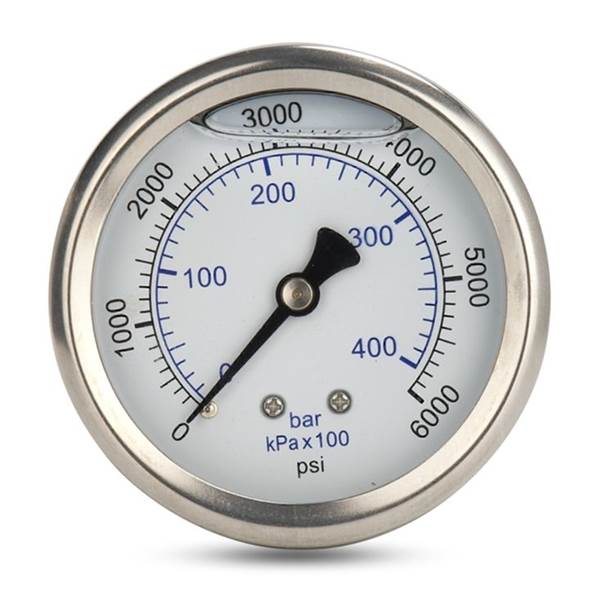
Si las bombas operan a mayor presión o el caudal de agua disminuye, significa que la vía de circulación del agua está obstruida.
Causa principal:
- Depósitos en tuberías y boquillas de pulverización
- Acumulación de lodos y biopelículas en filtros y conductos
- Formación de cristales de sulfato en zonas estrechas
Umbral de alarma:
Aumento de presión superior al 15 % o reducción del caudal superior al 10 % respecto a los valores normales.
3. Aumento del consumo de energía en los sistemas conectados (enfriadora, compresor, caldera)
¿Por qué es importante?
- Torre de refrigeración en buen estado = refrigeración óptima = menor carga de trabajo para enfriadoras y compresores.
- Si su factura de electricidad está aumentando, es probable que la raíz del problema se encuentre en la torre de refrigeración.
Calcule el impacto:
Cada aumento de 1 °C en la temperatura del agua de entrada a la enfriadora → aumento del 2-4 % en el consumo de energía.
Umbral de alerta:
Aumento superior al 10 % en el consumo de energía del sistema de refrigeración, sin cambios en la carga de trabajo.
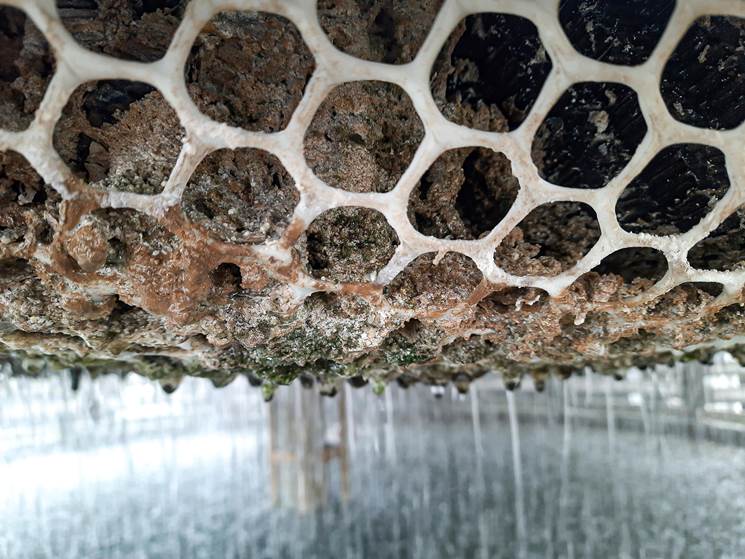
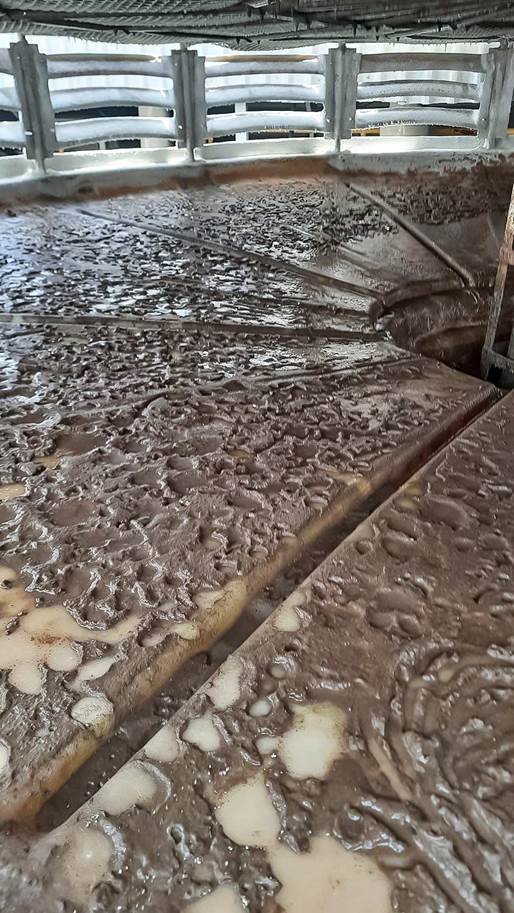
4. Presencia física de incrustaciones o corrosión detectada mediante inspección visual.
¿Por qué es importante?
El ojo humano es el sensor principal más preciso. Si durante una inspección rutinaria observa:
- Depósitos blancos o grises en superficies metálicas
- Manchas rojas (óxido) o verdes (corrosión del cobre)
- Pequeños orificios en las tuberías (corrosión por picaduras)
- Algas o una capa viscosa (biopelícula) en la cesta o en la zona de aspiración
→ Actúe de inmediato.
Consejo técnico:
- Depósitos blancos = carbonato de calcio
- Depósitos duros y negros = sulfatos o silicatos
- Capa viscosa y olor a aguas residuales = biopelícula bacteriana
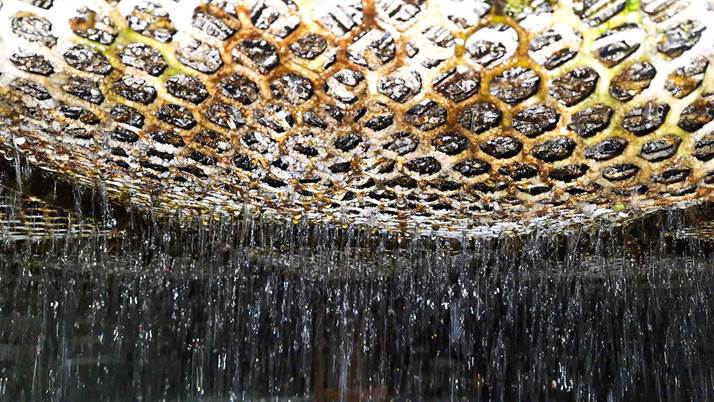
5. Mal olor o crecimiento de algas en el depósito o la zona de aspiración de la torre de refrigeración
¿Por qué es importante?
Un olor desagradable (similar al de huevos podridos o aguas residuales) es señal de la proliferación de bacterias reductoras de sulfatos (BRS), la causa principal de la corrosión bajo el biofilm.
Riesgos:
- Corrosión severa y perforación de tuberías
- Contaminación microbiana en las industrias alimentaria y farmacéutica
- Riesgo de legionelosis en entornos públicos
Nivel de alerta:
Cualquier olor inusual o crecimiento de algas, incluso si la eficiencia se mantiene normal.
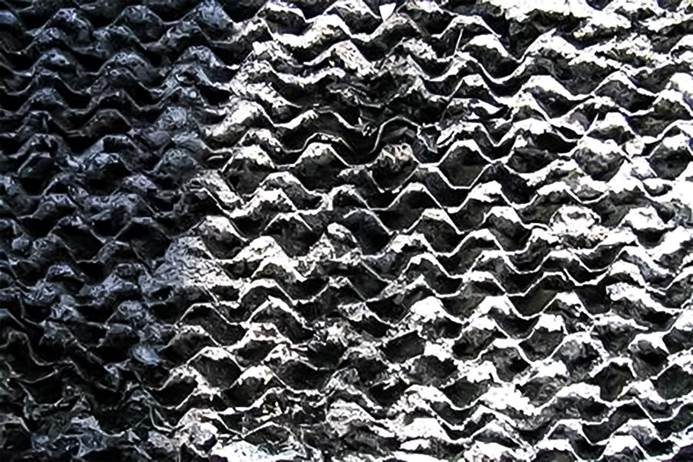
6. Reducción del flujo de aire en torres de refrigeración mecánicas
¿Por qué es importante?
En las torres de refrigeración de tiro forzado o inducido, el flujo de aire equivale a la transferencia de calor. Si los ventiladores hacen ruido o el flujo de aire disminuye, es probable que:
- Las aletas estén obstruidas por sedimentos o lodos
- La entrada de aire esté cubierta de algas
- Los filtros de aire estén sucios
Diagnóstico:
Utilice un anemómetro para medir la velocidad del aire; una reducción superior al 20 % respecto al valor de diseño indica una situación crítica.
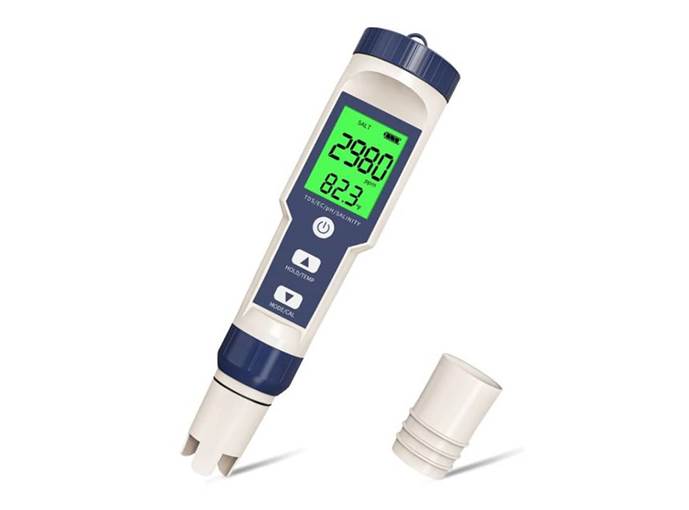
7. Aumento de los TDS (sólidos disueltos) y de la dureza del agua en circulación
¿Por qué es importante?
En los sistemas de circuito abierto, el agua se evapora constantemente, pero las sales permanecen. Esto provoca un aumento en la concentración de iones y, finalmente, la formación de incrustaciones.
Valores críticos:
- Dureza cálcica > 500 ppm
- Sólidos disueltos totales (TDS) > 3000 ppm
- pH > 8,5 o pH < 7
Solución rápida:
Aumentar la purga + limpieza química.
8. Aumento de la corrosión en las soldaduras
¿Por qué es importante?
La corrosión galvánica en las soldaduras o en las uniones de acero y cobre es señal de un desequilibrio químico en el agua; generalmente, un pH bajo o un alto contenido de cloruros.
Riesgo:
A menudo, este tipo de corrosión pasa desapercibido hasta que se produce una fuga.
Diagnóstico:
Prueba con cupones de corrosión: tasa de corrosión > 5 mpy (milésimas de pulgada por año) → necesidad inmediata de tratamiento químico correctivo.
9. Decoloración del agua en circulación o aparición de partículas en suspensión
¿Por qué es importante?
- Agua roja = partículas de óxido de hierro (corrosión del acero)
- Agua verde = partículas de cobre o crecimiento de algas
- Agua negra = lodo bacteriano o partículas de carbono
- Agua turbia = acumulación de sedimentos o biopelícula
Riesgo:
Estas partículas pueden obstruir los filtros o provocar desgaste en las bombas.
10. Aumento de la frecuencia de paradas no planificadas en la línea de producción
¿Por qué es importante?
Si la línea de producción se detiene repentinamente —y la causa reportada es "sobrecalentamiento"—, es probable que la torre de refrigeración sea la responsable.
Costes:
- Coste del tiempo de inactividad de la línea (incluso 1 hora puede suponer millones de dólares)
- Coste de la reparación inmediata
- Coste por pérdida de clientes
Solución:
Registrar con precisión los tiempos de inactividad y correlacionarlos con los parámetros de la torre de refrigeración; si se observa un patrón, es necesaria una limpieza química inmediata.
Tabla resumen: ¿Cuándo actuar?
Firmar | Parámetro medible | Límite de advertencia | Acción inmediata |
Aumento de temperatura | Temperatura del agua de salida | +3 °C por encima de lo normal | Lavado químico |
Aumento de la presión | Presión de la bomba | +15% | Inspección y lavado |
Mayor energía | Consumo de energía del enfriador | +10% | Análisis de temperatura + lavado |
Mal olor | Prueba microbiológica | Cualquier olor inusual | Lavado antimicrobiano |
Corrosión visible | Inspección visual | Cualquier mancha o agujero | Ensayo de corrosión + lavado |
Flujo de aire reducido | Velocidad del aire (m/s) | -20% | Limpieza y lavado de aletas |
Aumento de TDS | Medidor de TDS | >3000ppm | Aumentar purga + enjuague |
¿Cómo identificar el tipo de lavado químico?
El lavado químico no es una solución única para todos los casos. El producto químico utilizado debe ser adecuado para el tipo de contaminación presente:
- Depósitos de carbonato de calcio → Ácidos suaves (cítrico, sulfámico)
- Depósitos de sulfatos/sílice → Ácidos más fuertes (clorhídrico, con precaución)
- Biopelícula y lodos → Alcalinos + antimicrobianos (no oxidantes)
- Corrosión metálica → Inhibidores de corrosión (aminas, fosfonatos)
Punto crítico:
- El uso del producto químico inadecuado (p. ej., ácido fuerte sobre cobre) puede agravar el daño.
- Es fundamental tomar una muestra y analizar el agua antes de realizar el lavado.
¿Qué no hacer? — Errores comunes
❌Usar ácido sin verificar el pH ni el tipo de metal
❌Lavar solo con agua y esperar resultados
❌Posponer el lavado hasta los periodos de vacaciones; podría ser demasiado tarde
❌Utilizar materiales de baja calidad o sin fichas técnicas
❌Lavar sin una neutralización final; esto provoca corrosión secundaria
Si necesita ayuda profesional...
Si experimenta uno o varios de los síntomas anteriores —o desea contar con un plan preventivo antes de que surja un problema—, puede consultar a especialistas de laboratorio con experiencia en la limpieza química de torres de refrigeración.
Este equipo especializado:
- Analiza su muestra de agua de forma gratuita
- Identifica con precisión el tipo de incrustación o corrosión
- Recomienda el mejor producto químico (eliminador de incrustaciones, anticorrosivo, antibiopelícula), indicando la concentración y el tiempo exactos
- Realiza la limpieza sin detener la línea de producción
- Entrega un informe de rendimiento previo y posterior a la limpieza, junto con sugerencias para futuros ciclos
Contacte a nuestros expertos para recibir asesoramiento técnico y un informe gratuito sobre el estado de su torre de refrigeración.
compartir :
¿Por qué los sistemas industriales necesitan anticongelante/refrigerante en verano?
1405/03/02Pasos para la limpieza química de torres de refrigeración: guía de implementación
1405/02/07Tipos de sedimentos en sistemas de ósmosis inversa y métodos para identificarlos.
1405/02/05Beneficios de utilizar soluciones especializadas de Abrizan Company para MED
1404/12/09
Artículos relacionados
Pasos para la limpieza química de torres de refrigeración: guía de implementación
Guía paso a paso para la limpieza química de torres de refrigeración. Desde la preparación hasta la puesta en marcha. Restaure la eficiencia del sistema.
Los tres principales enemigos de las torres de refrigeración: incrustaciones, corrosión y bioincrustaciones.
Una guía completa para identificar y controlar los tres principales problemas de las torres de refrigeración: incrustaciones, corrosión y bioincrustaciones. Aumente la eficiencia del sistema.
¿Qué es un enfriador y qué tipos existen? Una guía completa para elegir el mejor sistema de refrigeración.
Guía completa para la selección de enfriadoras: Comparación de enfriadoras refrigeradas por agua, por aire, de absorción, de espiral, de tornillo y sus aplicaciones en hospitales, la industria petroquímica y la alimentaria.
Enfriadoras de absorción de bromuro de litio: aplicación, rendimiento y desafíos de mantenimiento
¿Cómo funcionan los enfriadores de absorción de bromuro de litio? ¿Por qué son adecuados para sistemas de aire acondicionado? Una guía completa sobre su funcionamiento, ventajas, limitaciones y mantenimiento químico.
¿Qué es un enfriador por absorción? Una guía completa sobre el funcionamiento, los beneficios y los desafíos de los sistemas de refrigeración térmica.
¿Cómo genera frío una enfriadora de absorción a partir de calor? Diferencias con una enfriadora de compresión, desafíos químicos y soluciones de mantenimiento, además de un análisis de la solución de bromuro de litio.
Types of cooling towers in terms of airflow | natural, mechanical, forced, induced, mixed
With a complete introduction to the 5 types of cooling towers in terms of airflow (natural, mechanical, forced, induced, mixed) and how each operates, choose the best chemical maintenance method to increase the efficiency and life of your equipment.
What is a chiller?
Chiller is derived from the Latin word Chill, meaning to cool. Various cycles are used to create refrigeration, the most important of which are the compression refrigeration cycle, the absorption refrigeration cycle, and the thermoelectric refrigeration cycle.
Sistema de refrigeración de la central eléctrica
Las centrales termoeléctricas hierven agua para generar vapor, que luego hace girar turbinas y produce electricidad. El calor necesario para hervir el agua puede provenir de la combustión de combustible, reacciones nucleares o la energía solar. A medida que el vapor pasa por una turbina, debe enfriarse hasta convertirse nuevamente en agua antes de poder utilizarse para generar más electricidad. El agua fría enfría el vapor con mayor eficacia, lo que aumenta la eficiencia de la generación de energía eléctrica.
Envía tu opinión
Tu dirección de correo electrónico no será publicada.