

¿Por qué los sistemas industriales necesitan anticongelante/refrigerante en verano?
23/05/2026
Pasos para la limpieza química de torres de refrigeración: guía de implementación
27/04/2026
Tipos de sedimentos en sistemas de ósmosis inversa y métodos para identificarlos.
25/04/2026
Beneficios de utilizar soluciones especializadas de Abrizan Company para MED
28/02/2026
Using nano-coatings against corrosion

Nano Coatings
Some of the coatings used today include materials made using nanotechnology. These methods include composite thin-film coatings, top-coat coatings, and surface passive layers. They are called nano coatings.
The term "nano" next to the coating suggests that this layer is a few nanometers thick and that nanoparticles are used to produce it. In this case, the components of these coatings are nanometers, but the coating itself will be more than 100 nanometers thick.
Important features of nano coatings include improved corrosion properties, reduced oxygen and water vapor permeability, improved mechanical properties, and improved metal surface finish. Composite thin film coatings that have high corrosion resistance and thermal stability properties include organic nanoparticles of silica gel, benzophenones and aminobenzoic acid as well as inorganic particles such as clay, zirconium, silica and carbon within polymer matrices (epoxy resin, polyamide, polystyrene, nylon, etc.) which have a very small volume of about 0.5 to 5%.
Nanostructured layers are formed using spray and reach maximum density and cohesion using brushes and electrostatic spontaneous processes, these layers can be used as a suitable layer to protect surfaces.
Nano coatings are different from conventional coatings. In conventional coatings, large spherical particles do not cover a large surface area, but in nanoparticles with the same volume, they have the ability to cover a much larger surface area.
The difference between nano coatings and conventional coatings is in their structure and properties. The properties of each material are related to its constituent particles. The properties of the coating depend on the size and type of particles that make up it. One of the major differences between nano-coatings and conventional coatings is the high resistance of nano-coatings to corrosion.
Nano-coatings are divided into three main categories.
- Nano-particles attached to a matrix
- Crystalline coatings with nano-structures
- Thin layers
The most important applications of nano-coatings are as follows:
Nano-hydroxyapatite coatings for implants used in the human body
Today, using electrophoretic techniques at ambient temperatures, nano-structured hydroxyapatite is coated on various implants. These implants have various applications in dentistry and orthopedics. The old methods included thermal spraying and chemical deposition, which have brought many benefits with the introduction of nanotechnology to this field. Among them are the following:
- The use of this technology increases the bond strength. The adhesion strength of the hydroxyapatite coating is very low with the application of old methods, so that scientifically speaking, the adhesion strength is 30Mpa in the thermal spraying method and 14Mpa in the chemical deposition method, while with the nano method, the adhesion strength increases to about 60Mpa.
- The use of nano methods improves corrosion resistance. These nano coatings are 100% compact and crystalline. This solves the problem of amorphous dissolution of these coatings and the compactness prevents body fluids from coming into contact with the metal. The corrosion polarization current in this case is 300 times lower than in the case where the implant is coated with the two old methods (thermal spraying and chemical deposition).
Nano-layered coatings
Recently, coatings with multiple layers have been developed, each of which serves a specific purpose. According to various reports, these coatings have military and civilian uses. These coatings serve several purposes, including:
- Reducing the life cycle cost of equipment
- Reducing the cost and maintenance of equipment
- Reducing environmental pollution
These coatings are widely used in gears, motors, electronic switches and sensors. One of the unique features of these coatings is that when the coating is damaged and needs to be replaced, it is easily removed from the surface. Also, sensor layers are used between the layers of this coating, which are capable of detecting mechanical damage and corrosion.
Nano-composite coatings that are resistant to corrosion are produced and replace dangerous chromium-based coatings. These coatings, which are suitable for magnesium alloys, are especially suitable for the needs of the automotive, aerospace and aviation industries.
Nano-coatings with corrosion-inhibiting ions
Today, some manufacturing and research companies are working on a type of composite coating that shows a very good protective effect. These coatings are made using the layer-by-layer assembly technique or electrostatic assembly. In these layer-by-layer nano-composite coatings, corrosion-inhibiting ions are placed so that they can penetrate the surface of the base metal and protect it against corrosion, and the final layer is a silicate barrier layer. These coatings also show good corrosion protection compared to chrome coatings and can be a suitable alternative to them (given that chrome coatings are becoming extinct due to environmental pollution).
Exceptional nano-structured alloy coatings that are resistant to corrosion
Research by the Institute of Chemistry and the Institute of Semiconductors has led to the creation and invention of a large number of new coatings of metal alloys with nano-structures that have attracted attention due to their exceptional resistance to corrosion. These coatings are created by magnetic metal spraying.
The nanocrystalline structure of these coatings creates stable, inert layers that do not have the imperfections and defects of traditional coatings. It has been observed that coatings with a nanocrystalline structure have a higher corrosion resistance than coatings with an amorphous structure.
compartir :
¿Por qué los sistemas industriales necesitan anticongelante/refrigerante en verano?
23/05/2026Pasos para la limpieza química de torres de refrigeración: guía de implementación
27/04/2026Tipos de sedimentos en sistemas de ósmosis inversa y métodos para identificarlos.
25/04/2026Beneficios de utilizar soluciones especializadas de Abrizan Company para MED
28/02/2026
Artículos relacionados
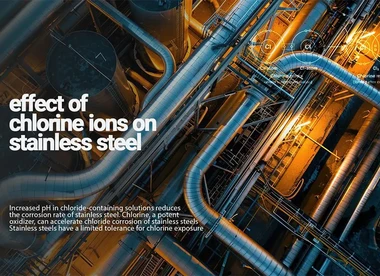
Efecto de los iones cloruro en los aceros inoxidables
Se expone el efecto del cloro y de los cloruros en la corrosión de los aceros inoxidables, así como los factores que influyen en su velocidad de corrosión; asimismo, se abordan los límites admisibles de las concentraciones de iones cloruro en el agua y las diferencias entre los efectos del cloro libre y de los cloruros en la corrosión de los aceros resistentes a la corrosión.
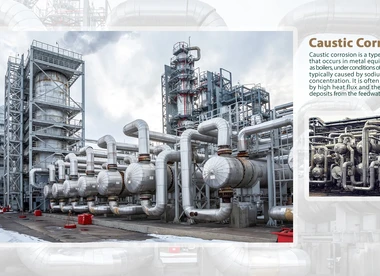
Corrosión cáustica
Corrosión localizada provocada por la concentración de sales cáusticas o alcalinas, la cual suele producirse en condiciones de alta evaporación o transferencia de calor. Las sales cáusticas —o la sosa cáustica— constituyen uno de los compuestos iónicos más utilizados; se emplean en diversos sectores, tales como el tratamiento de aguas, la producción de cartón y papel, la industria petrolera y de refinación, la fabricación de aluminio, la industria alimentaria, la producción de alcohol y la industria del vidrio.
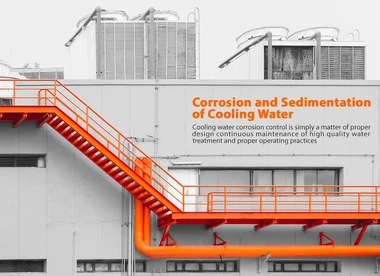
Corrosión y formación de depósitos en sistemas de agua de refrigeración, según la norma API 571
Se refiere a la corrosión general o localizada de los aceros al carbono y otros metales, causada por sales disueltas, gases, compuestos orgánicos o actividad microbiológica.

Corrosión microbiana según API 571
La corrosión microbiana es un tipo de corrosión causada por organismos vivos, tales como bacterias, algas u hongos. Este tipo de corrosión suele estar asociado a tubérculos o a materiales orgánicos viscosos.
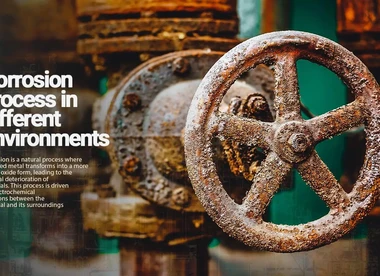
Proceso de corrosión en diferentes entornos
En una clasificación más exhaustiva, los procesos de corrosión se dividen en tres grupos: corrosión en soluciones o medios acuosos, corrosión en sales fundidas y metales líquidos, y corrosión en gases.
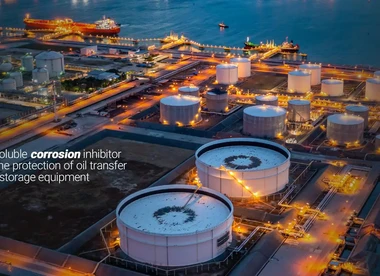
Inhibidor de corrosión soluble en aceite para la protección de equipos de transferencia y almacenamiento de petróleo
La corrosión es un fenómeno natural que se produce como resultado de la reacción electroquímica de un metal con el entorno que lo rodea. En la industria del petróleo y el gas, la corrosión constituye uno de los principales problemas, lo que supone un coste económico enorme cada año. Parte de estos costes se debe a la corrosión de tuberías o líneas de transporte de petróleo. Los métodos eficaces para prevenir la corrosión en los equipos de transporte y almacenamiento de petróleo se dividen en dos categorías: soluciones físicas y soluciones químicas.

uso de cupones
El método de cupones —o uso de cupones de corrosión— es la técnica más sencilla para el monitoreo de la corrosión. Los cupones constituyen la herramienta de monitoreo de la corrosión más antigua. Consisten en pequeñas piezas de metal o aleación —del mismo material que se desea analizar— que se sumergen en el medio del proceso; tras un periodo de tiempo determinado, se retiran para evaluar y examinar la pérdida de peso o de dimensiones que hayan experimentado.

Deaerators
Deaerators are mechanical devices that remove dissolved gases from the boiler feedwater. By reducing the concentration of oxygen and carbon dioxide in the solution, they minimize corrosion and protect the boiler from the effects of corrosive gases.
Envía tu opinión
Tu dirección de correo electrónico no será publicada.