

¿Por qué los sistemas industriales necesitan anticongelante/refrigerante en verano?
23/05/2026
Pasos para la limpieza química de torres de refrigeración: guía de implementación
27/04/2026
Tipos de sedimentos en sistemas de ósmosis inversa y métodos para identificarlos.
25/04/2026
Beneficios de utilizar soluciones especializadas de Abrizan Company para MED
28/02/2026
Causes of tube corrosion in the economizer of the steam generation system

Steam Generation System
A typical steam generation system consists of a pre-boiler section (deaerators, piping, pumps, stage heaters, and economizer), a steam generation section (including boilers, superheaters, and reheaters), a post-boiler section (including process equipment, steam pipes, and condensate traps), and a condensate section (including pipes, flash tanks, pumps, and condensate storage tanks).
- Pre-boiler Section
- Steam Generation Section
- Post-boiler Section
- Condensation Section
Corrosion in Steam Generation Systems
Corrosion in steam generation systems causes many problems in refineries, gas plants, and petrochemical plants. Boiler corrosion is a function of the concentration of oxygen, carbon dioxide, and ammonia and the control of these species, and in some cases, due to the presence of hydroxide and chloride anions or high concentrations of chelating chemicals in the boiler water. However, in more advanced steam generation systems, control of water-soluble gases such as oxygen and carbon dioxide usually results in reduced corrosion of the inner wall of the tubes used in steam generation systems. Pitting corrosion, alkali embrittlement, alkali gouging, chelating attacks, and hydrogen embrittlement are the most common corrosion mechanisms in steam generation systems.
The main factor of boiler corrosion
The results of many studies show that the control of boiler corrosion is largely influenced by the quality of the feed water and the conditions of deposition. Oxygen is the main factor of boiler corrosion. If the pH of the boiler is controlled, the amount of corrosion upstream and inside the boiler will be controlled. Oxygen corrosion and corrosion products in the boiler cause heavy boiler maintenance costs. The failure of expensive equipment and the deposition of corrosion products lead to a decrease in the efficiency of the boiler system. Therefore, monitoring and controlling the oxygen concentration in the boiler is of particular importance. In practice, in order to prevent oxygen corrosion in the boiler, the oxygen concentration of the boiler water must be reduced to a few ppb and controlled at these low values.
Oxygen Corrosion
The economizer and feed water heater are the first areas to suffer from oxygen corrosion in an operating system. In cases where the dissolved oxygen content in the water is high, oxygen corrosion may also affect other parts of the boiler system. In most cases, the damage caused by oxygen corrosion is very high even if the oxygen content exceeds the permissible limit for a short period of time.
Function of Economizers
The economizer is a key factor in increasing the thermal efficiency of the boiler due to the use of energy from the gas leaving the boiler system. The economizer preheats the boiler feed water. Economizers also reduce the potential for thermal shock and severe fluctuations in the temperature of the water entering the drum or water walls. In economizers, the heat transfer coefficient on the gas side is much lower than on the water side, which is compensated for by the use of finned tubes in economizers. The ultimate goal of designing an economizer is to achieve the desired heat transfer at the lowest cost.
Corrosion and failure of economizer tubes (similar to other equipment used in the boiler system) is divided into two categories: water side 1 and flame side 2. Of course, the main corrosion problems are observed on the water side. In general, abrasion by gas flow, corrosion in low temperature water, fatigue corrosion and pitting corrosion due to the presence of oxygen are the main causes of failure of economizer tubes.
When steel is exposed to water containing dissolved oxygen, reaction (1) takes place.
2Fe + H2O + O2 = Fe2O3 + H2 (1)
Controlling Oxygen Corrosion in Boilers
In a working boiler system, this type of corrosion can be easily controlled by reducing the dissolved oxygen concentration in the water entering the system. However, sometimes the presence of dissolved oxygen due to improper operation of the deaerator system, inappropriate chemicals used to remove oxygen, or air leakage into the system causes oxygen corrosion.
Mechanical Deoxygenation of Water
Due to the high operating pressure of the boiler, the only way for oxygen to enter is through the feed water. The initial deoxygenation of the feed water is carried out by mechanical deaerators. At this stage, the feed water is brought into contact with steam and the gases dissolved in it are separated and removed with the steam. Modern deaerators must be able to reduce the amount of dissolved oxygen in the water. Subsequently, deoxygenating chemicals are injected to further reduce the dissolved oxygen concentration. The mechanical removal of oxygen must be carried out before its removal by chemicals. In fact, most of the deoxygenation of water is carried out by mechanical methods.
How to inject oxygen scavengers into the boiler?
Since oxygen scavengers require time to function, it is necessary to have a time interval between the injection of oxygen scavengers and the consumption of water in the boiler. For this reason, in order to provide the maximum time for the oxygen scavenger to function, its injection should be immediately after mechanical deaeration. Usually, the injection is done in the deaerator storage tank. In addition, the use of chemicals with catalytic ability to remove oxygen is recommended to reduce its operating time. Oxygen scavengers are used in catalyzed form (cobalt and manganese salts are usually used for sulfites and organic catalysts are usually used for volatile oxygen scavengers).
Source:Analysis of the causes of tube corrosion in the economizer of a steam generation system. Akram Nouri Delavar, Mohsen Sabouri, Amir Pasha, Mehdi Javanmardi. Specialized Scientific Extension Quarterly / Winter 2014 / Issue 4
compartir :
¿Por qué los sistemas industriales necesitan anticongelante/refrigerante en verano?
23/05/2026Pasos para la limpieza química de torres de refrigeración: guía de implementación
27/04/2026Tipos de sedimentos en sistemas de ósmosis inversa y métodos para identificarlos.
25/04/2026Beneficios de utilizar soluciones especializadas de Abrizan Company para MED
28/02/2026
Artículos relacionados
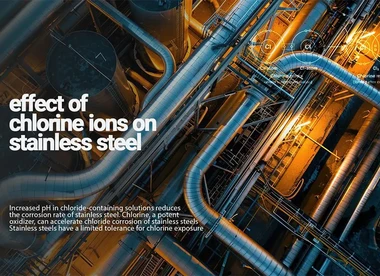
Efecto de los iones cloruro en los aceros inoxidables
Se expone el efecto del cloro y de los cloruros en la corrosión de los aceros inoxidables, así como los factores que influyen en su velocidad de corrosión; asimismo, se abordan los límites admisibles de las concentraciones de iones cloruro en el agua y las diferencias entre los efectos del cloro libre y de los cloruros en la corrosión de los aceros resistentes a la corrosión.
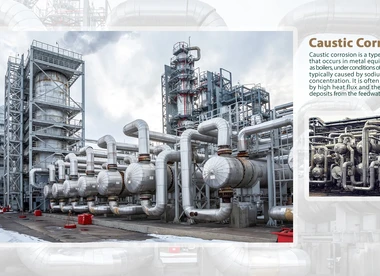
Corrosión cáustica
Corrosión localizada provocada por la concentración de sales cáusticas o alcalinas, la cual suele producirse en condiciones de alta evaporación o transferencia de calor. Las sales cáusticas —o la sosa cáustica— constituyen uno de los compuestos iónicos más utilizados; se emplean en diversos sectores, tales como el tratamiento de aguas, la producción de cartón y papel, la industria petrolera y de refinación, la fabricación de aluminio, la industria alimentaria, la producción de alcohol y la industria del vidrio.
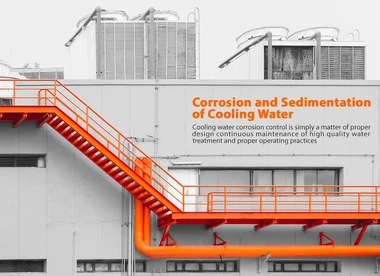
Corrosión y formación de depósitos en sistemas de agua de refrigeración, según la norma API 571
Se refiere a la corrosión general o localizada de los aceros al carbono y otros metales, causada por sales disueltas, gases, compuestos orgánicos o actividad microbiológica.

Corrosión microbiana según API 571
La corrosión microbiana es un tipo de corrosión causada por organismos vivos, tales como bacterias, algas u hongos. Este tipo de corrosión suele estar asociado a tubérculos o a materiales orgánicos viscosos.
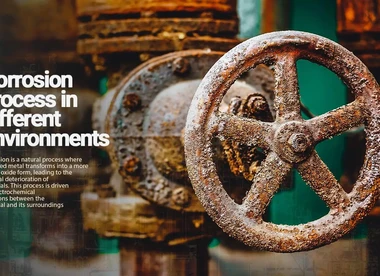
Proceso de corrosión en diferentes entornos
En una clasificación más exhaustiva, los procesos de corrosión se dividen en tres grupos: corrosión en soluciones o medios acuosos, corrosión en sales fundidas y metales líquidos, y corrosión en gases.
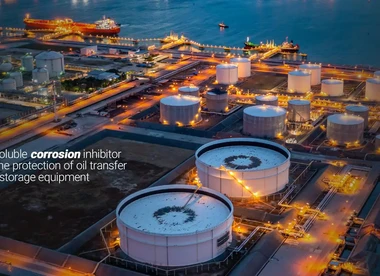
Inhibidor de corrosión soluble en aceite para la protección de equipos de transferencia y almacenamiento de petróleo
La corrosión es un fenómeno natural que se produce como resultado de la reacción electroquímica de un metal con el entorno que lo rodea. En la industria del petróleo y el gas, la corrosión constituye uno de los principales problemas, lo que supone un coste económico enorme cada año. Parte de estos costes se debe a la corrosión de tuberías o líneas de transporte de petróleo. Los métodos eficaces para prevenir la corrosión en los equipos de transporte y almacenamiento de petróleo se dividen en dos categorías: soluciones físicas y soluciones químicas.

uso de cupones
El método de cupones —o uso de cupones de corrosión— es la técnica más sencilla para el monitoreo de la corrosión. Los cupones constituyen la herramienta de monitoreo de la corrosión más antigua. Consisten en pequeñas piezas de metal o aleación —del mismo material que se desea analizar— que se sumergen en el medio del proceso; tras un periodo de tiempo determinado, se retiran para evaluar y examinar la pérdida de peso o de dimensiones que hayan experimentado.
Deaerators
Deaerators are mechanical devices that remove dissolved gases from the boiler feedwater. By reducing the concentration of oxygen and carbon dioxide in the solution, they minimize corrosion and protect the boiler from the effects of corrosive gases.
Envía tu opinión
Tu dirección de correo electrónico no será publicada.