

¿Por qué los sistemas industriales necesitan anticongelante/refrigerante en verano?
1405/03/02
Pasos para la limpieza química de torres de refrigeración: guía de implementación
1405/02/07
Tipos de sedimentos en sistemas de ósmosis inversa y métodos para identificarlos.
1405/02/05
Beneficios de utilizar soluciones especializadas de Abrizan Company para MED
1404/12/09
MVC desalination plant (Mechanical vapor compression)

MVC is the smallest, most energy-efficient, and smartest desalination technology for small and medium-sized industries — but without proper chemical management, the smallest mistakes can cause the biggest losses.
In this expert guide, we’ll cover everything about MVC desalination — from how it works and benefits to chemical challenges and practical solutions — in simple, actionable language. And, finally, we’ll show you how to increase efficiency, reduce costs, and extend equipment life.
Why read this article?
✅ Gain a deep understanding of how MVC desalination works
✅ Identify its advantages and disadvantages in industrial applications
✅ Learn about the industries that use MVC the most and why
✅ Expert solutions for controlling scale, corrosion, and chemical washing of evaporators
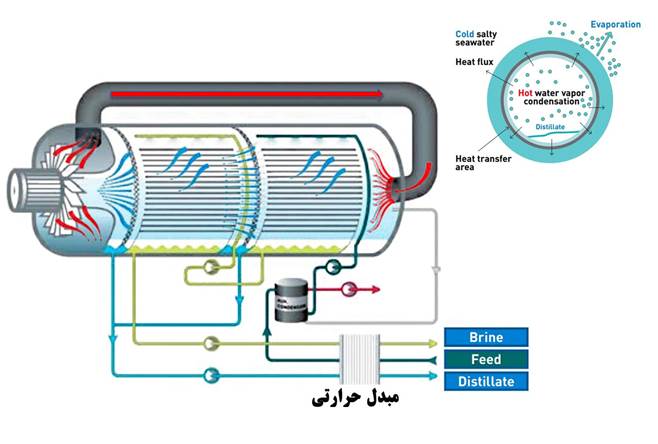
What is MVC desalination?
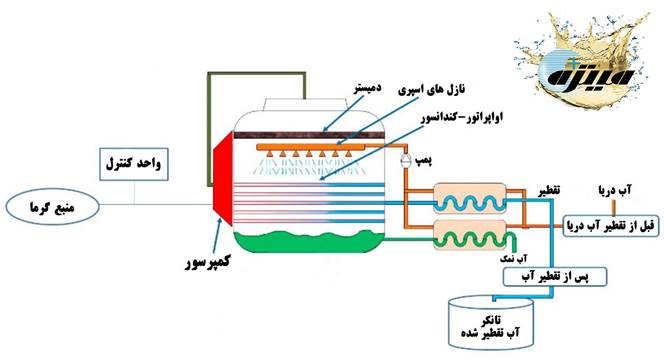
MVC stands for Mechanical Vapor Compression. A thermal technology that uses salt or brackish water to produce fresh water with very low energy consumption.
How MVC works:
- The salt water is heated and evaporated in the evaporator.
- The steam produced is compressed by a mechanical compressor and its temperature increases.
- The hot and compressed steam returns to the evaporator as a heat source and gives its heat to the incoming water.
- After condensation, the steam is collected as fresh water.
- The concentrated water (brine) is discharged from the system.
Key advantage: Closed system — no external heat source required — very low energy consumption.
Advantages of MVC desalination — why is it popular in small and medium industries?
1. Very low energy consumption (5 to 10 kWh per cubic meter of water)
- Only electricity required for the compressor — no steam or fuel required
2. Fully enclosed and compact system
- Suitable for confined spaces and mobile or remote projects
3. Automatic operation without the need for constant monitoring
- Advanced control systems — Ability to start up and maintain with minimal human effort
4. No need for external heat source
- Unlike MED or MSF, no need for steam or hot water — Suitable for industries without access to thermal energy
5. Very high outlet water quality (TDS < 10 ppm)
- Suitable for feeding boilers, laboratory uses and sensitive processes
Disadvantages and challenges of MVC desalination — What causes system failure?
1. Evaporator scale formation
- Formation of calcium carbonate, calcium sulfate and magnesium hydroxide on hot surfaces → Reduced heat transfer → Increased compressor load → Increased power consumption
2. Corrosion in compressor and pipes
- Presence of chlorides and dissolved oxygen → Corrosion of carbon steel and stainless steel — especially at high temperatures
3. Sensitivity to incoming water quality
- Highly hard or silica-containing water → Rapid scale formation — efficiency loss in less than 3 months
4. Relatively high initial cost (compared to RO in small capacities)
- Mechanical compressors and precise control equipment — increase investment cost
5. Need for periodic flushing with specialized chemicals
- Washing with strong acids → Damage to metals → Leakage and emergency shutdown
- Need for non-corrosive, temperature-compatible sedimentation vectors
In which industries is MVC desalination used? And why?
1. Small and medium industries (capacity 100 to 5000 cubic meters per day)
- → Why?
- Need for high quality water without heavy investment
- Lack of access to steam or hot water
- Limited space for equipment installation
2. Remote and island projects
- → Why?
- Need for an independent and low-consumption system
- Possibility of power supply with generator or solar panel
- Easy transportation and installation
3. Food and pharmaceutical industries
- → Why?
- Production of high purity water for production and washing processes
- Continuous operation and no need for regeneration chemicals
4. Small power plants and steam generation units
- → Why?
- Production of high purity boiler feed water
- Cost reduction by using local salty or brackish water
When should the MVC system be flushed?
- 10-15% increase in compressor power consumption
- 10-20% decrease in fresh water production
- Increase in operating temperature in evaporator
- Increase in pressure in evaporation chamber
- Increase in vibration or noise in compressor or pipes
Golden tip:
Don’t wait for the system to experience a significant drop in efficiency! Periodic cleaning (every 6-12 months) can double the life of the equipment and reduce energy costs by up to 25%.
Final conclusion:
The MVC desalination plant is an energy-efficient, smart technology ideal for small and medium-sized industries — but without proper chemical management, it becomes a source of cost and reduced efficiency.
compartir :
¿Por qué los sistemas industriales necesitan anticongelante/refrigerante en verano?
1405/03/02Pasos para la limpieza química de torres de refrigeración: guía de implementación
1405/02/07Tipos de sedimentos en sistemas de ósmosis inversa y métodos para identificarlos.
1405/02/05Beneficios de utilizar soluciones especializadas de Abrizan Company para MED
1404/12/09
Artículos relacionados
Pasos del lavado químico para la desalinización MED: Guía de implementación
Guía paso a paso para el lavado químico de plantas desalinizadoras MED: desde la detección de incrustaciones hasta una implementación segura y eficaz. Prevención de la corrosión y aumento de la eficiencia.
Normas internacionales para el mantenimiento y la limpieza de plantas desalinizadoras
¿Sabe qué normas internacionales se requieren para el mantenimiento y la limpieza de las plantas desalinizadoras? Una guía completa para prolongar la vida útil de los equipos y prevenir la sedimentación.
Medición de la turbidez del agua: una guía completa para la industria y el agua potable
¿Qué es la turbidez del agua? ¿Por qué es vital medirla? En esta guía completa, encontrará información sobre los métodos de medición, las normas y las formas de reducir la turbidez.
Tipos de depósitos y corrosión en agua de desalinización MED
Tipos de depósitos y corrosión en plantas de desalinización MED: carbonato de calcio, sulfatos, sílice, hidróxido de magnesio y corrosión bajo depósitos. Métodos de detección precisos mediante DRX, MEB e ICP. Soluciones especializadas para plantas de tratamiento de agua (marca Mitreh).
Why is it important to control sedimentation and corrosion in desalination devices؟
Why is scale and corrosion control vital in desalination plants? A technical and economic analysis of the impact of scale and corrosion on equipment performance, cost, and life. Warning signs and preventive measures. Suitable for engineers and industrial managers

Comparison of RO, MED, MSF desalination water in terms of cost, energy consumption, chemical requirement of the industry
Detailed comparison of RO, MED, MSF in terms of cost, energy consumption and chemical requirements. Technical analysis, comparison table and decision-making guide. MED with recycled heat is cheaper than RO! Suitable for engineers and industrial managers
EDI desalination plant (Electrodialysis)
EDI (Electrodialysis) Desalination — A Comprehensive Guide to Technology, Applications, Advantages and Disadvantages. Ultrapure Water Production Without Regeneration Chemicals. Applications in Pharmaceutical, Semiconductor and Power Plants. Pretreatment Requirements and Technical Challenges
MSF Desalination Plant (Multi-Stage Flash)
MSF (Multi-Stage Flash) Desalination Plant — Comprehensive Guide to Sediment and Corrosion Control with Solutions from Abrizan Company (Mitreh Brand). Specialized Chemical Washing, Anti-Sediment and Thermal Anti-Corrosion, Laboratory Consulting. Increased Efficiency — Reduced Energy Costs — Increased Equipment Life.
Envía tu opinión
Tu dirección de correo electrónico no será publicada.