

¿Por qué los sistemas industriales necesitan anticongelante/refrigerante en verano?
1405/03/02
Pasos para la limpieza química de torres de refrigeración: guía de implementación
1405/02/07
Tipos de sedimentos en sistemas de ósmosis inversa y métodos para identificarlos.
1405/02/05
Beneficios de utilizar soluciones especializadas de Abrizan Company para MED
1404/12/09
Water Tube Boilers | Types and Structure

Introduction: Why are Water Tube Boilers the Backbone of Large Industries?
In the oil, gas, refineries, power plants, and advanced process industries, high-pressure, high-temperature steam generation is a fundamental requirement. In these situations, Water Tube Boilers serve as the backbone of steam generation systems.
Unlike Fire Tube Boilers used in small industries, Water Tube Boilers are capable of producing steam at high pressures (up to 300 bar) and huge capacities (up to hundreds of tons per hour). These features have made this type of boiler an undeniable place in thermal power plants, large refineries, petrochemicals, and hydrogen production units.
In this article, we will provide a complete, in-depth, and practical review of Water Tube Boilers — from their working principles to their types, advantages, disadvantages, operational challenges, scale formation, and preventive maintenance solutions using specialized chemicals.
What is a Water Tube Boiler? (Definition and working principle)
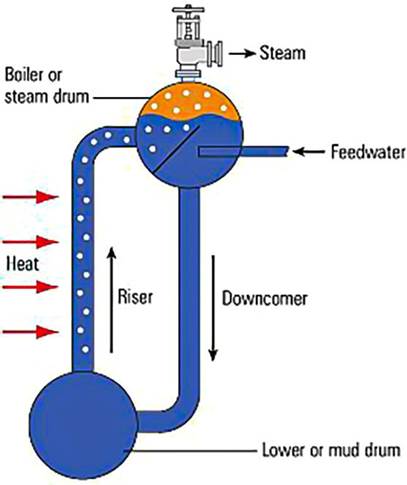
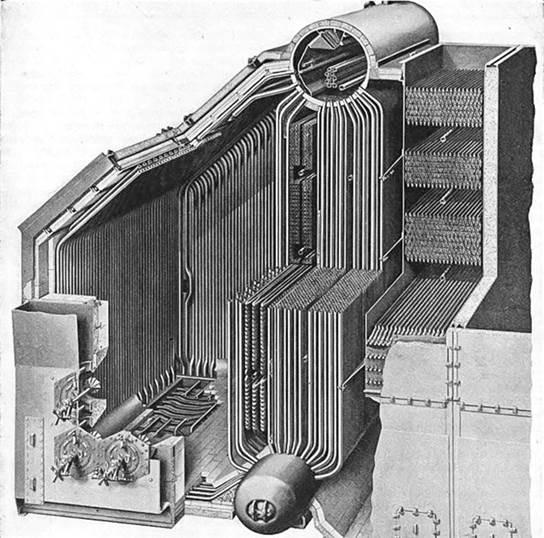
In a Water Tube Boiler, water flows through tubes that are exposed to a flame and hot gases. The heat transferred to the tubes turns the water into steam. The steam produced is directed to the upper drum (Steam Drum) and from there it is sent to the consumer systems. (How do water tube boilers work?)
Basic structure of water tube boilers:
- Steam generating tubes: Where water is converted into steam
- Upper drum (Steam Drum): Separates water from steam
- Lower drum (Mud Drum): Accumulates sludge and suspended solids
- Economizer: Preheats the feed water
- Superheater: Increases the temperature of the steam
- Reheater: In power plants, reheats the steam
- Burner: Creates a flame in the furnace
Flow direction in the boiler:
- Water and steam: In the tubes
- Flue gases: In the space between the tubes
Types of Water Tube Boilers
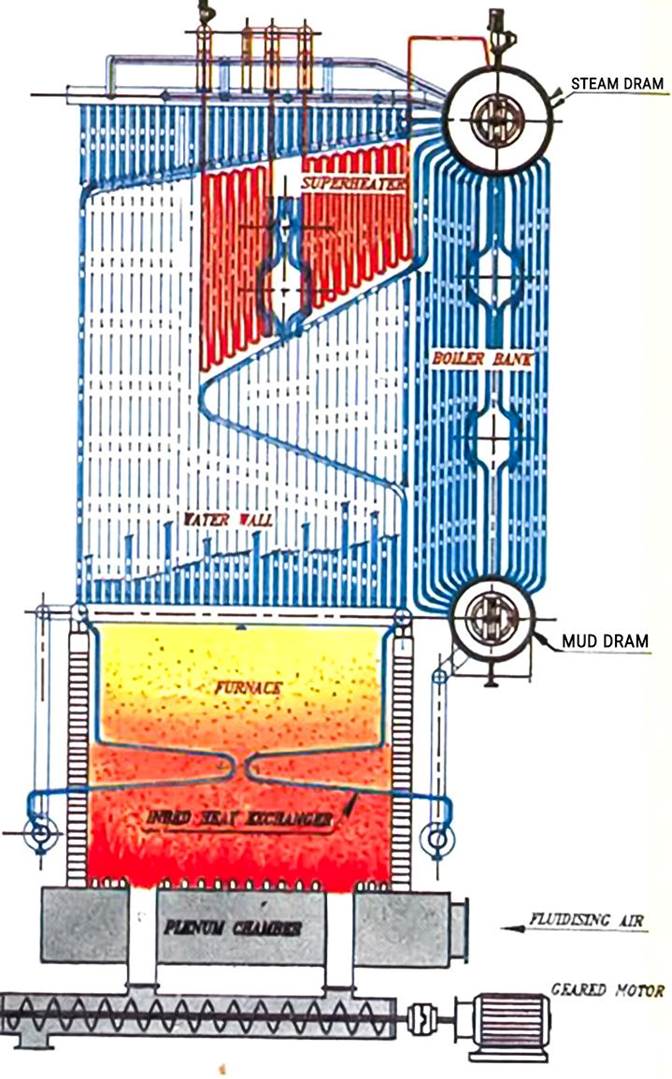
Drum Type Boilers (with Drum)
- Has an upper and lower drum
- Suitable for medium to high pressure
- Common in power plants and refineries
Subcategories:
- Natural Circulation: Water flows naturally (density difference)
- Forced Circulation: With internal pumps (at very high pressures)
Once-Through boilers (without drum)
- Water passes through the pipes once and turns into steam
- No upper drum
- Special for supercritical pressures
- Very high efficiency (up to 45%)

HRSG (Heat Recovery Steam Generator) Boilers
- Burnerless — uses the heat of hot gas turbine gases
- Combined Cycle
- Very common in gas power plants
Advantages of Water Tube Boilers
✅Very high capacity (up to several hundred tons of steam per hour)
✅High working pressure (up to 300 bar and above)
✅High efficiency (up to 90% in modern models)
✅Faster start-up speed than Fire Tube at high capacities
✅Possibility of producing superheated steam
✅Possibility of heat recovery with economizer and superheater
✅Higher safety (the volume of water inside the tubes is less — less risk of explosion)
✅Ability to be used in combined cycles (HRSG)
These advantages have made Water Tube Boilers the main choice in large power plants, global refineries, large petrochemicals and hydrogenation units.
Disadvantages and operational challenges
❌High initial cost
❌Need for specialized manpower
❌Complex and costly maintenance
❌Extreme sensitivity to feedwater quality
❌Scale formation in small pipes with serious consequences
❌Risk of corrosion in high temperature pipes
❌Need for advanced control system
Life of Water Tube Boilers
The life of these boilers is highly dependent on maintenance, water quality, and operating conditions.
Conditions | Average life |
Without regular maintenance | 12 to 15 years |
With periodic maintenance | 25 to 35 years |
With preventive maintenance and chemical washing | Up to 45 years |
Factors that reduce the life of boilers:
- Sediment formation in tubes
- Internal corrosion in the boiler
- Thermal fatigue
- Cracks in drums
- Corrosion due to failure to remove oxygen
The role of feed water in the performance of water tube boilers
The feed water in these boilers must be completely purified. Any impurities can lead to:
- Sediment formation in small tubes (diameter 50-75 mm)
- Reduced heat transfer
- Increased tube wall temperature
- Tube rupture
- Stop production and billions of dollars in losses
Critical parameters of boiler feed water:
Permissible limit | Parameter |
< 3500 ppm | TDS |
Difficulty 0 - 10 ppm | (Hardness) |
Silica 10 - 100 ppm | (SiO₂) |
Iron < 0.1 ppm | (Fe) |
<5ppb | Oxygen |
9.5 – 11.5 | pH up to 9.2 (with hydrazine or DEHA) |
Types of deposits in Water Tube boilers
Sediment type | Place of formation | Consequence |
Calcium carbonate | Upper drum | Surface scale |
Calcium sulfate | Lower pipes | Hard deposit |
Calcium silicate | Drums and pipes | Very resistant sediment |
Iron oxide | High temperature pipes | Subsoil corrosion |
Copper (Cu) | In systems with copper converters | Deposits and corrosion |
Water Tube Boiler Maintenance and Chemical Cleaning
Feed Water Pretreatment
- Softener + Desiner + Reverse Osmosis (RO) + Deionizer (Mixed Bed)
Periodic Blowdown
- Partial Water Drainage to Control TDS
Chemical Cleaning
- Every 12 to 36 Months Depending on Conditions
- Use Non-Acid Anti-Scaling Solutions
Basic Descaling
- In Cases Where Efficiency Loss is More Than 15%
- With Specialized Anti-Corrosion Solutions
Case Study: Chemical Cleaning in a Gas Refinery
- A High Capacity Boiler Unit
- Efficiency Loss, Increased Fuel Consumption
- Performing Cold Mitreh Solution Washing by a Team of Waterworks Specialists
- Result: Efficiency Returned to 91%, Fuel Consumption Reduced by 19%


Safety Tips for Maintaining Water Tube
- Relieve pressure completely before entering the drum
- Use a respirator and eye protection
- Test safety valves
- Make sure washing solutions are non-corrosive
- After washing, a thorough water rinse and residue test are essential
Why is choosing a washing solution critical?
Using an inappropriate solution can:
- Cause corrosion to the pipes
- Cause cracks in the steel
- Cause secondary deposits
Ideal solution characteristics:
- Non-acid
- Contains anti-corrosion agents
- Ability to dissolve silicates and sulfates
- Completely washable
✅Mitreh products with specialized formulations meet these conditions and have proven their effectiveness in hundreds of large industrial projects.
Summary and operational recommendations
- Water Tube boilers are essential for large industries.
- Preventive maintenance is the main key to increasing life and efficiency.
- Periodic chemical washing with specialized solutions (such as Mitre) can improve efficiency by up to 45% and is very critical.
- It is essential to use a specialized team to carry out the operation.
- Boiler feedwater pretreatment is the first line of defense against scale and is very important.
Credible sources
1. ASME BPVC Section I – Power Boilers
2. NACE SP0106 – Control of Corrosion in Boilers
3. API 560 – Fired Heaters and Steam Generators
4. U.S. DOE – Boiler Efficiency and Maintenance Guidelines
5. ScienceDirect: "Fouling and Cleaning of Water Tube Boilers"
6. Reports and tests of Abrizan Industrial Research Company – Washings performed with Mitreh solution
compartir :
¿Por qué los sistemas industriales necesitan anticongelante/refrigerante en verano?
1405/03/02Pasos para la limpieza química de torres de refrigeración: guía de implementación
1405/02/07Tipos de sedimentos en sistemas de ósmosis inversa y métodos para identificarlos.
1405/02/05Beneficios de utilizar soluciones especializadas de Abrizan Company para MED
1404/12/09
Artículos relacionados
Beneficios de utilizar soluciones especializadas de Abrizan Company para MED
Reduzca la corrosión, prevenga la acumulación de incrustaciones y aumente la eficacia de la desinfección química con las soluciones especializadas de Mitreh. Formulaciones personalizadas para desafíos químicos específicos.
¿Por qué está prohibido el uso de ácidos comunes en la limpieza de calderas? (Peligro de explosión y corrosión)
El uso de ácido clorhídrico en la limpieza de calderas provoca corrosión severa y riesgo de explosión. Con la solución especializada de Mitreh Abrizan, podrá desincrustar de forma segura sin dañar el metal. Consulta gratuita.
Lavado químico frente a mecánico en MED: ¿qué método es mejor?
¿Qué método es mejor para la limpieza de dispositivos médicos? Comparativa técnica, costes y riesgos de la limpieza química frente a la mecánica.
¿Cuándo es el mejor momento para realizar el lavado de una planta de desalinización térmica?
Indicadores de la necesidad de lavado de plantas de desalación térmica (MED/MSF) + Guía para la toma de decisiones basada en datos.

Desafíos comunes en el mantenimiento de plantas desalinizadoras y soluciones prácticas
6 desafíos clave en el mantenimiento de plantas desalinizadoras asociadas a centrales eléctricas + soluciones prácticas para prevenir interrupciones en la generación de energía.
Tipos de depósitos y corrosión en intercambiadores de calor y métodos de identificación
Una guía exhaustiva para identificar depósitos de corrosión por carbonato de calcio, sulfato, sílice, óxido de hierro y MIC en intercambiadores de calor mediante métodos de DRX y MEB.
Guía paso a paso para la limpieza química de calderas: ejecución profesional y segura
Guía paso a paso para la limpieza química de calderas conforme a las normas ASME, desde la parada del sistema hasta la pasivación final. Ejecución segura y eficaz.
Señales de advertencia que indican la necesidad de una limpieza química del intercambiador de calor.
¿Ha perdido eficiencia su intercambiador de calor? 5 señales de alerta (aumento de temperatura, disminución del ΔT, alta presión, fugas, mal olor) + lista de verificación para un diagnóstico rápido.
Envía tu opinión
Tu dirección de correo electrónico no será publicada.