

¿Por qué los sistemas industriales necesitan anticongelante/refrigerante en verano?
1405/03/02
Pasos para la limpieza química de torres de refrigeración: guía de implementación
1405/02/07
Tipos de sedimentos en sistemas de ósmosis inversa y métodos para identificarlos.
1405/02/05
Beneficios de utilizar soluciones especializadas de Abrizan Company para MED
1404/12/09

Descaling of marine equipment

Chemical descaling of cooling box systems of ships, tugboats and various vessels
Systems in the operation lines of various industries such as power plants, refineries, petrochemicals, drilling and acidizing operations of oil wells, etc., which operate in aqueous and humid environments. Under various conditions such as pressure, temperature and purity of the process water, after a while, deposits form on the inner wall of the layers, which are most often iron oxide layers or adhered carbonate and silicate deposits. The heat transfer surfaces are the hottest point that the cooling water reaches.
The solubility of calcium carbonate present in the device is inversely related to temperature, as a result, the possibility of calcium carbonate settling and precipitation occurs on the heat transfer surfaces. The accumulation of calcium carbonate sediment layers reduces heat transfer, which causes corrosion and creates hot spots that themselves cause thermal stress. All of these will affect the efficiency and life of the device, which will cause a decrease in device efficiency. Therefore, considering the above, the purpose of this article is to select the appropriate corrosion inhibitor.
Seawater is used to cool equipment and heat exchangers in ships. Seawater contains significant amounts of mineral salts, including sulfate, chloride, and carbonate. These substances cause sediment in the exchangers over time. In addition to mineral salts, seawater is a huge source of microorganisms.
Which, upon entering the cooling heat exchangers and considering the appropriate ambient temperature (about 30 to 35 degrees Celsius), which is very suitable for the growth of bacteria and other microorganisms, quickly grow and multiply on the surfaces of the exchanger. The thermal resistance of a biofilm layer with a certain thickness is greater than a layer of silica sediments with the same thickness. Therefore, the growth of biofilm in seawater systems is the main factor in reducing the efficiency of the exchanger and heat transfer. Ship sedimentation
Sedimentation leads to lower thermal efficiency and pressure drop. Which may also lead to corrosion and cause the exchangers to fail. Most heat exchangers in ships are subject to fouling due to non-compliance with operating instructions or due to poor water quality.
In the event of fouling, fouling should be removed to design conditions close to zero point and achieve the necessary efficiency.
Two types of fouling are proposed, each with its own advantages and disadvantages.
Descaling without stopping the water circulation system
Mechanical descaling requires stopping the system and opening and closing the equipment, resulting in a long stoppage of the ship, which entails costs and possible damages from dismantling the exchangers, tube bundles and ancillary equipment, and a long time, which is almost obsolete or will entail many problems.
The second method is modern chemical fouling, which was invented and used by Abrizan Company.
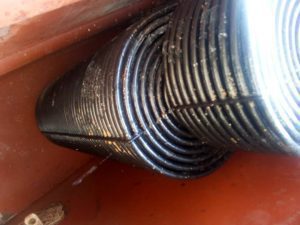
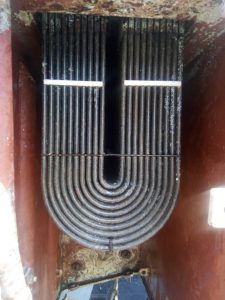
In this type of operation, the solution produced by Abrizan Industrial Research Company under the trade name Mitreh Kashti is used in a closed system for engines and diesel generators of ships by injecting a sediment removal agent. Sediment removal of cooling box systems or heat exchangers in an open system that have direct contact with seawater is carried out chemically on the dock. In this case, sediment removal operations have been carried out on several ships located in Bandar Abbas, Shahid Rajaee Pier and Bandar Imam Mahshahr.
Pictures before sediment removal operations:
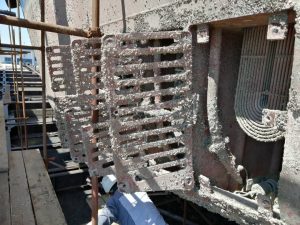
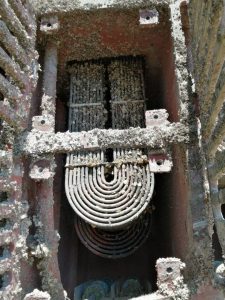
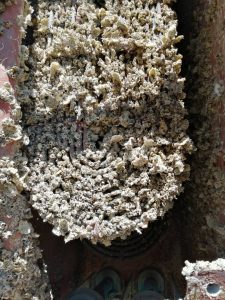
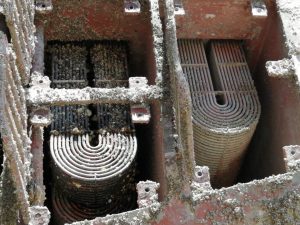
Pictures after sediment removal operation with ship's miter saw:
Conclusion
Deposits on marine equipment, which are mostly calcium and magnesium, act as an insulator between the metal surface and the water and increase the temperature of the metal, resulting in reduced engine cooling. Descaling of marine equipment plays a significant role in reducing costs, including fuel consumption, equipment maintenance, washing, etc. Descaling methods for marine equipment, like other devices, are possible in electronic, mechanical, and chemical forms.
compartir :
¿Por qué los sistemas industriales necesitan anticongelante/refrigerante en verano?
1405/03/02Pasos para la limpieza química de torres de refrigeración: guía de implementación
1405/02/07Tipos de sedimentos en sistemas de ósmosis inversa y métodos para identificarlos.
1405/02/05Beneficios de utilizar soluciones especializadas de Abrizan Company para MED
1404/12/09
Artículos relacionados
Tipos de sedimentos en sistemas de ósmosis inversa y métodos para identificarlos.
Guía técnica para ingenieros: Diagnostique con precisión los depósitos de ósmosis inversa (carbonato de calcio, sílice, biopelícula) y seleccione una solución de limpieza eficaz.
Limpieza inteligente e ininterrumpida de intercambiadores de aceite: proyecto piloto CIP en Gachsaran
Reducción de la caída de presión de 4,5 a 0,5 bar mediante limpieza química *in situ* (CIP). Una solución inteligente para intercambiadores de aceite que no requiere detener la unidad.
Complete guide to chemical washing of industrial equipment Methods, detergents and safety tips
A comprehensive guide to chemical cleaning and descaling of industrial equipment — a variety of methods, detergents, safety tips, and an introduction to the MDA0102 cold miter as a safe, on-line solution. Increase efficiency, reduce costs, and protect equipment.
Physical and chemical descaling methods
In industries such as oil, gas and petrochemical, there is always an attempt to prevent the formation of deposits using different methods in equipment such as heat exchangers and boilers. In this field, a lot of money is spent on chemical materials and additives. But most industrial heat exchangers are exposed to sedimentation due to various reasons such as the low quality of water in different areas. These deposits are mostly formed in the pipes of the converters. In order to reduce the losses caused by sedimentation, the converter must be continuously monitored and cleaned.
Formación de sedimentos en calderas
El agua de alimentación de la caldera debe estar libre de dureza. En ocasiones, debido a un funcionamiento inadecuado o insuficiente del dispositivo de medición de dureza, o a la falta de regeneración oportuna de las resinas, se introduce cierta dureza en el agua de alimentación de la caldera. El aumento de la temperatura del agua en la caldera reduce la solubilidad de los solutos disueltos. El agua cercana a las superficies calientes se satura, lo que favorece la sedimentación de sustancias menos solubles y, finalmente, la formación de sedimentos.
Retire la solución de sedimentos Mitreh
Mitreh es una solución superior para el tratamiento de incrustaciones en diversas industrias. La solución de eliminación de incrustaciones Mitreh, un producto revolucionario de Abrizan Industrial Research Company, es una alternativa eficaz a los métodos tradicionales. Este producto ofrece una solución integral al problema de las incrustaciones en diversas industrias, superando las limitaciones de los métodos físicos y químicos existentes.
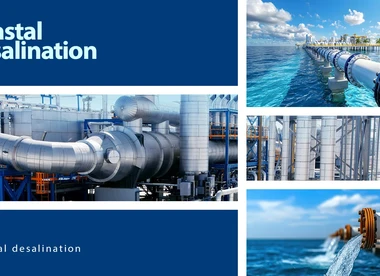
Eliminación de sedimentos de agua dulce en zonas costeras (MED)
Uno de los métodos para producir agua dulce para uso industrial es el uso de plantas desalinizadoras térmicas multietapa para desalinizar agua de mar. Debido al alto contenido de compuestos solubles e insolubles en el agua de mar y al fuerte choque térmico en los equipos de desalinización, la sedimentación en estos equipos es inevitable. Por esta razón, es necesario realizar una limpieza periódica de los sedimentos en las plantas desalinizadoras.
Sedimentos y problemas causados por ellos en las instalaciones
Cuando se utiliza agua como fluido térmico, las sales y la dureza presentes en ella se separan debido al choque térmico y se depositan en las superficies, formando sedimentos. Estos sedimentos son uno de los factores más importantes de erosión y corrosión en las instalaciones de calefacción y refrigeración.
Envía tu opinión
Tu dirección de correo electrónico no será publicada.