

MED Desalination Chemical Washing Steps — Implementation Guide
1404/12/02
The three main enemies of cooling towers: scale, corrosion, biofouling
1404/11/29
Can antifreeze also prevent the formation of deposits and corrosion?
1404/11/27
What is a chiller and what are its types? A comprehensive guide to choosing the best cooling system
1404/11/20
X Ray Fluorescence spectrometer (XRF)

XRF Analysis Method
X-ray fluorescence or XRF analysis is the characteristic “secondary” (or fluorescent) emission of X-rays from a material that has been excited by bombardment with high-energy X-rays or gamma rays. XRF analysis is widely used for elemental and chemical analysis, particularly in the examination of metals, glass, ceramics, and building materials, as well as research in geochemistry, forensic science, archaeology, and art objects such as paintings.
How does XRF analysis work?
In XRF analysis, when materials are exposed to short-wavelength X-rays or gamma rays, ionization of their atoms may occur. Ionization involves the removal of one or more electrons from an atom and may occur if the atom is exposed to radiation with an energy greater than the ionization energy. X-rays and gamma rays can be energetic enough to knock tightly bound electrons out of the inner orbit of an atom. Removing an electron in this way makes the electronic structure of the atom unstable, and electrons in higher orbits “fall into lower orbits” to fill the remaining hole.
During the fall, energy is released in the form of a photon, the energy of which is equal to the energy difference between the two orbits involved. The material therefore emits radiation, which is characteristic of the energy of the atoms present. In XRF analysis, the term fluorescence is used for the phenomenon in which the absorption of radiation of a particular energy leads to the re-emission of radiation of a different (generally lower) energy.
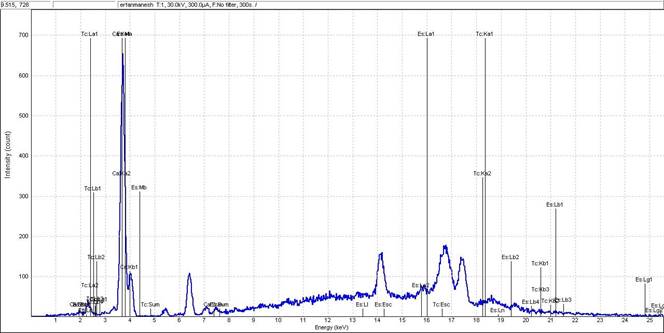
What is X-ray fluorescence (XRF) analysis?
An X-ray fluorescence spectrometer (XRF) is an X-ray instrument used for routine and relatively non-destructive chemical analysis of rocks, minerals, sediments, and liquids. The method works on the principles of wavelength dispersive spectroscopy, which is similar to electron microprobe analysis (EPMA). However, an XRF analyzer generally cannot analyze the small sizes typical for EMPA, which are 2-5 microns in size, so XRF analysis is typically used to analyze larger fractions of geological materials. The relative ease and low cost of sample preparation and the stability and ease of use of XRF analysis make it one of the most widely used methods for analyzing major and trace elements in rocks, minerals, and sediments.
Specialized Applications of XRF Analysis
XRF analysis is used in a wide range of applications, including:
- Research in igneous, sedimentary and metamorphic petrology
- Soil investigation
- Cement production
- Ceramic and glass manufacturing
- Metallurgy (e.g., quality control)
- Environmental studies (e.g., particulate matter analysis in air filters)
- Petroleum industry (e.g., sulfur in crude oils and petroleum products)
- Fine analysis in geological and environmental studies
XRF analysis is suitable for investigations performed on:
- Bulk chemical analysis of major elements (Si, Ti, Al, Fe, Mn, Mg, Ca, Na, K, P) in rocks and sediments
- Bulk chemical analysis of trace elements with an abundance of less than 1 ppm (Ba, Ce, Co, Cr, Cu, Ga, La, Nb, Ni, Rb, Sc, Sr, Rh, U, V, Y, Zr, Zn) In rocks and sediments, detection of trace elements is usually in the order of a few parts per million.
What are the limitations of XRF analysis?
- Relatively large samples, typically greater than 1 gram
- Materials that can be prepared as powders and effectively homogenized
- Materials that are compositionally similar, with complete standards available
- Materials containing large amounts of elements for which absorption and fluorescence effects are well understood
Can XRF analysis be performed on powdered materials?
In most cases, for rocks, ores, sediments, and minerals, the sample is prepared as a fine powder. At this point, it may be analyzed directly, especially for trace element analysis. However, the very wide range of different elements, especially iron, and the wide range of samples in a powdered sample make it difficult to compare accurately with standards. For this reason, it is common to mix the powdered sample with a chemical flux and use a furnace or gas burner to melt the powdered sample. Melting a sample creates a homogeneous sample that can be analyzed and the abundance of elements (now somewhat diluted) calculated.
share :
MED Desalination Chemical Washing Steps — Implementation Guide
1404/12/02The three main enemies of cooling towers: scale, corrosion, biofouling
1404/11/29Can antifreeze also prevent the formation of deposits and corrosion?
1404/11/27What is a chiller and what are its types? A comprehensive guide to choosing the best cooling system
1404/11/20
Related Articles

Gas chromatography/mass spectrometry (GC/MS)
Gas chromatography-mass spectrometry separates chemical mixtures (gas phase) and identifies components at the molecular level (mass phase). It is one of the most accurate tools for analyzing environmental samples.

Flame Photometer
Flame photometry is used to determine the concentration of alkaline earth and alkaline elements (in inorganic chemical analysis to determine the concentration of certain metal ions including sodium, potassium, lithium, and calcium) in aqueous solutions.

UV-Vis or ultraviolet-visible spectrometer (spectrophotometer)
A spectrophotometer, or visible and ultraviolet spectrometer, sometimes called UV, is a device for measuring the amount of a substance based on the amount of electromagnetic absorption of that substance.

FTIR Infrared Spectrometer
Fourier transform infrared (FTIR) spectroscopy is a method that scientists use to determine the structure of molecules by absorbing characteristic infrared radiation. The infrared spectrum is the vibrational spectrum of a molecule. When exposed to infrared radiation, sample molecules selectively absorb radiation of specific wavelengths, which causes a change in the dipole moment of the sample molecules.

Autolab device
The Autolab is an ideal choice for those looking for a low-cost, compact, yet high-performance electrochemical analyzer. Fully integrated with NOVA software, this compact instrument can perform resistance measurements in the microhertz to megahertz frequency range.

High-performance liquid chromatography (HPLC)
HPLC analysis, or high-performance liquid chromatography, is suitable for analyzing and separating chemical and plant compounds and is used in various fields of chemistry, pharmacy, industrial chemistry, and clinical diagnostics.

Glass membranes
A silicate glass used for glass membranes consists of an infinite three-dimensional structure of four negatively charged SiO4 groups, in which each silicon is bonded to four oxygens and each oxygen to two silicons. Within the network of this structure there are enough cations to neutralize the negative charge of the silicate group. Singly charged cations such as sodium and lithium move in the network and are responsible for electrical conduction within the membrane.

pH measurement and its methods
The pH of water determines the concentration of hydrogen ions and its acidity or alkalinity. Pure water dissociates to a very small extent into H and OH ions. The pH of drinking water should usually be around 7 (neutral). If the pH is less than 7, the water is acidic, and if the pH is above 7, the water is alkaline.
Submit your opinion
Your email address will not be published.