

MED Desalination Chemical Washing Steps — Implementation Guide
1404/12/02
The three main enemies of cooling towers: scale, corrosion, biofouling
1404/11/29
Can antifreeze also prevent the formation of deposits and corrosion?
1404/11/27
What is a chiller and what are its types? A comprehensive guide to choosing the best cooling system
1404/11/20
EDI desalination plant (Electrodialysis)

EDI is the only water treatment technology that produces ultrapure water without the need for regeneration chemicals — but it is highly sensitive to the quality of the incoming water.
In this expert guide, we explore everything about EDI desalination — from how it works and benefits to technical challenges and industrial applications — in simple, actionable language. Our goal is to help you make an informed decision about whether this technology is right for your industry.
Why read this article?
✅Gain a deep understanding of how EDI desalination works
✅Identify its advantages and disadvantages in industrial applications
✅Learn about the industries that use EDI the most and why
✅Understand the pretreatment needs and operational challenges
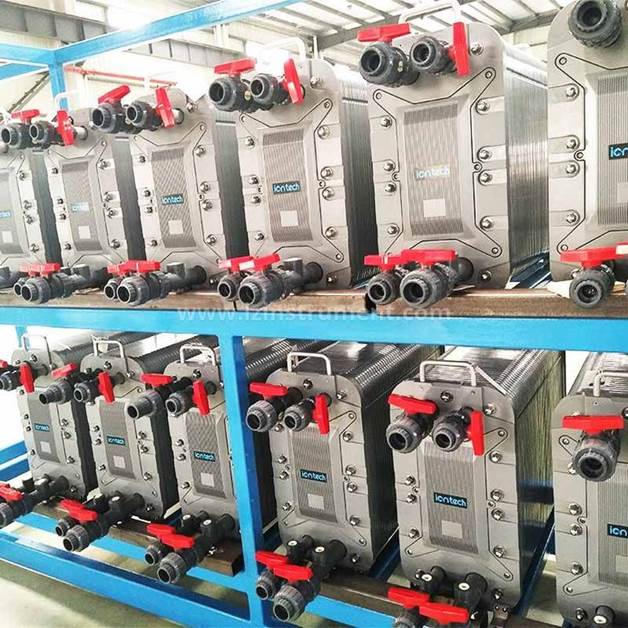
What is EDI desalination?
EDI stands for Electrodeionization. An advanced technology for producing ultrapure water (UPW) without the need for regeneration chemicals (such as acid or soda). EDI desalination is usually used for the final purification of RO effluent and to make the water purer.
How EDI desalination works
- Input water passes through chambers containing ion exchange resins (cationic and anionic).
- At the same time, an electric field is applied that directs positive and negative ions to positive and negative electrodes.
- The ions are separated through ion-selective membranes and transferred to the effluent stream (Concentrate).
- The output water (Product) has a very low electrical conductivity (less than 0.1 µS/cm) and a TDS close to zero.
Key advantage of EDI desalination: Continuous production of ultrapure water without the need to stop for chemical regeneration.
Advantages of EDI desalination — Why is it used in sensitive industries?
1. Ultrapure water (UPW) production without the need for regeneration chemicals
- Eliminates the need for acid, soda or salt to regenerate resins — reduces costs and chemical hazards
2. Continuous and automatic operation
- No need to stop the system for regeneration — Suitable for sensitive and non-stop processes
3. Environmental compatibility
- No production of hazardous chemical effluents — Reduces environmental burden
4. Precise control of outlet water quality
- Ability to monitor conductivity, pH and TOC in real time — Suitable for industries under standards (e.g. GMP, FDA)
5. Ability to combine with RO as pretreatment
- EDI is usually placed after RO — so that water with low TDS (less than 20 ppm) enters EDI and higher purity water is obtained.
Disadvantages and Challenges of EDI Desalination — What Causes System Failure?
1. Extreme sensitivity to inlet water quality
- Presence of silica, CO2, TOC, suspended particles or heavy metal ions → leads to bauxite of resins and membranes.
2. Need for strong pretreatment (usually RO + fine filter)
- Without proper pretreatment, the life of EDI chambers is severely reduced — even less than 1 year.
3. High initial cost
- Each EDI chamber can be expensive — and in large systems, multiple chambers are required.
4. Relatively high power consumption
- Due to the need for a continuous electric field — EDI energy consumption is higher than RO.
5. Inability to remove dissolved gases (such as CO2 or O2)
- A degasser is required before EDI to remove CO2 — otherwise, efficiency decreases.
In which industries are EDI desalination used? And why?
1. Pharmaceutical and biotechnology industries
- → Why?
- Need for ultrapure water for the production of drugs, vaccines and biological products
- Requirement of FDA, GMP, USP standards
- No tolerance for ionic or organic contamination in the production process
2. Semiconductor and electronics industries
- → Why?
- Washing wafers and sensitive components — even nanometer particles can cause damage
- Requirement of water with conductivity < 0.056 µS/cm
- No need for regeneration chemicals that may cause contamination
3. Research and calibration laboratories
- → Why?
- Use in HPLC, ICP, AA and ... devices
- Requirement of high purity water to prevent test errors
- Requirement of ASTM D1193, ISO 3696 standards
4. High pressure and supercritical steam power plants
- → Why?
- Production of very high purity boiler feed water — prevention of scale and corrosion at high temperatures and pressures
- Reducing the need for water control chemicals in the steam cycle
5. Optical and laser industries
- → Why?
- Washing lenses and sensitive surfaces — without leaving stains or residue
- Requires deionized, particle-free water
Pretreatment requirements for EDI — Without these, EDI won’t work!
1. RO (Reverse Osmosis) System
- Reduce the inlet TDS to less than 20 ppm — otherwise, the resins will quickly become saturated.
2. Cartridge filter (1 micron or less)
- Prevent suspended particles from entering the EDI chamber — which will clog the channels.
3. CO2 removal (optional — but recommended)
- Using a degasser or soda injection to convert CO2 to bicarbonate — because CO2 passes through the membranes as a gas and ionizes in the EDI — causing an increase in electrical charge and a decrease in efficiency.
4. TOC (Total Organic Matter) Control
- High TOC → Adsorption on the surface of the resins → Reduced ion exchange capacity
- Use UV or activated carbon filter to reduce TOC
5. Silica control
- Soluted silica → Adsorption on anion resins → Reduced capacity — Maximum allowed: 0.5 ppm
When should the EDI chamber be replaced or flushed? — Warning Signs
- Increased effluent conductivity (e.g. from 0.06 to 0.2 µS/cm)
- Decreased effluent pH (due to CO2 or organic contamination)
- Increased EDI inlet pressure (due to clogged channels)
- Decreased effluent flow
- Increased electrical current without improvement in water quality (sign of resin saturation)
Important Technical Note:
Chemical flushing of EDI chambers is usually impractical or ineffective — because contaminants chemically bind to the resins. In most cases, chamber replacement is the only effective solution. Prevention with proper pretreatment is the key to success in EDI.
EDI vs. Conventional Ion Exchange Resins — Which is Better?
Parameter | EDI | Conventional ion exchange resin |
Need for regeneration chemicals | No | Yes (acid/base) |
Performance | Continuous | Need to stop to regenerate |
Operating cost | Bottom (after installation) | High (chemicals + wastewater disposal) |
Outlet water quality | Ultrapure (0.056 µS/cm) | Pure (0.1-1 µS/cm) |
Input sensitivity | Very high | Medium |
Environmental compatibility | Excellent | Weak (chemical wastewater) |
Initial cost | Top | Down |
Conclusion: If you need ultrapure water, consistent performance, and reduced chemical costs — EDI is a better option. However, if the initial budget is limited and the quality of “pure” water is sufficient — conventional resin is more economical.
Final Conclusion:
EDI desalination is an advanced technology for producing ultrapure water without the need for regeneration chemicals — but its success is completely dependent on the quality of the incoming water and proper pretreatment. This system is an excellent choice in industries where ultrahigh purity, process stability, and continuity are critical — such as pharmaceuticals, semiconductors, and supercritical power plants.
share :
MED Desalination Chemical Washing Steps — Implementation Guide
1404/12/02The three main enemies of cooling towers: scale, corrosion, biofouling
1404/11/29Can antifreeze also prevent the formation of deposits and corrosion?
1404/11/27What is a chiller and what are its types? A comprehensive guide to choosing the best cooling system
1404/11/20
Related Articles
MED Desalination Chemical Washing Steps — Implementation Guide
A step-by-step guide to chemical flushing of MED desalination plants: from scale detection to safe and effective implementation. Preventing corrosion and increasing efficiency
International standards for maintaining and cleaning desalination plants
Do you know what international standards are required for the maintenance and cleaning of desalination plants? A complete guide to extending the life of equipment and preventing sedimentation.
Water Turbidity Measurement: A Comprehensive Guide for Industry and Drinking Water
What is water turbidity? Why is it vital to measure it? Read about measurement methods, standards, and ways to reduce turbidity in this complete guide.
Types of deposits and corrosion in MED desalination water
Types of deposits and corrosion in MED desalination plants — calcium carbonate, sulfate, silica, magnesium hydroxide, subsedimentary corrosion. Accurate detection methods with XRD, SEM, ICP. Specialized solutions for water treatment plants with (Mitreh brand).
Why is it important to control sedimentation and corrosion in desalination devices؟
Why is scale and corrosion control vital in desalination plants? A technical and economic analysis of the impact of scale and corrosion on equipment performance, cost, and life. Warning signs and preventive measures. Suitable for engineers and industrial managers

Comparison of RO, MED, MSF desalination water in terms of cost, energy consumption, chemical requirement of the industry
Detailed comparison of RO, MED, MSF in terms of cost, energy consumption and chemical requirements. Technical analysis, comparison table and decision-making guide. MED with recycled heat is cheaper than RO! Suitable for engineers and industrial managers
MVC desalination plant (Mechanical vapor compression)
MVC (Mechanical Vapor Compression) Desalination — Comprehensive Guide to Application, Advantages, Disadvantages and Chemical Solutions by Abrizan Company (Mitreh Brand). Evaporator Chemical Washing, Thermal Anti-Fouling, Laboratory Consulting. Increase Efficiency — Reduce Energy Costs
MSF Desalination Plant (Multi-Stage Flash)
MSF (Multi-Stage Flash) Desalination Plant — Comprehensive Guide to Sediment and Corrosion Control with Solutions from Abrizan Company (Mitreh Brand). Specialized Chemical Washing, Anti-Sediment and Thermal Anti-Corrosion, Laboratory Consulting. Increased Efficiency — Reduced Energy Costs — Increased Equipment Life.
Submit your opinion
Your email address will not be published.