

MED Desalination Chemical Washing Steps — Implementation Guide
1404/12/02
The three main enemies of cooling towers: scale, corrosion, biofouling
1404/11/29
Can antifreeze also prevent the formation of deposits and corrosion?
1404/11/27
What is a chiller and what are its types? A comprehensive guide to choosing the best cooling system
1404/11/20
International standards for maintaining and cleaning desalination plants

Introduction: Why do your desalination plants fail prematurely?
Many technical managers and industrial engineers are faced with the question: “Despite the high investment, why do our desalination plants lose their efficiency after a few months?”
Short answer:Failure to comply with international standards in the maintenance and flushing of desalination systems.
Scale, corrosion and biological contamination are the three main enemies of this equipment. Without careful planning based on global standards, even the most advanced systems quickly suffer from reduced efficiency, increased energy consumption and costly breakdowns.
In this article, focusing on practical solutions, we review the most important international standards in the maintenance and flushing of desalination plants — from MSF and MED to RO and thermal systems.
What is a desalination plant and why is its maintenance vital?
Desalination plants are devices that convert brackish or semi-braked water into usable fresh water. These technologies are widely used in the oil and gas industry, power plants, shipping, coastal cities and large factories.
Three main factors that reduce the efficiency of desalination plants:
1. Formation of mineral deposits (such as calcium carbonate, barium sulfate)
2. Metal corrosion due to improper chemical conditions
3. Growth of biofilm and microorganisms (Biofouling)
Each of these factors can lead to:
- A severe reduction in water flow
- Increase in operating pressure
- Clogging of pipes and membranes
- Permanent equipment failure
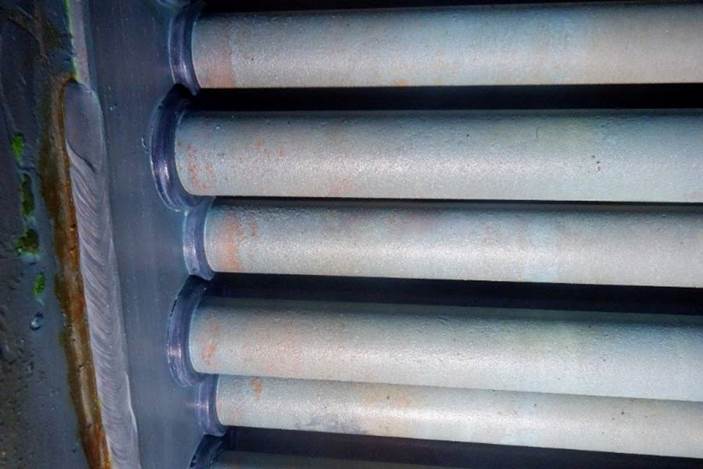
Clean desalination water before sedimentation
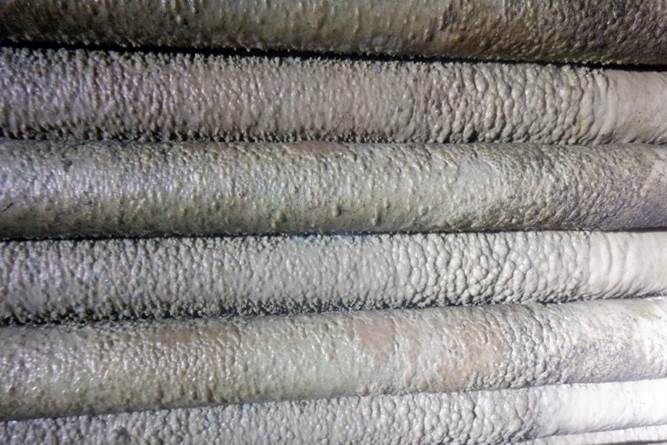
Desalination plant with sediment
What are the most important international standards in desalination maintenance?
The desalination industry is governed by several international organizations that set technical, safety and environmental standards. The most important of these are:
ASTM (American Society for Testing and Materials) Standard
ASTM D4582:Standard method for evaluating anti-fouling cleaners in thermal systems.
ASTM D6980:Guide for the selection of chemicals for corrosion control in circulating water systems.
ASTM E3072:Standard for evaluating the effectiveness of anti-foaming agents in industrial processes.
These standards specify what types of chemicals are allowed to be used and how their performance should be tested.
ISO (International Organization for Standardization) Standard
ISO 21670:Specific standard for thermal desalination systems (MSF/MED).
ISO 20480:Maintenance and operating instructions for RO systems.
ISO 15859:Requirements for the quality of incoming and outgoing water in industrial processes.
These standards place special emphasis on documentation, traceability, and quality control.
NACE (National Association of Corrosion Engineers) Standard
NACE SP0106:Comprehensive Guide for Corrosion Control in Thermal Desalination Systems.
NACE TM0172:Testing Materials for Resistance to Saline and Acidic Environments.
NACE has a special place, especially in the oil and gas industry.
Local and Regional Standards (e.g. ADWR, SWCC)
In the Middle East, organizations such as:
SWCC (Saudi Water Conversion Corporation)
ADWR (Abu Dhabi Water Regulation)
have set strict criteria for permitted chemicals, flushing cycles, and environmental regulations.
Practical Tip: If your system operates in the Middle East, adhering to SWCC standards is not only a smart choice, but also a legal requirement.
When does a desalination plant need flushing? (Operational Indicators)
Many units wait for a “complete failure”, while the following indicators can extend the life of the system for years:
RO system washing indicators:
- 10–15% decrease in outlet water flow
- 15% increase in inlet pressure
- Increase in pressure difference between inlet and outlet (ΔP)
- Decrease in salt removal efficiency
Thermal system washing indicators (MSF/MED):
- Increase in boiling point temperature due to scale insulation
- Reduce heat transfer in exchangers
- Increase in fuel or steam consumption
- Detection of metal ions in outlet water (corrosion sign)
Deli washing methods according to standards
Chemical washing (CIP – Clean-in-Place)
This method is designed according to ASTM D4582 and ISO 20480 and includes the following steps:
1. Detection of scale type (laboratory or online)
2. Selection of washing solution Suitable:
- Acidic (for carbonate deposits)
- Alkaline (for organic contaminants and biofilms)
- Combined (for complex deposits)
3. pH, temperature and contact time adjustment
4. Backwash in RO systems
5. Final rinse and performance test
✅Standard note:According to ISO 20480, each wash must be accompanied by an operational report (CIP Log) that includes: date, type of detergent, concentration, pH, temperature, duration and test results.
Mechanical cleaning
In thermal systems (MSF/MED), sometimes chemical cleaning is not sufficient. ISO 21670 specifies the conditions for using:
- Special brushes
- and high-pressure water jets
Acidic washing — when and how?
Acid washing is only suitable for mineral deposits. The standards recommend:
- Use dilute (not concentrated) citric acid or hydrochloric acid.
- The pH of the cleaning solution should be between 2–4.
- Do not exceed 40°C washing temperature (except in resistant systems).
- Be sure to use a corrosion inhibitor.
❌Common mistake: Using acid without inhibitor → Severe corrosion of pipes and exchangers.
How to correctly identify the type of sediment? (Standard washing requirement)
Washing without accurate identification of the type of sediment is a waste of resources and damage to equipment. The standards recommend three main methods:
Online testing (Online Monitoring)
- Measurement of LSI (Langlier Saturation Index) for calcium carbonate
- SDI (Silt Density Index) for suspended particles
- ORP (Oxidation-Reduction Potential) for microbial activity
Laboratory analysis of sediment (Offline Analysis)
- XRD (X-ray Diffraction): to identify crystalline compounds
- SEM-EDS: for elemental analysis of the sediment surface
- ICP-MS: to detect heavy metals
Feedwater Analysis
According to ISO 15859, the inlet water must be analyzed for:
- Hardness
- Sulphate
- Silica
- Iron and manganese
- TOC (Total Organic Carbon).
Practical example:If the feed water contains > 50 ppm silica, using citric acid is not effective — you need silica-specific detergents.
Common Challenges in Desalination Washing and Standard Solutions
Challenge | Possible cause | Standard solution |
Temporary decrease in performance after washing | Chemical residue | Complete drainage according to ISO 20480 |
Corrosion after pickling | Not using a deterrent | Use of Corrosion Inhibitor according to NACE SP0106 |
Rapid sediment return | Incorrect detection of sediment type | XRD analysis + laboratory consultation |
Reducing the life of RO membranes | Harsh washing or inappropriate pH | pH control between 2–12 and temperature < 40°C |
The role of chemicals in standard desalination washing
Chemicals must:
- Comply with ASTM D6980 and ISO 20480.
- Be biodegradable.
- Be free of phosphorus and heavy metals (according to SWCC).
Types of permitted chemicals:
Antiscalants: Prevent scale formation in the first stage
Membrane Cleaners: Alkaline/Acidic/Combined
Biocides: Control biofouling (within the permitted dosage)
Antifoams: Prevent foam in CIP tanks
Warning: Use of non-standard materials can void the equipment warranty.
Preventive Maintenance Best Practices
Washing is only part of the strategy. The standards emphasize preventive maintenance:
1. Installation of pretreatment systems (e.g. scale removers, cartridge filters, softeners)
2. Continuous monitoring of feedwater quality
3. Periodic (non-reactive) washing schedule
4. Training of operating personnel according to ISO guidelines
5. Complete recording of operating data for trend analysis
Frequently Asked Questions (FAQ)
Can household detergents be used for desalination?
No. Household detergents contain surfactants that are incompatible with membranes and can cause permanent damage.
How many times a year should the desalination be washed?
Depends on the quality of the feedwater. Under normal conditions:
- RO systems: every 1–3 months
- Thermal systems: every 6–12 months
But always decide based on operational indicators, not a timer.
Is acid washing suitable for all systems?
No. In systems with polyamide (PA) membranes, a pH below 2 is not allowed. Always check the technical specifications of the equipment.
Conclusion: Standard = Long Life + Savings + Reliability
Adhering to international standards in the maintenance and washing of desalination plants is not just a technical requirement — it is also a smart economic strategy. By properly implementing these standards:
- Equipment life is increased by up to 40%.
- Energy consumption is reduced by up to 25%.
- The risk of unexpected stops is greatly reduced.
If you want to protect your investment, consider washing as a scientific and documented process — not a routine maintenance task.
If you need expert advice to identify the type of scale or the optimal selection of chemicals, Abrizan Company specialists, with over 20 years of experience in advanced laboratories, are ready to provide customized solutions to various industries.
share :
MED Desalination Chemical Washing Steps — Implementation Guide
1404/12/02The three main enemies of cooling towers: scale, corrosion, biofouling
1404/11/29Can antifreeze also prevent the formation of deposits and corrosion?
1404/11/27What is a chiller and what are its types? A comprehensive guide to choosing the best cooling system
1404/11/20
Related Articles
MED Desalination Chemical Washing Steps — Implementation Guide
A step-by-step guide to chemical flushing of MED desalination plants: from scale detection to safe and effective implementation. Preventing corrosion and increasing efficiency
Water Turbidity Measurement: A Comprehensive Guide for Industry and Drinking Water
What is water turbidity? Why is it vital to measure it? Read about measurement methods, standards, and ways to reduce turbidity in this complete guide.
Types of deposits and corrosion in MED desalination water
Types of deposits and corrosion in MED desalination plants — calcium carbonate, sulfate, silica, magnesium hydroxide, subsedimentary corrosion. Accurate detection methods with XRD, SEM, ICP. Specialized solutions for water treatment plants with (Mitreh brand).
Why is it important to control sedimentation and corrosion in desalination devices؟
Why is scale and corrosion control vital in desalination plants? A technical and economic analysis of the impact of scale and corrosion on equipment performance, cost, and life. Warning signs and preventive measures. Suitable for engineers and industrial managers

Comparison of RO, MED, MSF desalination water in terms of cost, energy consumption, chemical requirement of the industry
Detailed comparison of RO, MED, MSF in terms of cost, energy consumption and chemical requirements. Technical analysis, comparison table and decision-making guide. MED with recycled heat is cheaper than RO! Suitable for engineers and industrial managers
MVC desalination plant (Mechanical vapor compression)
MVC (Mechanical Vapor Compression) Desalination — Comprehensive Guide to Application, Advantages, Disadvantages and Chemical Solutions by Abrizan Company (Mitreh Brand). Evaporator Chemical Washing, Thermal Anti-Fouling, Laboratory Consulting. Increase Efficiency — Reduce Energy Costs
EDI desalination plant (Electrodialysis)
EDI (Electrodialysis) Desalination — A Comprehensive Guide to Technology, Applications, Advantages and Disadvantages. Ultrapure Water Production Without Regeneration Chemicals. Applications in Pharmaceutical, Semiconductor and Power Plants. Pretreatment Requirements and Technical Challenges
MSF Desalination Plant (Multi-Stage Flash)
MSF (Multi-Stage Flash) Desalination Plant — Comprehensive Guide to Sediment and Corrosion Control with Solutions from Abrizan Company (Mitreh Brand). Specialized Chemical Washing, Anti-Sediment and Thermal Anti-Corrosion, Laboratory Consulting. Increased Efficiency — Reduced Energy Costs — Increased Equipment Life.
Submit your opinion
Your email address will not be published.