


Antifreeze Calculation Guide for Villa Packages — Table + Practical Example

Guide to Calculating the Amount of Antifreeze for a Villa Package
Did you know that using the wrong amount of antifreeze — too little or too much — can both damage your villa's heating system? If it's too little, the system will freeze in the cold of winter; if it's too much, thermal efficiency will decrease and costs will increase. In this guide, you'll learn step-by-step how to estimate the total volume of water in the system, consider the minimum temperature in your area, and calculate the exact amount of antifreeze based on a standard table — without the need for an engineer or complicated tools.

Why is accurate antifreeze calculation important?
Many villa owners add only “one or two liters” of antifreeze to the system — without considering:
- The actual temperature of the area (for example, Saveh with a temperature of -35 degrees requires a higher concentration)
- The actual volume of water in the system (200-meter villa ≈ 80 liters of water; 500-meter villa ≈ 200 liters)
- The optimal mixture ratio (each temperature requires a specific ratio)
Result:
- Low antifreeze: freezing, bursting of pipes
- High antifreeze: increased viscosity, reduced flow, excessive load on the pump
Our goal: the lowest effective amount — not the highest, not the lowest.
Step 1: Estimate the volume of water in the villa’s heating system
The volume of water in the system can be calculated approximately from the area of the villa and the number of radiators:
Villa area | Number of radiators (approximate) | System water volume (liters) |
100–150 meters | 6–8 pieces | 50–70 liters |
150–250 meters | 8–12 pieces | 70–100 liters |
250–400 meters | 12–16 pieces | 100–150 liters |
400–600 meters | 16–20+ pieces | 150–250 liters |
Practical tip:
- A standard radiator has a capacity of ≈ 7–10 liters
- Internal piping accounts for ≈ 30–40% of the total volume
If you want to be more precise:
1. Drain the system
2. Collect the drained water in 20 liter containers
3. Count the number of containers
Step 2: Determine the minimum temperature of the region
Before calculating, you need to know what the lowest temperature your region has experienced in winter is. You can get this data from:
- Iranian Meteorological Organization website
- Reports from the last 10 years of the region
- Local experience (for example, "In 1400, the temperature in our villa reached -28")
To be more certain, add 3 to 5 degrees Celsius to the lowest historical record.
Example:
- Region: Saveh → Lowest temperature: -32 → Protection target: -35 degrees
- Region: Karaj → Lowest temperature: -18 → Protection target: -23 degrees
Step 3: Using the standard consumption table
With the target temperature and the volume of water in the system, use the table below:
Temperature range (°C) | Mixture ratio (antidikh: water) | Interpretation |
0 to -15 | 1liter of antifreeze for 2–3 liters of water | Mild areas (northwest, south) |
-15to -23 | 1liter of antifreeze for 1–2 liters of water | Cold regions (Alburz, Southern Zagros) |
-23to -34 | 1liter of antifreeze per 1 liter of water | Very cold areas (Saveh, Dizin) |
-34to -48 | 1liter of antifreeze for 0.5–1 liter of water | Cold regions (elevations above 2500 meters) |
Calculation example:
- Your villa in Saveh (target: -35)
- System volume: 120 liters
- Required ratio: 1:1 (according to the table for -34 to -23)
- Amount of antifreeze = 120 ÷ 2 = 60 liters
Technical note: The ratio of 1:1 means 50% antifreeze + 50% water, not using pure antifreeze.
Step 4: How to properly inject antifreeze
1. Completely empty the system
2. If necessary, perform chemical flushing
3. Mix the antifreeze with clean water (according to the ratio in the table)
4. Enter the mixture into the system through the filling valve or injection pump
5. Adjust the system pressure to 1.5 bar
6. Run the system for a few hours to allow the mixture to spread evenly
Warning:
Never inject pure (undiluted) antifreeze — there is a risk of damage to metals and reduced efficiency
Use antifreeze that is also anti-corrosion, anti-foam and anti-scale
Frequently asked questions by villa owners
Can I fill antifreeze directly into the system without draining it?
Only if:
- The system already contained antifreeze
- The old antifreeze is still intact (pH > 8.5, clear color)
Otherwise, draining and flushing are necessary — as the mixture of old and new antifreeze may cause an adverse reaction.
Can I use car antifreeze?
No. Car antifreeze:
- Designed for aluminum and steel
- May damage copper (in villa pipes)
- No anti-foam and anti-scale
How do I know if the antifreeze is suitable for the temperature in my area?
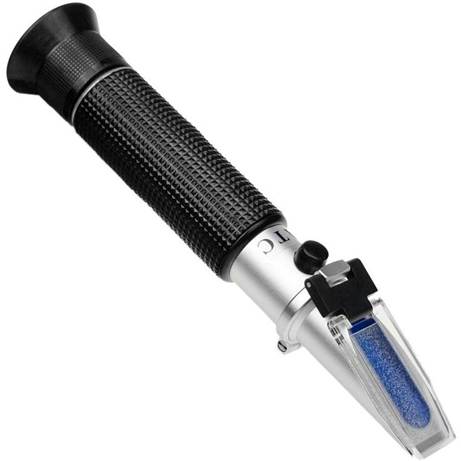
You can measure the actual freezing point of the mixture with a refractometer (affordable, available online). If the freezing point is lower than your target, that's fine.

Conclusion: Correct Calculation = Smart Protection
Accurate antifreeze calculation is not a complicated technical task, but a smart decision that prevents:
- Freezing pipes
- Package burst
- Emergency repair costs
With two simple data points — system volume and area temperature — you can calculate the exact amount of antifreeze in 10 minutes.
If you are still not sure of the right amount, take a water sample from the system right now and perform a simple pH or freezing test. This small task can prevent thousands of dollars in costs.
If you need expert advice to identify the type of sediment or the optimal selection of chemicals, Abrizan Company specialists, with more than 20 years of experience in advanced laboratories, are ready to provide customized solutions to various industries.
share :
Related Articles

Does antifreeze reduce the thermal efficiency of the system?
Does using antifreeze in heating systems reduce efficiency? Scientific answer + solutions to compensate for performance loss.

Why is plain water not enough for home heating? — 4 scientific reasons
Plain water in the water heater causes deposits, corrosion, freezing, and boiling. How to prevent damage with specialized materials? A practical guide for the home

Industrial antifreeze and anti-boiler: A complete guide to protecting heating and cooling systems
Why are industrial antifreeze and anti-scaling agents essential for circulating systems? A comprehensive guide to preventing freezing, scalding, corrosion and deposits in boilers, chillers and engine rooms

When to Replace System Antifreeze? — Testing and Replacement Guide
6 Signs Your Antifreeze Needs to Be Replaced + Proper Testing Methods at Home and in the Lab. Prevent Freezing and Corrosion.

Protecting Your Villa's Heating System Before Winter — The Complete Guide
How to protect your villa's heating system from freezing, corrosion, and damage before winter in 4 simple steps? Practical guide + antifreeze consumption table.

Guide to annual maintenance of heating systems with specialized chemicals
How to control corrosion, scale and foam in heating systems with annual chemical maintenance? Seasonal guide + list of essential materials + water analysis (anti-boiling and anti-boiling)

Introduction of antifreeze mitreh
Mitreh's antifreeze and antifreeze has a great performance in terms of heat transfer due to its high heat capacity, and it is considered the most economical and available fluid for this purpose. Water alone has a relatively low boiling point, which means that it boils at a high temperature, and it also has a high freezing point, which means that it freezes quickly in the cold, most importantly due to the presence of solutes, ions, dissolved oxygen, etc. Rotting and rusting of facilities and ducts.

The importance of antifreeze and its uses
Antifreeze is a colored liquid that mixes with water and helps in regulating the engine in extreme temperatures. and is pumped throughout the engine block to maintain a uniform operating temperature. In addition to temperature regulation, mitreh antifreeze is also effective in preventing corrosion.
Submit your opinion
Your email address will not be published.