
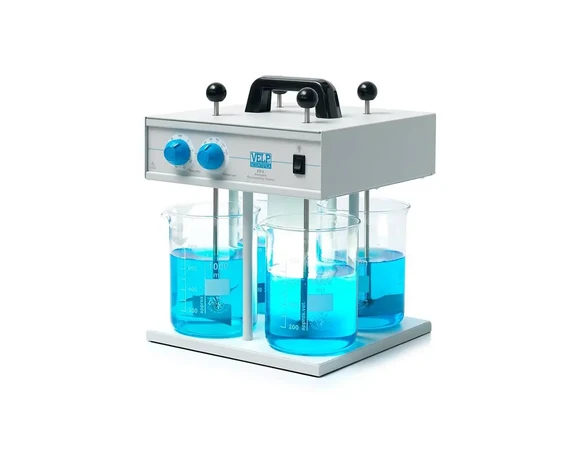
What is a jartest?
It is a pilot scale laboratory test that simulates coagulation/flocculation with different chemical doses. The purpose of the test is to estimate the minimum coagulant dose required to achieve specific water quality objectives. Jartest tests are performed on four- or six-place agitators that can be used to simulate mixing and coagulation conditions in water and wastewater treatment.
What is the purpose of a jartest test?
It is a laboratory method that simulates coagulation/flocculation with different chemical doses. The purpose of this method is to estimate the minimum coagulant dose required to achieve water quality objectives.
What is the flocculation process?
Flocculation is a process by which a chemical coagulant added to water acts to facilitate the bonding between particles, creating larger aggregates that are easier to separate. This method is widely used in water treatment plants and can also be used for sample processing for monitoring programs.
Applications of Jartest:
- A comparison of coagulants
- Determining the appropriate coagulant dose
- Identification of the type of coagulant
What is the test method?
The steps of the Jartest test according to D 2035 – 80 (Reapproved 2003) An American National Standard are as follows:
Add the coagulant to each container and stir at approximately 100 rpm for 1 minute.
Turn off the mixers and allow the containers to stand still for 30 to 45 minutes.
Reduce the stirring speed to 25 to 35 rpm and continue mixing for 15 to 20 minutes.
* The laboratories of Abrizan Industrial Research Company, located in Fars Science and Technology Park, are capable of measuring a variety of specialized water parameters, including the Jartest test, with experienced staff and the use of advanced devices and equipment.