

MED Desalination Chemical Washing Steps — Implementation Guide
1404/12/02
The three main enemies of cooling towers: scale, corrosion, biofouling
1404/11/29
Can antifreeze also prevent the formation of deposits and corrosion?
1404/11/27
What is a chiller and what are its types? A comprehensive guide to choosing the best cooling system
1404/11/20
Cement plant description

Cement Plant Description
Cement Production Processes
(I) General Description
The cement production process (shown in Figure 2-2) requires three steps:
Raw material preparation:
Crushing a mixture of raw materials to create a raw material.
Clinker burning (Pyro-processing):
Heating the raw material to a sintering temperature > 1400°C in a cement kiln to produce clinker.
Cement preparation:
Crushing the prepared clinker with gypsum and other additives to make cement.
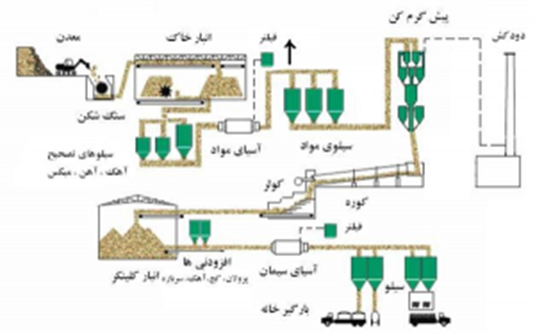
Figure 2-2: Simple diagram of the cement production process
The most common raw materials used for cement production are limestone, marls and clay (although other materials can also be used). The selected materials are crushed and mixed to produce a suitable raw material for use in the subsequent processes. Approximately 1.50-1.60 tons of dry (raw) mix is required to produce 1 ton of clinker due to the calcination of the limestone component of the raw material. The second step in this process involves transferring the raw material to a kiln system where it is gradually heated. Sequential chemical reactions take place as the temperature of the raw materials increases. The stages of this reaction are shown in Table 2-3.
Table 2-3: Chemical reactions of the furnace (CEMBUREAU, 1999)
Furnace temperature (°C) | Chemical reaction |
20 – 900 | Drying and preheating: release of free water and water hydrogen bonds |
850 – 950 | Calcination: Release of CO2 from calcium carbonate (limestone) and initial reactions accompanied by the formation of clinker minerals and intermediate phases. |
1250 – 1450 | Sintering or Clinkerization: Formation of calcium silicate and partial melting |
1350 – 1200 | Internal furnace cooling: crystallization of calcium aluminate and calcium ferrite from partial melting |
Typically, temperatures of about 1400-1450°C are required to complete the reactions and produce alite (a characteristic structure of Portland cement). Partial melting causes the materials to be added to a lump or lump known as clinker, which is then cooled by air to a temperature of 100-200°C. The heat released from the kiln system is usually used to dry the raw materials in the raw grinding section of the manufacturing process. A typical clinker consists of the compositions shown in Table 2-4.
Table 2-4: General composition of cement clinker (IEA GHG،1999)
Average maximum | Content (%) | Minimum | Chemical formula | Composition |
75 | 62 | 45 | 3 CaO.SiO2 | Tricalcium silicate (Alite) |
35 | 15 | 5 | 2 CaO.SiO2 | Dicalcium silicate (Belite) |
15 | 8 | 4 | CaO.Al2O3. FeO3 | Calcium aluminoferrite (Ferrite) |
15 | 11 | 4 | 3 CaO.Al2O3 | Tricalcium aluminate (Aluminate) |
4 | 1 | 0.1 | CaO | Free Calcium oxide |
4.5 | 1.5 | 0.5 | MgO | Free Magnesium oxide |
The final step in the production process involves grinding the clinker together with additives such as gypsum, limestone, granulated blast furnace slag and fly ash to control the properties of the cement.
The four process routes in the ‘factory’
The three production steps mentioned earlier are common to the four main ‘factory’ process routes by which cement can be produced. These process routes are distinguished based on the moisture content of the feed entering the kiln and are known as:
Wet process: The raw materials are poured into water to form a slurry which is injected directly into the kiln or first into a dryer.
Semi-wet process: The raw slurry is first sealed in filter presses and the filtered pellets are extruded as compressed pellets and fed to a kiln heating system or directly into a filtered pellet dryer to produce a raw mix.
Semi-dry: The dry raw mix is mixed with water and fed into a grid preheater before the kiln or a long kiln equipped with chains and cross-cuts to facilitate heat exchange between the kiln feed and the combustion gases.
Dry process: The raw materials are dried to form a raw mix in the form of a powder. The dry raw mix is fed into a preheater or precalciner kiln or, rarely, into a long dry kiln.
Each process requires a modified method and the use of equipment in the first two of the three production stages, i.e. the crushing and thermal processing stages. These are discussed in the following sections.
Historically, the clinker production process has involved the use of “wet” to “dry” systems and intermediate semi-wet and “semi-dry” stages. The first rotary kilns, introduced around 1895, were long wet kilns (CEMBUREAU, 1999). “Wet” kilns allow for easier mixing and homogenization of the raw materials. However, with the development of technology, it became possible to produce a homogeneous raw mixture using the dry process. The “dry” production process requires less energy and therefore has lower fuel costs than the wet process and is therefore generally preferred where possible.
Wet process
In the wet process, the raw material is prepared by grinding dry raw materials with water in a wash mill or rubber-lined ball mill. The resulting slurry is mixed in slurry tanks where compressed air is maintained and the slurry mixture is continuously stirred to produce a slurry with a constant composition.
In the conventional wet process, this thick liquid slurry, which may contain 30-40% water, is injected directly into the kiln where the water is evaporated in the drying zone at the kiln inlet. This drying zone is filled with chain barriers that cause heat exchange between the slurry and the exhaust gases resulting from the combustion of the fuel in the kiln, the reverse flow of which together with the slurry feeds the kiln. After passing through the drying zone, the raw material is transferred to the kiln through the preheating zone to be calcined and converted into clinker in the porous zone of the kiln. Conventional wet kiln technology has a high heat consumption and produces a large volume of exhaust gases. In wetter kiln systems, water is removed from the raw paste in a paste dryer before it enters the kiln. Slurry “thinner” chemicals may be added so that the slurry can be transported to the kiln with minimal water. These modern wet kiln systems have lower heat consumption than conventional wet kilns.
The fuel consumption is higher in this process (around 5000–7000 kJ/kg clinker) but the energy consumption is typically lower, 110–115 kWh/ton cement (Chemical Company, 2007).
Semi-wet process
As in the wet process, the raw mix used in the semi-wet process is prepared as a slurry. Unlike the wet process, the slurry is dried in a pressure dryer before entering the preheater for preheating, calcination and clinker formation.
The fuel consumption of the semi-dry and semi-wet processes is around 3500–5000 kJ/kg clinker. Energy consumption is typically in the range of 115-120 kWh per ton of cement (World Chemical, 2007).
Semi-dry process
In the semi-dry process, the dry powder raw mix is pelletized in a clinker pan with the addition of 10-13% water. The pellets are loaded onto a grid preheater, dried and preheated, and the raw mix is partially calcined. The pellets are then sent to the kiln for complete calcination and incorporation into the clinker.
In the case of the semi-dry process, the kiln exhaust gases are not utilized in the drying and grinding process of the raw mix due to their low temperature. This problem, as well as the high maintenance costs of the heating system grid, have led to the semi-dry process no longer being used in modern cement plants.
The fuel consumption of the semi-dry and semi-wet processes is about 3500-5000 kJ/kg of clinker. Energy consumption is typically in the range of 115-120 kWh per ton of cement (World Chemical, 2007).
Dry process
In the dry process, the raw materials are dried in a combined dryer and pulverizer to reduce the moisture content to less than 1%. The materials are ground in a ball mill or a roller mill, and the drying of the materials is achieved by the machine with the exhaust gases from the kiln. The drying capacity of the raw mill system may be supplemented by auxiliary air-generating kilns. The dried raw material powder is then mixed and homogenized with a mixture prepared with compressed air.
The mixed and homogenized raw material is then typically transferred to a gas suspension preheater before a small rotary kiln. These preheaters consist of continuous heat exchangers and cyclone collection stages arranged in series in a tower. Partial calcination of the raw material mixture takes place before the mixture enters the rotary section of the kiln.
In addition, a precalciner can be installed between the kiln and the preheater, which completes the calcination of the raw material mixture before it enters the kiln. Precalciner increases the capacity of the kiln and reduces energy consumption.
The fuel consumption in this process is low and is in the range of 2750-4000 kJ/kg clinker. The energy consumption is in the range of 120-125 kWh/ton cement (World Chemical, 2007). However, the most modern dry process cement plant can have an electricity consumption in the range of 80-100 kWh/ton cement, using compression grinding equipment to grind the raw mix instead of ball mills. The production of blended cement is also widely used to reduce the unit electricity consumption.
share :
MED Desalination Chemical Washing Steps — Implementation Guide
1404/12/02The three main enemies of cooling towers: scale, corrosion, biofouling
1404/11/29Can antifreeze also prevent the formation of deposits and corrosion?
1404/11/27What is a chiller and what are its types? A comprehensive guide to choosing the best cooling system
1404/11/20
Submit your opinion
Your email address will not be published.