

MED Desalination Chemical Washing Steps — Implementation Guide
1404/12/02
The three main enemies of cooling towers: scale, corrosion, biofouling
1404/11/29
Can antifreeze also prevent the formation of deposits and corrosion?
1404/11/27
What is a chiller and what are its types? A comprehensive guide to choosing the best cooling system
1404/11/20
Condenser in a power plant: performance, types and maintenance solutions

Introduction: Why is a condenser critical in a power plant?
Imagine a steam power plant operating without a condenser—what happens? System efficiency is severely reduced, cycle water is lost, and operating costs increase dramatically. The condenser not only recycles water, but also optimizes the overall cycle efficiency by reducing the turbine outlet pressure.
In this article, we will examine the condenser in a power plant in a complete: from its types and structure to common challenges and new maintenance and operation solutions.
What is a condenser and what does it do?
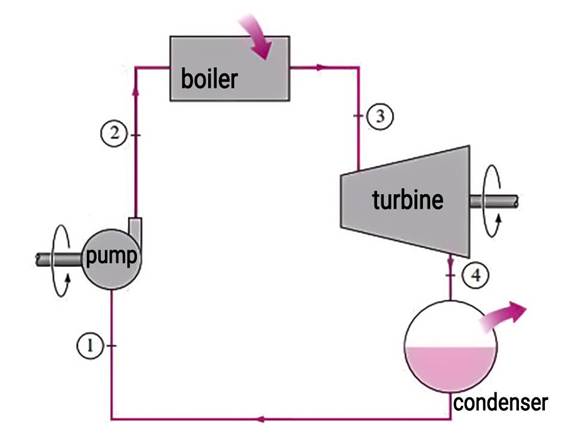
The condenser is a key component of the Rankine cycle in steam power plants. Its main function is to convert the steam leaving the turbine into liquid water (condensate) to re-enter the cycle. This process allows:
- Feedwater to be reused without waste.
- The outlet pressure from the turbine is lowered and the thermal efficiency of the system is significantly increased.
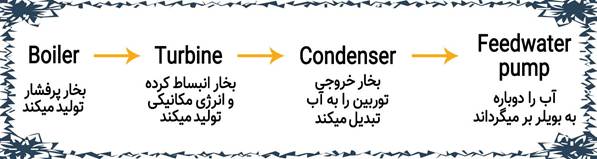
In the simple Rankine cycle, the flow is as follows:
Types of condensers in power plants
The choice of condenser type depends on factors such as water resources, climate, power plant capacity and environmental requirements. Below we will examine the most important types.
1. Surface condenser
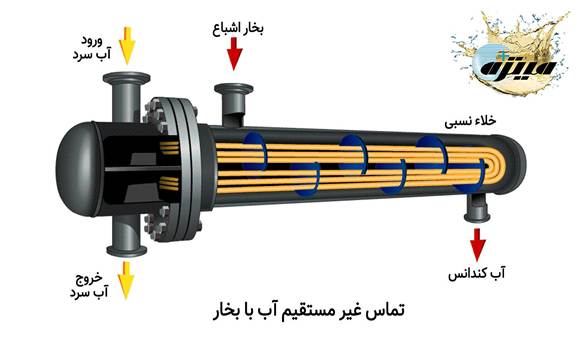
This type of condenser is the most widely used in large power plants. In it, steam and cooling water flow in two separate paths and exchange heat only through the surface of the tubes.
Tube material:
- Copper-nickel (suitable for seawater)
- Titanium (for highly corrosive environments)
- Duplex stainless steel or SS316 (balance between price and resistance)
Working pressure range: 0.04 to 0.1 bar absolute
Advantages:
- Maintaining the purity of condensate water
- High efficiency
- Possibility of using seawater without contaminating the cycle
Disadvantages:
- High initial cost
- Requires constant maintenance
2. Direct injection condenser (Jet or Mixing Condenser)
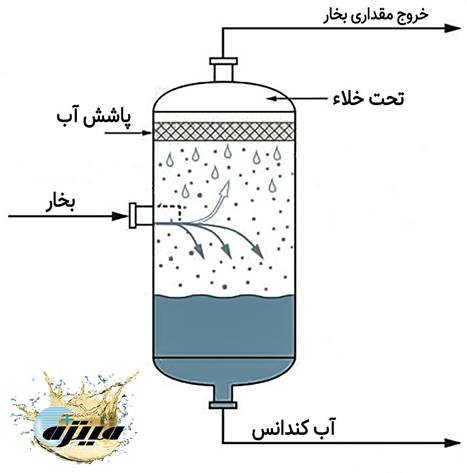
In this type, steam and cooling water are mixed directly with each other.
Application: Small power plants, temporary industrial units
Pressure range: 0.1 to 0.3 bar absolute
Advantages:
- Simple design
- Low cost
- Less space
Disadvantages:
- Reduced feed water quality
- Lower efficiency
3. Air-Cooled Condenser (ACC)
In areas with water shortages, air-cooled condensers are a good alternative.
Structure: Forced air flow finned tubes
Pressure range: 0.1 to 0.25 bar absolute
Advantages:
- Water saving
- Reduced thermal pollution
Disadvantages:
- Low efficiency in hot weather
- High installation cost
4. Hybrid and evaporative condensers
- Hybrid condenser:A combination of water and air cooling, suitable for variable climates.
- Evaporative condenser:Uses surface evaporation of water to cool the steam. It uses less water but requires scale control.
Condenser Cooling Systems
1. Once Through System
Water is taken directly from natural sources and discharged after use. This method is common in coastal power plants, but it creates thermal pollution.
2. Cooling Tower
Water circulates in a closed cycle and heat is transferred to the air in the cooling tower. This method is the most widely used method in inland power plants.
3. Air System (Dry Cooling)
In dry areas and areas without water resources, air systems are a suitable alternative to reduce water consumption.
Common Challenges in Condenser Operation
Condensers, if not maintained properly, can both reduce plant efficiency and increase operating costs. The most important problems include:
- Scaling: Prevents heat transfer in the pipes and reduces efficiency.
- Corrosion: Especially in systems that use seawater.
- Air leakage: causes reduced vacuum and loss of efficiency.
- Pipe leakage: leads to contamination of the feed water.
- Vacuum loss: sometimes caused by improper operation of the condensate drain pump.
Condenser maintenance and monitoring
To maintain optimal condenser performance, the following measures are necessary:
Periodic cleaning of the pipes:
- By mechanical methods (sponge balls)
- Or chemical (using appropriate scale removers and anti-corrosion agents)
Continuous monitoring:
- Condenser pressure and vacuum
- Outlet water temperature
- Electrical conductivity of the condensate (to detect leaks)
Laboratory tests:
- Examination of the type of scale
- Accurate selection of the chemistry of the required materials
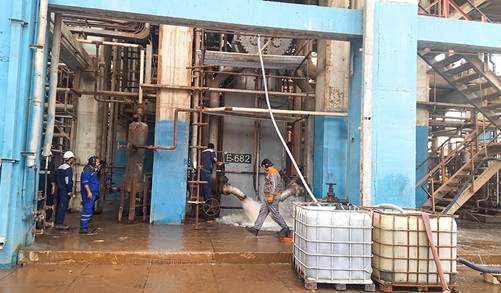
Abrizan's expert team is removing sediment
Key points in condenser selection and design
Criteria | Importance |
Local water resources | Determining the type of cooling system |
Climate | Choosing between ACC or cooling tower system |
Power plant capacity | Surface condenser for large units |
Environmental requirements | Reducing thermal pollution on the coasts |
Initial budget | Jet condenser for small projects |
Summary: What role does the condenser play in the future of power plants?
Today, with rising water prices and environmental pressures, power plants are increasingly looking to optimize their cooling systems and intelligent condenser maintenance.
Choosing the right condenser type, along with careful planning for cleaning, antifouling and anticorrosion, not only extends equipment life, but also dramatically improves overall system efficiency.
Given the complexity of operating conditions, consulting with laboratory experts to accurately identify the type of scale, select the right chemistry, and schedule cleaning can make a significant difference in costs and performance.
Bottom line:
If you operate in the power plant, desalination, or thermal equipment industry, proper condenser management can reduce your operating costs and increase system efficiency.
Targeted laboratory testing and expert advice can help you get started.
☎️Free call and consultation with Abrizan specialists☎️
Do you have any comments, questions or experiences about condensers? Share them with us and other readers in the comments section!
share :
MED Desalination Chemical Washing Steps — Implementation Guide
1404/12/02The three main enemies of cooling towers: scale, corrosion, biofouling
1404/11/29Can antifreeze also prevent the formation of deposits and corrosion?
1404/11/27What is a chiller and what are its types? A comprehensive guide to choosing the best cooling system
1404/11/20
Related Articles
Condenser and its types
Condenser: A unit for controlling temperature in refrigerators, air conditioning systems, and chillers. Its main function is as a heat exchanger in which it converts a substance (refrigerant) from a gas state to a liquid state, from where the latent heat is dissipated by the substance and transferred to the condenser coolant.
Submit your opinion
Your email address will not be published.