

MED Desalination Chemical Washing Steps — Implementation Guide
1404/12/02
The three main enemies of cooling towers: scale, corrosion, biofouling
1404/11/29
Can antifreeze also prevent the formation of deposits and corrosion?
1404/11/27
What is a chiller and what are its types? A comprehensive guide to choosing the best cooling system
1404/11/20
The process of desalination and its necessity

Lack of freshwater in the world: Why is seawater desalination necessary?
Due to the rapid increase in population and rapid growth in industrial and agricultural fields, clean water supply has become an essential need in modern life. Many countries are now suffering from freshwater shortages, and freshwater levels in many reserves are declining. In addition, the wastewater of factories and industrial power plants and wastewater of the large cities contaminate the remaining freshwater sources.
Figure 1 shows that only 0.5 % of the water is freshwater and 2 % of the glaciers and icebergs, while seawater accounts for 97 % of the water on the ground. Oceans and seas are the largest water reserves. However, because of the high salt concentration, they are not suitable for human use. Therefore, desalination has become an important technique for supplying freshwater in many countries, especially in the Middle East and North Africa, most of which are desert with abundant energy sources. It is estimated that more than 75 million people worldwide use seawater or saltwater for their needs.
According to global statistics released by the International Detribution Association (IDA), the number of saltwater desalination plants in 2004 reached 17348 units with a capacity of 37.75 million cubic meters per day of freshwater from 10350 units in 2002. The recent capacity of the global desalination plant is 40 million cubic meters per day and its average annual growth rate for the past 5 years was 12 percent.
Jebel Ali's desalination plant, in its second phase, a dual -purpose facility in the United Arab Emirates, is the largest desalination plant in the world and uses a capacity of 300 million cubic meters of water per year in multi -stage flash distillation (MSF). The largest US desalination facility, located in the Gulf of Tampa, Florida, began in 2007 with a capacity of 95,000 cubic meters per day.
In almost all of the world's brine sources, seawater makes up about 60 % and 40 % saline water. Since desalination is one of the most important processes for the production of drinking water that can be used for human consumption, irrigation and industry, in the past decades, much research has been done to minimize the cost of this process and various methods have been obtained. Among these methods, distillation is one of the best and most economical ways, especially for mass production of fresh water from high salt water such as seawater.
The principle of distillation in water depletion: How does saline become fresh water?
All distillation techniques are based on a similar principle. Water and soluble gases can evaporate during saline boiling, while minerals and salts are not easily evaporated at boiling temperatures above 300 degrees Celsius. Therefore, in all practical distillation methods, it is assumed that during boiling water, only pure water vapor and some soluble gases are removed while salts and minerals remain. As a result, during its condensation, only water vapor becomes pure and clean distilled water. There have been several distillation methods for water desalination technology that vary in simplicity, cost and application.
Traditional water distillation: Simple but costly - why is energy consumption high?
Traditional distillation is the simplest way to distillate saltwater, but at the same time it is the most expensive in terms of energy consumption. This water distillation method is commonly used in chemistry laboratories as well as home applications. The principles of this method are shown in Figure 1.
In this method, salt water in the boiling flask is heated by a heat source (electric heater, natural stove, oil stove, solar panel or any other heat source) to begin boiling and evaporated. The water vapor goes to the condensation unit, which is cooled by separate cooling water. Therefore, water vapor loses some of its hidden heat and changes from gas (pure distilled water) from the gas (pure distilled water). The droplets of the water are combined and move to the collection flask. This method requires a great deal of energy to evaporate saline due to the high heat of water evaporation, which is about 2257 kg / kg at 100 ° C. As a result, the traditional distillation method is only suitable for salt depletion.

Figure(1)
Types of water used for saltwashing
The types of water used for desalination are mainly seawater and saltwater.
Seawater seawater
The water that is to be reduced can be obtained from or below the sea level. The more effective way to use filters to minimize the necessary pre -water levels before the water reaches the primary purification systems. The methods of dewatering from the surface include intrusion galleries, vertical coastal wells and radial wells.
Brackish Water Salt Water
Salt water is significantly lower than saline seawater and is usually found in groundwater aquifers that are groundwater reserves or the lower routes that are the river reaching the sea.
Seawater
Heat distillation is one of the best methods of seawater and saltwater treatment to turn them into drinking water. The most common thermal desalination processes are:
- Multi-Stage Flash Distillation Sudden Distillation
- Multiple-Effect Distillation (Multiple-Effect)
- Vapor-compression evaporation evaporation
Multicolor
In a sudden multi -stage distillation, saline water passes through several chambers where it is heated and compressed at high temperatures and pressure. By moving water through the chambers, the pressure decreases. As a result, saline boils and forms fresh water vapor that is dense and collected.
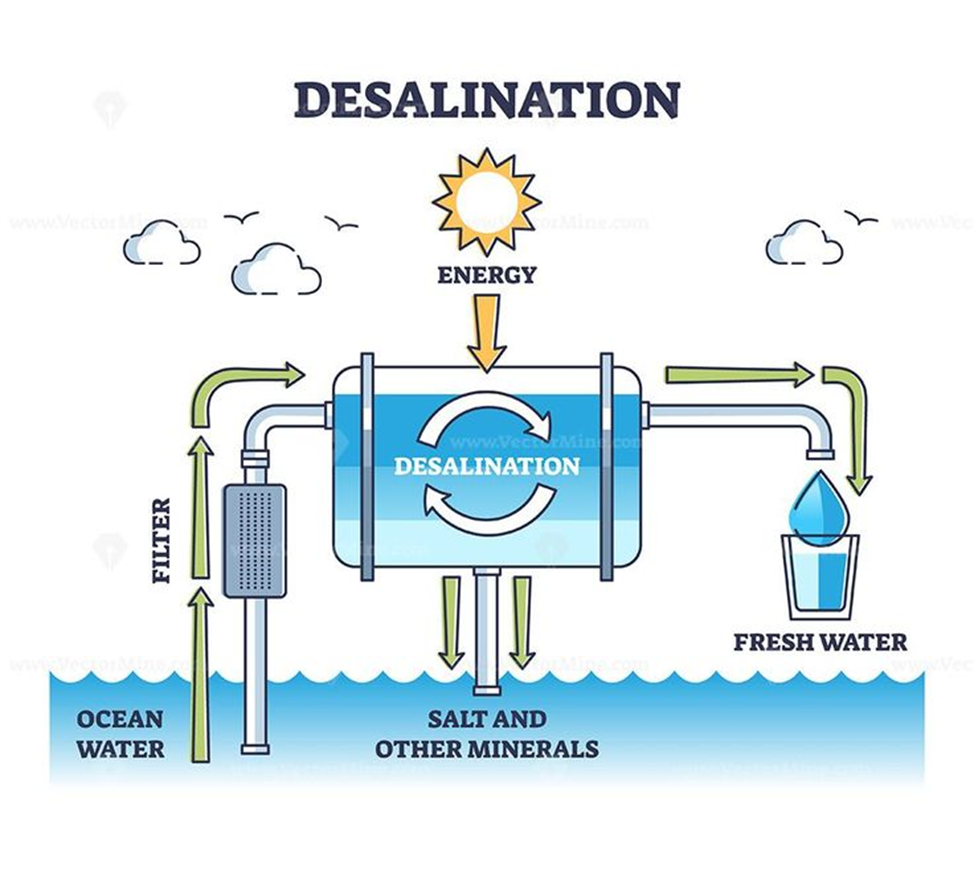
Multistage Distillation
Multistage distillation uses the same process as multistage flash distillation. The main difference is that instead of using multiple chambers in a single tank, this process uses tanks in series. Multiple tanks make the process more efficient.
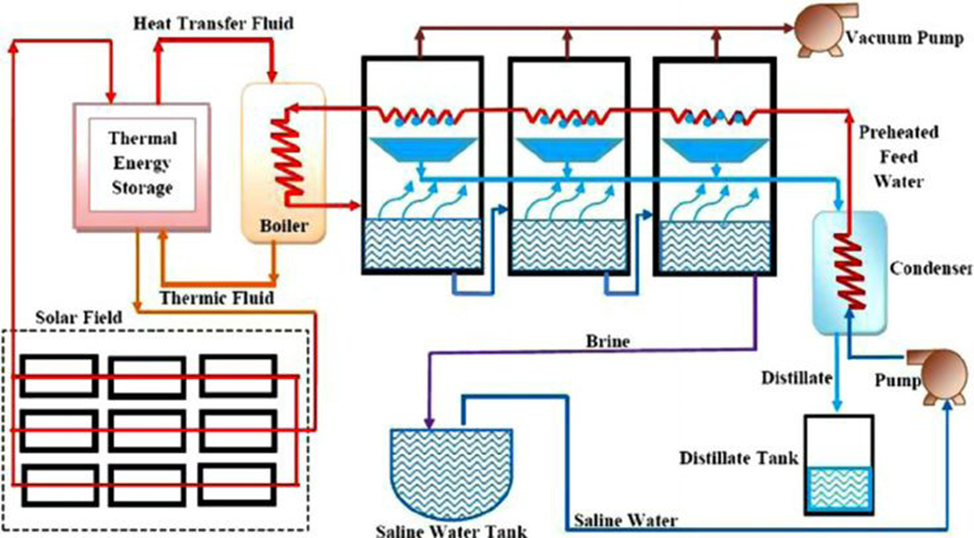
Solar-powered multi-stage desalination plant
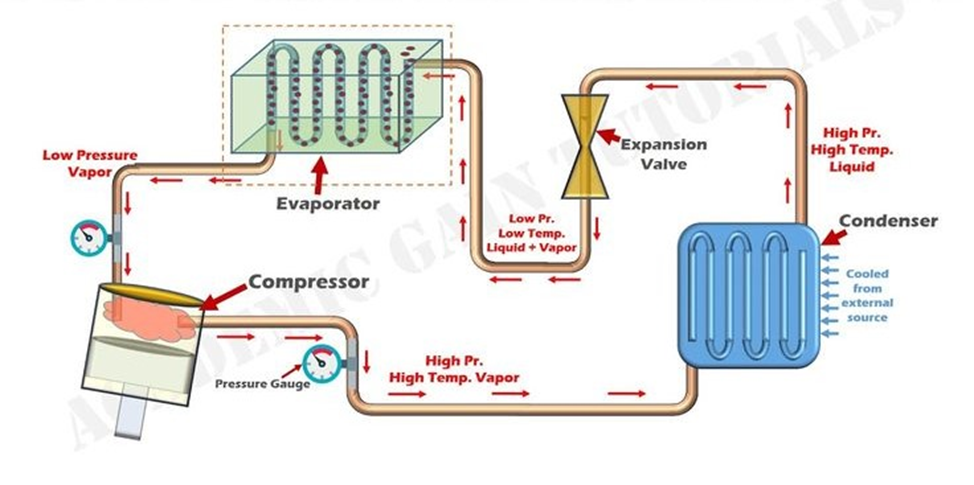
Vapor Compression Distillation
Vapor compression distillation uses the heat of vapor compression to evaporate feed water. It can be used independently or in combination with another process for thermal distillation. These units are typically used for small to medium-sized purposes such as resorts, industries, and oil drilling sites. (Water vapor and its characteristics)
Electrodialysis
This is another method used to desalinate large volumes of water, using membranes that only allow the passage of negatively or positively charged ions at a time. The four common ionic molecules in salt water are calcium, sodium, chloride, and carbonate. The driving force is an electrical potential that attracts and moves cations and anions through a permeable membrane, producing fresh water on the other side. (Electrodialysis Water Purification)
Reverse Osmosis
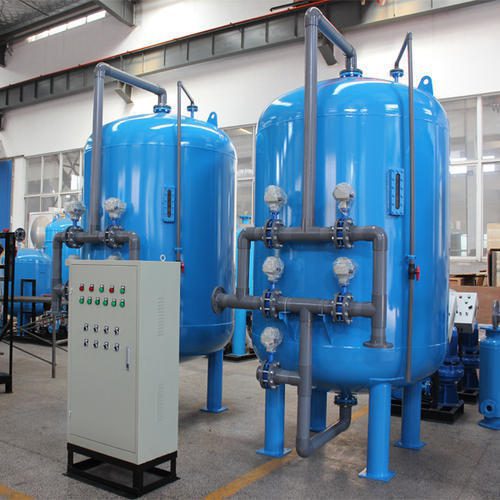
Reverse osmosis is a type of water purification that uses a pressure gradient to push saltwater at high pressure through a membrane that filters out chlorine, salt, and contaminants. The membrane used will have different pore sizes depending on the process, and the process can be microfiltration, nanofiltration, ultrafiltration, or reverse osmosis. Because the reverse osmosis membrane has micropores, it is necessary to pre-treat the incoming water both biologically and physically to prevent scaling and remove suspended solids. (Reverse Osmosis and Natural Osmosis)
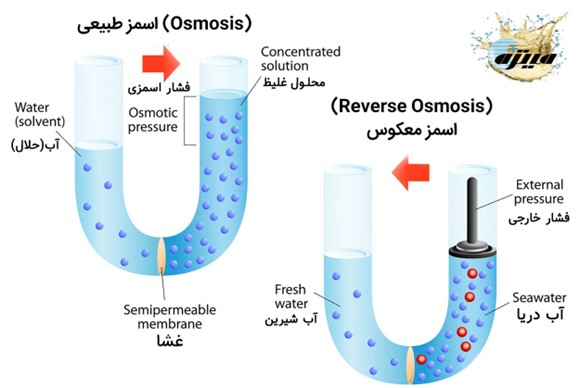
Reverse osmosis and natural osmosis
share :
MED Desalination Chemical Washing Steps — Implementation Guide
1404/12/02The three main enemies of cooling towers: scale, corrosion, biofouling
1404/11/29Can antifreeze also prevent the formation of deposits and corrosion?
1404/11/27What is a chiller and what are its types? A comprehensive guide to choosing the best cooling system
1404/11/20
Related Articles
MED Desalination Chemical Washing Steps — Implementation Guide
A step-by-step guide to chemical flushing of MED desalination plants: from scale detection to safe and effective implementation. Preventing corrosion and increasing efficiency
International standards for maintaining and cleaning desalination plants
Do you know what international standards are required for the maintenance and cleaning of desalination plants? A complete guide to extending the life of equipment and preventing sedimentation.
Water Turbidity Measurement: A Comprehensive Guide for Industry and Drinking Water
What is water turbidity? Why is it vital to measure it? Read about measurement methods, standards, and ways to reduce turbidity in this complete guide.
Types of deposits and corrosion in MED desalination water
Types of deposits and corrosion in MED desalination plants — calcium carbonate, sulfate, silica, magnesium hydroxide, subsedimentary corrosion. Accurate detection methods with XRD, SEM, ICP. Specialized solutions for water treatment plants with (Mitreh brand).
Why is it important to control sedimentation and corrosion in desalination devices؟
Why is scale and corrosion control vital in desalination plants? A technical and economic analysis of the impact of scale and corrosion on equipment performance, cost, and life. Warning signs and preventive measures. Suitable for engineers and industrial managers

Comparison of RO, MED, MSF desalination water in terms of cost, energy consumption, chemical requirement of the industry
Detailed comparison of RO, MED, MSF in terms of cost, energy consumption and chemical requirements. Technical analysis, comparison table and decision-making guide. MED with recycled heat is cheaper than RO! Suitable for engineers and industrial managers
MVC desalination plant (Mechanical vapor compression)
MVC (Mechanical Vapor Compression) Desalination — Comprehensive Guide to Application, Advantages, Disadvantages and Chemical Solutions by Abrizan Company (Mitreh Brand). Evaporator Chemical Washing, Thermal Anti-Fouling, Laboratory Consulting. Increase Efficiency — Reduce Energy Costs
EDI desalination plant (Electrodialysis)
EDI (Electrodialysis) Desalination — A Comprehensive Guide to Technology, Applications, Advantages and Disadvantages. Ultrapure Water Production Without Regeneration Chemicals. Applications in Pharmaceutical, Semiconductor and Power Plants. Pretreatment Requirements and Technical Challenges
Submit your opinion
Your email address will not be published.