

Why do industrial systems require anti-freeze/coolant in the summer?
1405/03/02
Cooling Tower Chemical Cleaning Steps — Implementation Guide
1405/02/07
Types of sediments in RO systems and methods for identifying them
1405/02/05
Benefits of using specialized solutions from Abrizan Company for MED
1404/12/09
What is reverse osmosis and natural osmosis?

Reverse Osmosis Process
The reverse osmosis process is one of the most widespread separation methods, which has various applications. Desalination of seawater, separation of organic and toxic substances from industrial wastewater are two important uses of this technology. Reverse osmosis is one of the main methods of desalination of water, along with methods such as distillation, electrodialysis, deionization, etc., which is used on laboratory, urban and industrial scales.
The history of the use of the reverse osmosis method dates back to the 1950s, when experiments were conducted by Reed and Burton at the University of Florida, USA, and the first reverse osmosis membrane was made of cellulose acetate, and in the late 1960s this phenomenon was used commercially.
Theoretical principles of reverse osmosis
Understanding the phenomenon of reverse osmosis requires identifying the osmotic property. In general, mass transfer from one environment to another occurs due to a difference in concentration, or better said, due to a difference in chemical potential.
How Reverse Osmosis Works
For example, consider a container of water into which a piece of table salt crystal is dropped. In the part of the container where the salt crystal is present, the salt concentration is high and the water concentration is negligible, and in the other part of the container, the salt concentration is zero and the water concentration is very high. Due to the difference in concentration, the salt crystal molecules begin to penetrate into the other part, which is water, and on the other hand, the water molecules also penetrate into the part rich in salt. This process continues until the concentrations of water and salt in the two parts are equal. Because after that, the driving force, which is the concentration difference, does not exist between the two environments and, in other words, a state of equilibrium has been established.
What is reverse osmosis?
The property of osmosis is the passage of a solvent from the dilute solution part to the concentrated solution part through a semi-permeable membrane. To explain this property, consider the following two figures (normal osmosis and reverse osmosis) which represent two parts and a membrane. Water or a dilute salt solution in one part, a concentrated salt solution in the other, and a membrane that only allows water molecules to pass through. The membrane prevents the ions that make up the salt from passing through because they are too large.
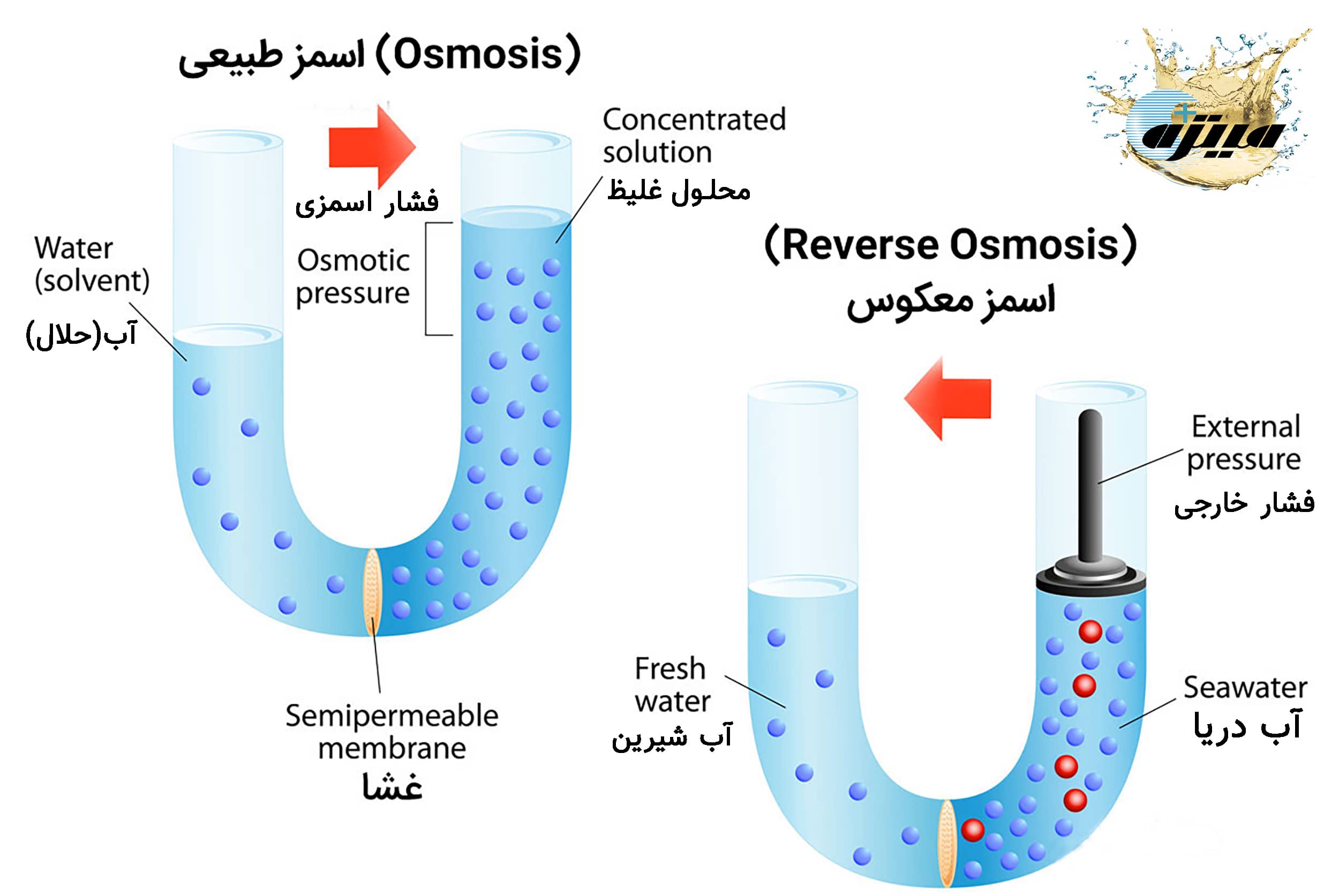
Initially, the liquid levels in the two compartments are equal. Due to the tendency to equalize the concentrations in the two compartments, water molecules from the dilute solution pass through the membrane and penetrate into the concentrated solution. The liquid level in the concentrated compartment increases (natural osmosis). The flow of water molecules through the membrane occurs until the difference in liquid level (in other words, the pressure difference) in the two compartments prevents the movement of water molecules. The pressure difference in the compartment separated by the membrane, where it prevents the net flow of water molecules, is called osmotic pressure.
Osmotic pressure causes equilibrium in the two compartments. Now, if a pressure greater than the osmotic pressure is applied to the concentrated solution compartment, the opposite of the osmotic phenomenon occurs (reverse osmosis), in other words, water molecules flow from the more concentrated solution compartment to the more dilute solution compartment. This phenomenon is called reverse osmosis.
What is osmotic pressure?
The pressure difference in the compartment separated by the membrane, where it prevents the net flow of water molecules, is called osmotic pressure.
Reverse Osmosis Application
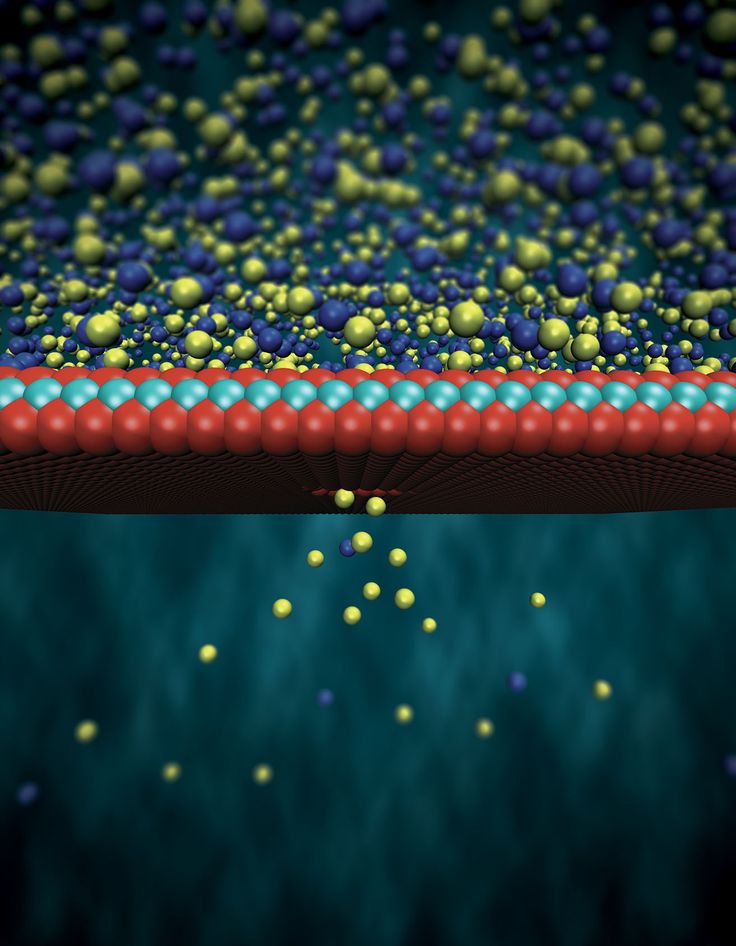
The phenomenon of reverse osmosis is used for water purification and, more generally, for the process of concentration and separation. Osmotic pressure is directly proportional to the concentration of salts in the solution. For example, in an aqueous solution of table salt, increasing the concentration by one milligram per liter increases the osmotic pressure by 0.01 Psi. Note that as water molecules pass through the membrane, the concentration of ions in the solution behind the membrane gradually increases, and as a result, the osmotic pressure also increases. Also, as water passes over the membrane surface, colloidal particles, sediments, microbial contaminants, and dissolved salts in the water cause clogging, which requires periodic cleaning of the reverse osmosis membrane (CIP). To remove these contaminants, you can use specialized membrane cleaning solutions produced by Abrizan Company.
share :
Why do industrial systems require anti-freeze/coolant in the summer?
1405/03/02Cooling Tower Chemical Cleaning Steps — Implementation Guide
1405/02/07Types of sediments in RO systems and methods for identifying them
1405/02/05Benefits of using specialized solutions from Abrizan Company for MED
1404/12/09
Related articles
Membrane processes
Membrane processes refer to physical methods for separating a solvent from its dissolved salts using semipermeable membranes. These processes have made great progress in recent years. The history of using membranes for filtration dates back to the early 20th century.
Cation and anion resins (ion exchange)
The process of ion exchange has been used since ancient times. Eratosthenes Thallis used this process to contact salt water with soil to produce fresh water. In 1845, Thomson showed that when water containing ammonium sulfate was passed through soil, calcium sulfate would be produced in the effluent.
Sedimentation water softening processes
Softening processes are used to reduce water hardness. Using chemicals, water hardness undergoes chemical reactions and precipitates. As a result, water hardness is reduced. Water hardness is due to the presence of carbonates, sulfates, chlorides, and nitrates of the metals calcium, magnesium, iron, and aluminum.
Types of water transfer systems
Water transmission systems include the channels necessary to transport water from one point to another. In most cases, it is necessary to transport water from its source to a treatment facility and from there to consumers. Pumping is used to provide the energy necessary to move the water from the beginning to the end of the transmission system. Pumping stations are usually located at the raw water intake, treatment plant and distribution network.
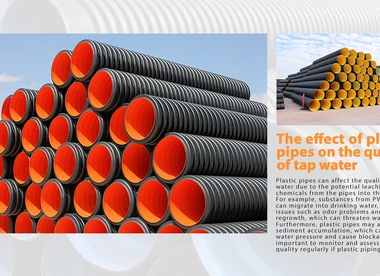
The effect of plastic pipes on the quality of tap water
The impact of plastic pipes on water quality in household plumbing and water distribution systems causes leakage of metals such as lead into drinking water. Lead, as the most widespread heavy and toxic element in the environment, is naturally present in river water at a level of 1 to 10 micrograms per liter. Lead compounds enter water sources as a result of mining, battery manufacturing, fossil fuel, paint, and glass and enamel industries.
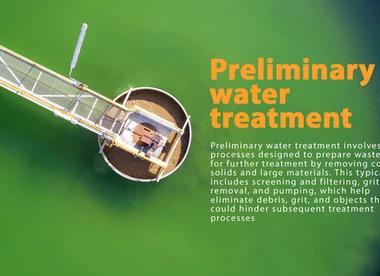
Preliminary water treatment for optimal use of membrane in reverse osmosis
Preliminary treatment is performed to optimize the use of membranes and increase membrane operating time. During this operation, water is prepared to pass through the membrane.

Earth's water reserves
Water is the source of life and the continuation of life for living organisms, as well as a fundamental factor in the emergence of human communities and civilizations. Today, the total volume of the Earth's water, which is the source of life for all organisms, has remained almost constant and unchanging since its formation. These water resources were created about 4.5 billion years ago.
Impurities in water
Pure water does not exist in nature due to its high solubility and contains various impurities. Water impurities are classified into three general categories: dissolved solids, suspended and colloidal solids, and gases.
Submit your opinion
Your email address will not be published.