

MED Desalination Chemical Washing Steps — Implementation Guide
1404/12/02
The three main enemies of cooling towers: scale, corrosion, biofouling
1404/11/29
Can antifreeze also prevent the formation of deposits and corrosion?
1404/11/27
What is a chiller and what are its types? A comprehensive guide to choosing the best cooling system
1404/11/20
Types of deposits and corrosion in heat exchangers and identification methods

Why is your heat exchanger still losing efficiency despite maintenance?
In the water, oil and gas industries, heat exchangers are the backbone of heating and cooling systems. But even with regular maintenance programs, many engineers are faced with sudden drops in efficiency, increased energy consumption or unexpected failures. The root cause of these problems is often unknown scaling and corrosion. Correctly identifying the type of scaling or corrosion, whether calcium carbonate, barium sulfate, silica, iron oxide or microbial corrosion (MIC), is the first step in choosing an effective solution. In this article, we review the common types of scaling and corrosion in heat exchangers and explain in simple and practical language the precise methods for their identification (including XRD and SEM analysis).
⚡⚡⚡ Common Types of Scaling in Heat Exchangers ⚡⚡⚡
1. Calcium Carbonate (CaCO₃) Scaling
Cause of Formation:
Calcium carbonate is formed when water hardness caused by calcium and bicarbonate ions at high temperatures is converted into an insoluble scale. This deposit occurs most often at temperatures above 60 ° C and pH above 8.5.
Appearance:
- White or light gray
- Hard and brittle
- Usually deposits on hot surfaces (such as exchanger tube walls)
Effect on performance:
Calcium carbonate layers are strong thermal insulators and even 0.5 mm of deposit can reduce thermal efficiency by up to 10%.
Note: Calcium carbonate is the most common type of deposit in hot water systems and can usually be managed by controlling pH and using polymeric anti-scalants.
2. Sulfate deposit (CaSO₄, BaSO₄, SrSO₄)
Cause of formation:
Unlike calcium carbonate, sulfates become less soluble with increasing temperature (reverse behavior). In systems with seawater or industrial wastewater, barium or strontium sulfate can also form.
Appearance:
- White or colorless
- Very hard and resistant to mild acids
- Difficult to identify without a laboratory
Deterrence challenge:
Regular hydrochloric acid cannot dissolve sulfates. Requires specialized detergents or fortified acid formulations.
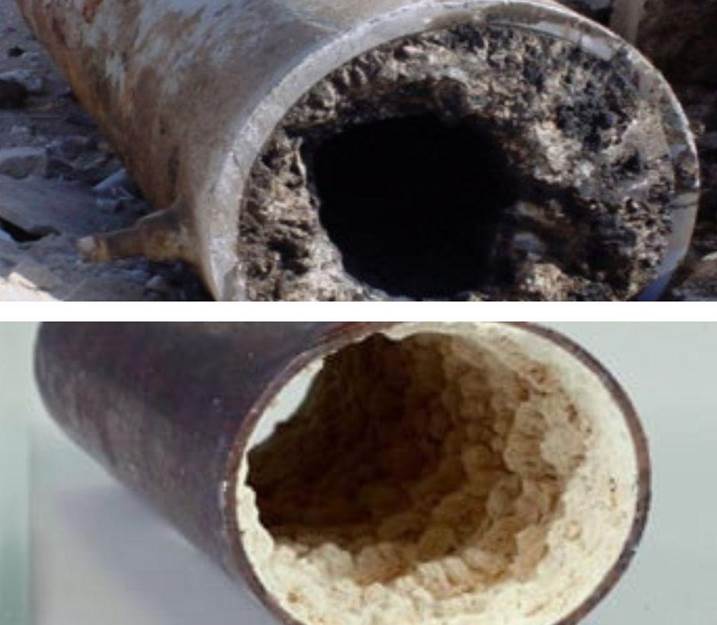
Calcium carbonate and sulfate precipitation
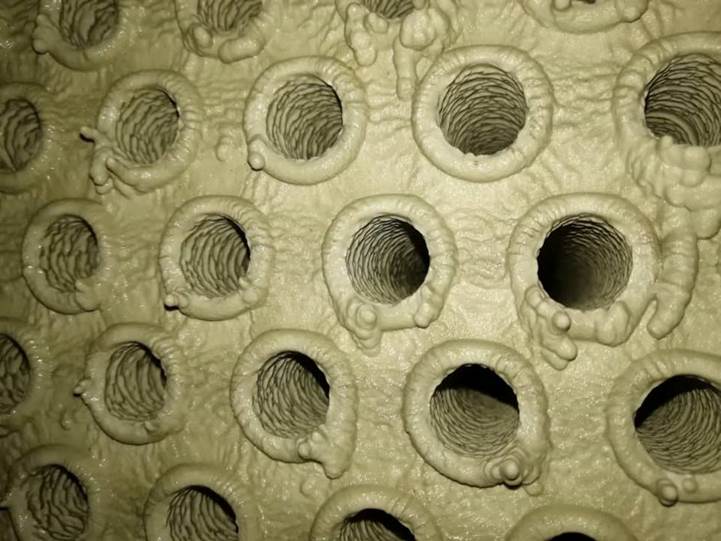
Deposits in the heat exchanger
3. Silica (SiO₂) scale
Cause:
Origins from waters with a high silica content (such as groundwater or geothermal effluents). At high pH and temperatures above 100°C, silica forms a gel or glass-like layer.
Appearance:
- Transparent or opaque
- Very sticky and hard
- Usually combined with other scales (e.g. iron oxide)
Important warning:
Silica is one of the most difficult scales to wash off and requires hydrofluoric acids or strong alkaline detergents — which must be applied with great care to avoid damaging the metal.
⚡⚡⚡ Types of corrosion in heat exchangers ⚡⚡⚡
1. Iron Oxide Corrosion
Cause:
In combination with the presence of dissolved oxygen in the water and low pH. Iron oxide (Fe₃O₄ or Fe₂O₃) usually appears as “red sludge”.
Symptoms:
- Red to brown discoloration of water lines
- Reduced pipe wall thickness
- Clogging due to fine iron oxide particles
Solution:
Use oxygen scavengers and adjust pH to prevent carbonic acid formation.
2. Galvanic Corrosion
When does it occur?
When two metals with different electrochemical potentials (e.g. copper and steel) are brought into electrical contact in the presence of an electrolyte (water).
Vulnerable locations:
- Connections between copper and steel pipes
- Aluminum flanges or caps on steel bodies
Prevention:
Use dielectric insulators (e.g. plastic gaskets) between dissimilar metals.
3. Microbiologically Influenced Corrosion (MIC)
Why is it dangerous?
Sulfate-reducing bacteria (SRB), acid-producing bacteria (APB), and microbial biofilms can quickly cause pipe perforation, even in systems with proper antifouling.
Warning signs:
- Foul odor (hydrogen sulfide)
- Black or green stains on interior surfaces
- Pitting beneath biofilm layers
Diagnosis:
Water tests for bacterial colony count (MPN Test) and use of oxidizing or non-oxidizing biocides.
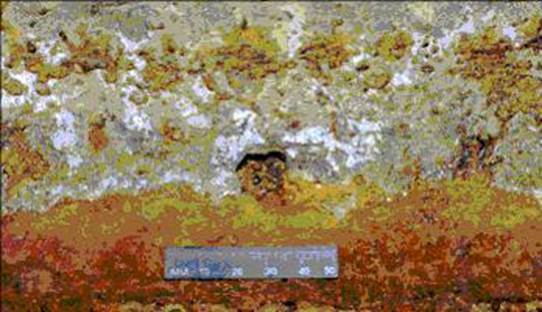
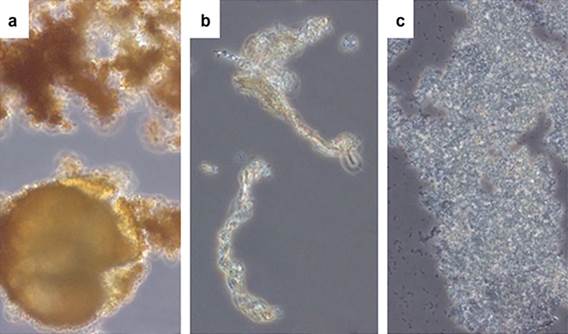
Microscopic image of microbial corrosion
What methods are there to accurately identify the type of deposit or corrosion?
1. Visual inspection and simple field test
Test with 10% hydrochloric acid:
- If the deposit foams with carbon dioxide gas, it is probably calcium carbonate.
- If it remains unreacted, it may be sulfate or silica.
Magnetometry:
- To detect the presence of iron oxide (ferromagnetic materials).
Limitations: These methods are approximate and cannot accurately identify complex or mixed compounds.
2. XRD (X-ray Diffraction) Analysis
How does it work?
XRD identifies the crystal structure of solids based on the X-ray diffraction pattern.
Advantages:
- Accurate identification of mineral phases (e.g., distinguishing CaCO₃ from CaSO₄ )
- Determine the percentage of each component in a mixed deposit
Application:
To design a targeted detergent formulation — for example, if the deposit is 60% silica and 40% iron oxide, the detergent should be both acidic and fluoride-containing.
3. SEM-EDS (Scanning Electron Microscopy with Energy-Dispersive X-ray Spectroscopy) Analysis
What information does it provide?
- High-resolution image of the deposit or corrosion surface
- Elemental composition (percentage of Ca, Si, Fe, S, etc.)
Why is it useful for MIC?
SEM can show the structure of biofilm and pitting corrosion pores, while EDS confirms the presence of sulfur (SRB indicator).
Note: XRD and SEM analyses are only useful for the detailed work of identifying complex deposits and are the basis for effective chemical cleaning programs.
How to prevent scale formation and corrosion in heat exchangers?
1. Continuous water quality monitoring
- Control hardness, pH, sulfate, silica, dissolved oxygen and TDS
- Use online sensors for early warning
2. Proper system design
- Avoid dead legs
- Choose homogeneous materials to prevent galvanic corrosion
- Proper insulation to reduce temperature gradients
3. Preventive flushing schedule
- Annual acid flushing for hard water systems
- Use polyacrylic or phosphonate anti-scalers to inhibit crystal growth
- Periodic injection of non-oxidizing biocides in systems with MIC risk
Common question: Are anti-scalers always effective?
Answer:No. Anti-scalers only prevent scale formation, not remove existing scale. Also, the choice of anti-scale type should be based on the predominant scale type. Improper use can have the opposite effect.
When should we perform chemical flushing?
The following signs indicate an urgent need for cleaning:
- A 10% or more increase in pressure drop between the inlet and outlet
- A 5% or more decrease in thermal efficiency
- Increase in fuel or electricity consumption without a change in system load
- Localized leaks or corrosion on borescope inspections
Technical note: Chemical cleaning without first identifying the type of scale is like prescribing antibiotics without a blood test—it may be useless or destructive.
Conclusion and next steps
Scaling and corrosion in heat exchangers are not just a “maintenance problem”; they are an engineering decision that requires careful identification, targeted planning, and professional execution. Using analytical methods such as XRD and SEM not only reduces operating costs but also extends the life of the equipment by several years.
If your heat exchanger is experiencing reduced efficiency or frequent leaks, the first step is to collect a scale sample and send it to a specialized laboratory. Only by accurately identifying the enemy can you design an effective solution.
If you need expert advice to identify the type of sediment or the optimal selection of chemicals, Abrizan specialists, with over 20 years of experience in advanced laboratories, are ready to provide customized solutions to various industries.
share :
MED Desalination Chemical Washing Steps — Implementation Guide
1404/12/02The three main enemies of cooling towers: scale, corrosion, biofouling
1404/11/29Can antifreeze also prevent the formation of deposits and corrosion?
1404/11/27What is a chiller and what are its types? A comprehensive guide to choosing the best cooling system
1404/11/20
Related Articles
Chemical vs. Mechanical Washing in MED: Which Method is Better?
Which method is better for cleaning MED devices? Technical comparison, cost and risk of chemical vs. mechanical cleaning.
When is the best time to thermal desalination plant washing?
Signs of need for thermal desalination plant flushing (MED/MSF) + Data-based decision-making guide.

Common challenges in desalination plant maintenance and practical solutions
6 key challenges in power plant desalination plant maintenance + practical solutions to prevent power generation outages.
Step-by-step guide to chemical boiler cleaning — professional and safe execution
Step-by-step guide to chemical boiler cleaning in compliance with ASME standards, from system shutdown to final passivation. Safe and effective execution.
Warning signs that indicate the need for chemical cleaning of the heat exchanger
Has your heat exchanger lost its efficiency? 5 warning signs (increasing temperature, decreasing ΔT, high pressure, leakage, bad smell) + quick diagnosis checklist.
Comparison of boiler cleaning methods — chemical, mechanical or hydrojet
Which boiler cleaning method is best for you? A complete comparison of chemical, mechanical, and hydrojet methods in terms of cost, safety, time, and efficiency.
Signs of Needing Chemical Backwashing of RO Water Desalination — How to Know if an RO System is "Breathing"?
Is your RO system experiencing reduced water production, increased pressure, or reduced water quality? In this comprehensive article, we explore the 10 warning signs that your RO needs chemical flushing, with technical details, industry statistics, and practical guidance. Free consultation + free sediment sample analysis from your sink.
Signs of Need for Chemical Flushing of MED Water Desalination Plant - A Comprehensive Guide to Diagnosis, Analysis and Immediate Action
Signs of the need for chemical cleaning of MED water softeners — increased steam consumption, reduced water production, leaks, increased temperature. Guide to identifying the type of scale and specialized cleaning solutions by Abrizan (Mitreh brand).
Submit your opinion
Your email address will not be published.