

Why do industrial systems require anti-freeze/coolant in the summer?
1405/03/02
Cooling Tower Chemical Cleaning Steps — Implementation Guide
1405/02/07
Types of sediments in RO systems and methods for identifying them
1405/02/05
Benefits of using specialized solutions from Abrizan Company for MED
1404/12/09
Signs of Needing Chemical Backwashing of RO Water Desalination — How to Know if an RO System is "Breathing"?

Table of Contents
1.Introduction:Why is it important to identify the need for RO flushing early?
2. Key signs that your RO system needs chemical flushing
3.Quick Checklist: Does your RO system need flushing?
4. Industry Statistics: What Happens If You Delay Flushing?
5. The Difference Between “Natural Performance Decline” and “Urgent Need for Flushing”
6. How to Identify the Type of Sediment by Symptoms?
7.Expert Solutions: From Diagnosis to Implementation
8. Frequently Asked Questions (FAQ)
9. Request a Free Consultation — Free Sediment Sample Analysis
Introduction: Why is it important to identify the need for RO flushing early?
Reverse osmosis (RO) systems are some of the most sensitive and expensive equipment in the freshwater production line. RO membranes act as the “lungs of the system,” but if they become clogged, the system begins to “breathe.”
The Hard Truth:
Some industries don’t think about chemical backwashing until the system is completely down. While every day of delay increases operating costs and reduces membrane life.
In this article, we will review the 10 key signs that RO chemical backwashing is needed, not just theoretically, but with real data, comparison tables, and practical guidance so you can make an informed decision.
Key Signs of a System Needing Chemical Backwashing
1. 15% or More Decrease in Freshwater Production (Permeate Flow)
- Cause: Membrane fouling or fouling → Decrease in water flux
- Industry Standard: According to ASTM D4516, a decrease of more than 15% from the initial performance indicates the need for backwashing.
- Note: This decrease should be checked after temperature compensation (Temperature Normalization).
Temperature normalization formula:
Q₂= Q₁ ×[1 + 0.03×(T₁-T₂)]
→ (Q = fresh water flow rate, T = inlet water temperature)
2. Increased inlet pressure to RO modules
- Cause: Increased flow resistance due to membrane clogging
- Warning threshold: 10-15% increase in inlet pressure compared to the initial state
- Danger: Increased pump energy consumption + risk of mechanical damage to membranes
3. Decreased outlet water quality (increased TDS)
- Cause: Damage to the active membrane layer or the presence of small holes in the membrane
- Warning threshold: 10-15% increase in fresh water TDS
- Note: This symptom usually appears later than other symptoms, meaning that significant damage has occurred.
4. Increased frequency of pre-treatment filter replacements
- Cause: Increased contamination load in the inlet line → A sign of a change in raw water quality
- Hidden message: The pre-treatment system can no longer protect the RO membranes.
5. Unpleasant odor or discoloration of the outlet water
- Cause: Microbial growth (biofouling) on the surface of the membranes
- Danger: Biofilm production → Permanent reduction in efficiency + health risk (in the food and pharmaceutical industries)
6. Increased pressure difference (ΔP) between the inlet and outlet of the module
- Cause: Clogging of the primary layers of the module
- Alarm threshold: 15% increase in ΔP compared to the initial state
- Note: This indicator is the most sensitive indicator for detecting physical clogging.
7. Abnormal fluctuations in pressure or flow rate
- Cause: Formation of sediment or biofilm flocs in the flow path
- Danger: Erosion of membranes due to pressure shocks
8. Increased consumption of antiscalant chemicals
- Cause: Decreased antiscalant effectiveness due to changes in raw water composition
- Hidden message: The current antiscalant formula is no longer suitable.
9. Abnormal heating of the module housing
- Cause: Increased flow friction → A sign of severe fouling
- Danger: Thermal damage to membranes (especially at temperatures above 45 °C)
10. Control system (SCADA/PLC) reports about "decreased efficiency"
- Cause: Automatic calculation of system efficiency based on real data
- Note: These systems usually warn 30-60 days before a complete shutdown, but many operators do not pay attention to them!
Quick Checklist: Does your RO system need a flush?
✅ Has the fresh water flow rate decreased by 15% or more?
✅ Has the inlet pressure increased by 10% or more?
✅ Has the outlet TDS increased by 10% or more?
✅ Has the differential pressure (ΔP) increased by 15% or more?
✅ Are pre-filters being replaced more than twice as often?
✅ Is there an unpleasant odor or unusual color in the outlet water?
If you answered “yes” to 3 or more questions → Your RO system needs a chemical flush immediately.
Industry Stats: What Happens If You Delay Flushing?
Index | No wash (12 months) | With periodic cleaning (every 6 months) |
Membrane life | 18 months | 36 months |
Energy consumption | +22% | Stable |
Membrane replacement cost | 100% | 40% |
Production stoppage | 3 times/year | 0.5 times/year |
Case Study: 50 Industrial RO Systems in Iran
Conclusion:
Timely flushing reduces long-term costs by 60%, even if we consider the initial flushing cost.
The difference between "natural performance decline" and "urgent need for flushing"
All RO systems have a natural decline in efficiency over time, but this decline is gradual and predictable.
Natural decline:
- 1-2% decline per year
- Without change in pressure or TDS
- Can be compensated for with regular maintenance
Urgent need for flushing:
- Sudden or accelerated decline
- With change in pressure, TDS or ΔP
- Sign of severe fouling or fouling
Key point for water purifiers:
If the decline in performance is more than 5% in less than 3 months, this is no longer "natural" but an urgent need for flushing.
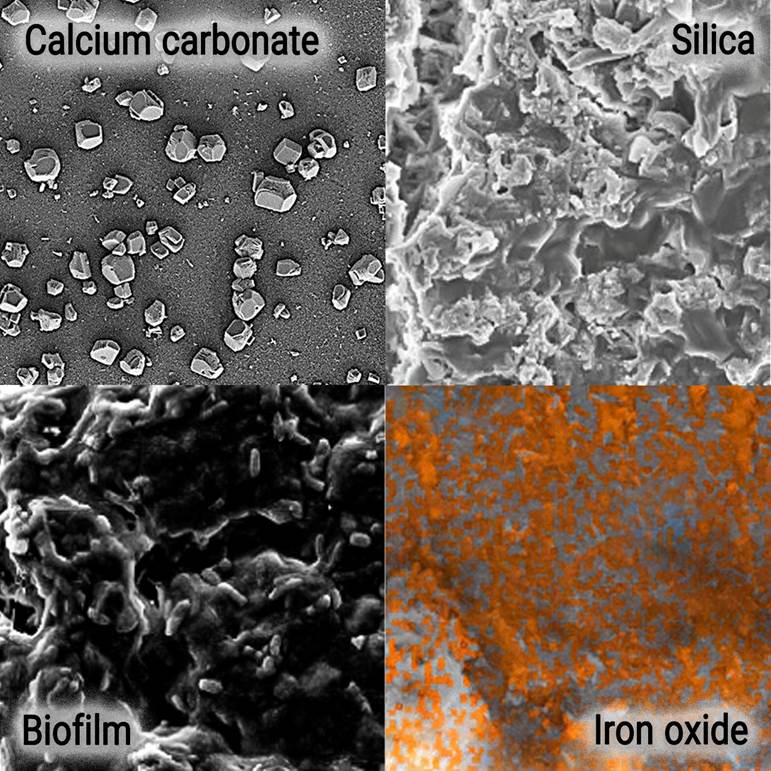
How to identify the type of fouling from the symptoms?
Sediment type | Dominant sign | Place of formation | Sediment color |
Calcium carbonate | Decrease flow rate + increase pressure | Initial layers of the module | White |
Calcium sulfate | Decrease in flow rate + increase in ΔP | Initial layers | White/Gray |
Iron oxide | Increased TDS + red color of water | All layers | Red/Orange |
Silica | Severe flow reduction + high resistance | End layers | White/Glass |
Biofouling | Bad smell + reduced flow rate | Membrane surface | Sludge/green |
Abrizan Solution:
Sediment sample submission → XRD/SEM analysis → Accurate sediment type identification → Production of a proprietary solution
Abrizan Specialized Solutions: From Diagnosis to Implementation
Abrizan Industrial Research Company, relying on a specialized laboratory and a professional executive team, offers comprehensive solutions:
1. Free sediment sample analysis
- Send a sample of RO membrane or effluent water
- XRD/SEM analysis in our laboratory
- Specialized report including sediment type and element concentration
2. Production of specialized washing solution
- Acidic and alkaline membrane cleaning solutions based on mineral compounds
- Acidic and alkaline membrane cleaning solutions based on organic compounds
- Special membrane detergent solutions to remove microbial contaminants, biofilms and other organic materials
3. Professional executive services
- On-site washing by technical teams throughout Iran
- Monitoring of post-washing performance
- Training of the operator team for periodic maintenance
Special offer:
Send us your first sediment sample — receive analysis + report + specialized solution for free!
Frequently Asked Questions
Can I wash with citric acid?
Citric acid is only suitable for light carbonate deposits and is completely ineffective on sulfate, silica and metal oxides. For mixed deposits, a specialized Abrizan solution is necessary.
How often should you flush your RO?
It depends on the quality of the raw water — but in general:
- Brackish sea water:every 4-6 months
- Well water: every 6 months
- Town water: every 12 months
Does flushing damage RO membranes?
If a specialized pH-controlled solution (such as Abrizan products) is used, no damage will occur. However, common acids such as hydrochloric acid can destroy the active layer of the membrane.
Request a free consultation — Free sediment sample analysis
✅ Free specialized chemical consultation
✅ Free sediment or RO water sample analysis
✅ Dedicated solution delivery throughout Iran
✅ Professional implementation at your project site
Request a free consultation — RO washing
Immediate action:
Send us your first RO membrane sediment sample — We will give you an analysis + report + dedicated solution + implementation guide
share :
Why do industrial systems require anti-freeze/coolant in the summer?
1405/03/02Cooling Tower Chemical Cleaning Steps — Implementation Guide
1405/02/07Types of sediments in RO systems and methods for identifying them
1405/02/05Benefits of using specialized solutions from Abrizan Company for MED
1404/12/09
Related articles
Benefits of using specialized solutions from Abrizan Company for MED
Reduce corrosion, prevent scale and increase MED efficiency with specialized Mitreh solutions. Customized formulations for unique chemical challenges.
Why is the use of general acids prohibited in boiler cleaning? (Danger of explosion and corrosion)
Using hydrochloric acid in boiler cleaning causes severe corrosion and explosion hazard. Experience safe descaling without damaging the metal with Mitreh Abrizan's specialized solution. Free consultation.
Chemical vs. Mechanical Washing in MED: Which Method is Better?
Which method is better for cleaning MED devices? Technical comparison, cost and risk of chemical vs. mechanical cleaning.
When is the best time to thermal desalination plant washing?
Signs of need for thermal desalination plant flushing (MED/MSF) + Data-based decision-making guide.

Common challenges in desalination plant maintenance and practical solutions
6 key challenges in power plant desalination plant maintenance + practical solutions to prevent power generation outages.
Types of deposits and corrosion in heat exchangers and identification methods
A comprehensive guide to identifying calcium carbonate, sulfate, silica, iron oxide, and MIC corrosion deposits in heat exchangers using XRD and SEM methods.
Step-by-step guide to chemical boiler cleaning — professional and safe execution
Step-by-step guide to chemical boiler cleaning in compliance with ASME standards, from system shutdown to final passivation. Safe and effective execution.
Warning signs that indicate the need for chemical cleaning of the heat exchanger
Has your heat exchanger lost its efficiency? 5 warning signs (increasing temperature, decreasing ΔT, high pressure, leakage, bad smell) + quick diagnosis checklist.
Submit your opinion
Your email address will not be published.