

MED Desalination Chemical Washing Steps — Implementation Guide
1404/12/02
The three main enemies of cooling towers: scale, corrosion, biofouling
1404/11/29
Can antifreeze also prevent the formation of deposits and corrosion?
1404/11/27
What is a chiller and what are its types? A comprehensive guide to choosing the best cooling system
1404/11/20
Using nano-coatings against corrosion

Nano Coatings
Some of the coatings used today include materials made using nanotechnology. These methods include composite thin-film coatings, top-coat coatings, and surface passive layers. They are called nano coatings.
The term "nano" next to the coating suggests that this layer is a few nanometers thick and that nanoparticles are used to produce it. In this case, the components of these coatings are nanometers, but the coating itself will be more than 100 nanometers thick.
Important features of nano coatings include improved corrosion properties, reduced oxygen and water vapor permeability, improved mechanical properties, and improved metal surface finish. Composite thin film coatings that have high corrosion resistance and thermal stability properties include organic nanoparticles of silica gel, benzophenones and aminobenzoic acid as well as inorganic particles such as clay, zirconium, silica and carbon within polymer matrices (epoxy resin, polyamide, polystyrene, nylon, etc.) which have a very small volume of about 0.5 to 5%.
Nanostructured layers are formed using spray and reach maximum density and cohesion using brushes and electrostatic spontaneous processes, these layers can be used as a suitable layer to protect surfaces.
Nano coatings are different from conventional coatings. In conventional coatings, large spherical particles do not cover a large surface area, but in nanoparticles with the same volume, they have the ability to cover a much larger surface area.
The difference between nano coatings and conventional coatings is in their structure and properties. The properties of each material are related to its constituent particles. The properties of the coating depend on the size and type of particles that make up it. One of the major differences between nano-coatings and conventional coatings is the high resistance of nano-coatings to corrosion.
Nano-coatings are divided into three main categories.
- Nano-particles attached to a matrix
- Crystalline coatings with nano-structures
- Thin layers
The most important applications of nano-coatings are as follows:
Nano-hydroxyapatite coatings for implants used in the human body
Today, using electrophoretic techniques at ambient temperatures, nano-structured hydroxyapatite is coated on various implants. These implants have various applications in dentistry and orthopedics. The old methods included thermal spraying and chemical deposition, which have brought many benefits with the introduction of nanotechnology to this field. Among them are the following:
- The use of this technology increases the bond strength. The adhesion strength of the hydroxyapatite coating is very low with the application of old methods, so that scientifically speaking, the adhesion strength is 30Mpa in the thermal spraying method and 14Mpa in the chemical deposition method, while with the nano method, the adhesion strength increases to about 60Mpa.
- The use of nano methods improves corrosion resistance. These nano coatings are 100% compact and crystalline. This solves the problem of amorphous dissolution of these coatings and the compactness prevents body fluids from coming into contact with the metal. The corrosion polarization current in this case is 300 times lower than in the case where the implant is coated with the two old methods (thermal spraying and chemical deposition).
Nano-layered coatings
Recently, coatings with multiple layers have been developed, each of which serves a specific purpose. According to various reports, these coatings have military and civilian uses. These coatings serve several purposes, including:
- Reducing the life cycle cost of equipment
- Reducing the cost and maintenance of equipment
- Reducing environmental pollution
These coatings are widely used in gears, motors, electronic switches and sensors. One of the unique features of these coatings is that when the coating is damaged and needs to be replaced, it is easily removed from the surface. Also, sensor layers are used between the layers of this coating, which are capable of detecting mechanical damage and corrosion.
Nano-composite coatings that are resistant to corrosion are produced and replace dangerous chromium-based coatings. These coatings, which are suitable for magnesium alloys, are especially suitable for the needs of the automotive, aerospace and aviation industries.
Nano-coatings with corrosion-inhibiting ions
Today, some manufacturing and research companies are working on a type of composite coating that shows a very good protective effect. These coatings are made using the layer-by-layer assembly technique or electrostatic assembly. In these layer-by-layer nano-composite coatings, corrosion-inhibiting ions are placed so that they can penetrate the surface of the base metal and protect it against corrosion, and the final layer is a silicate barrier layer. These coatings also show good corrosion protection compared to chrome coatings and can be a suitable alternative to them (given that chrome coatings are becoming extinct due to environmental pollution).
Exceptional nano-structured alloy coatings that are resistant to corrosion
Research by the Institute of Chemistry and the Institute of Semiconductors has led to the creation and invention of a large number of new coatings of metal alloys with nano-structures that have attracted attention due to their exceptional resistance to corrosion. These coatings are created by magnetic metal spraying.
The nanocrystalline structure of these coatings creates stable, inert layers that do not have the imperfections and defects of traditional coatings. It has been observed that coatings with a nanocrystalline structure have a higher corrosion resistance than coatings with an amorphous structure.
share :
MED Desalination Chemical Washing Steps — Implementation Guide
1404/12/02The three main enemies of cooling towers: scale, corrosion, biofouling
1404/11/29Can antifreeze also prevent the formation of deposits and corrosion?
1404/11/27What is a chiller and what are its types? A comprehensive guide to choosing the best cooling system
1404/11/20
Related Articles
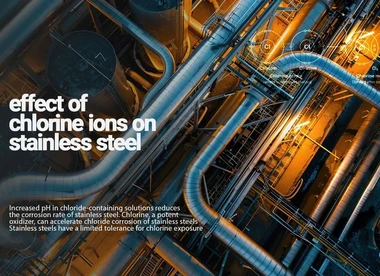
Effect of chlorine ions on stainless steels
The effect of chlorine and chloride parameters on the corrosion of stainless steels and the parameters affecting their corrosion rate, as well as the acceptable limits of chlorine ion levels in water and the differences in the effects of free chlorine and chloride on the corrosion of corrosion-resistant steels, are stated.
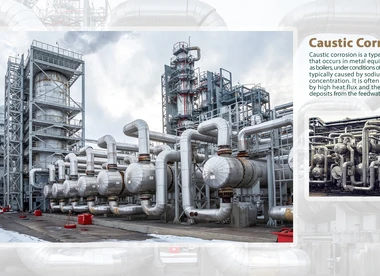
Caustic corrosion
Localized corrosion caused by the concentration of caustic or alkaline salts, which usually occurs under conditions of high evaporation or heat transfer. Caustic salt or caustic soda is one of the most widely used ionic compounds and is used in various industries including water treatment, cardboard and paper production, oil and refinery industries, aluminum production industries, food industries, alcohol production and glass.
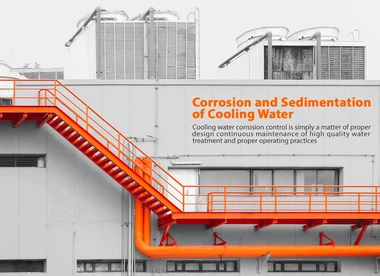
Corrosion and deposition of cooling water based on API 571
It refers to general or localized corrosion of carbon steels and other metals caused by dissolved salts, gases, organic compounds, or microbiological activity.

Microbial corrosion based on API 571
Microbial corrosion is a type of corrosion caused by living organisms such as bacteria, algae, or fungi. This type of corrosion is often associated with tubercles or slimy organic materials.
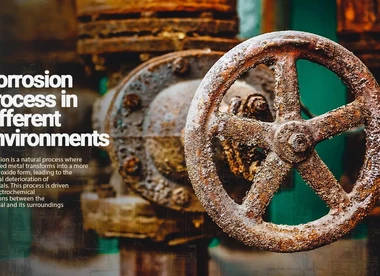
Corrosion process in different environments
Corrosion processes are divided into three groups in a more comprehensive classification: corrosion in aqueous solutions or environments, corrosion in molten salts and liquid metals, and corrosion in gases.
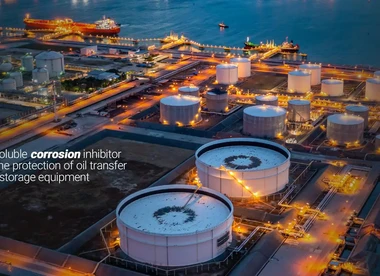
Oil-soluble corrosion inhibitor for the protection of oil transfer and storage equipment
Corrosion is a natural phenomenon that occurs as a result of the electrochemical reaction of metal with the surrounding environment. In the oil and gas industry, corrosion is one of the major problems that accounts for a huge amount of money annually. Part of these amounts are related to the corrosion of pipes or oil transmission lines. Effective ways to prevent corrosion of oil transmission and storage equipment are divided into two categories: physical and chemical solutions.

couponing
The coupon method or corrosion coupons is the simplest method of corrosion monitoring. Coupons are the oldest corrosion monitoring tool. Corrosion coupons are small pieces of metal or alloy of the material of interest that are immersed in the process medium and removed after a specified period of time and their weight or dimension loss is evaluated and examined.
Deaerators
Deaerators are mechanical devices that remove dissolved gases from the boiler feedwater. By reducing the concentration of oxygen and carbon dioxide in the solution, they minimize corrosion and protect the boiler from the effects of corrosive gases.
Submit your opinion
Your email address will not be published.