

MED Desalination Chemical Washing Steps — Implementation Guide
1404/12/02
The three main enemies of cooling towers: scale, corrosion, biofouling
1404/11/29
Can antifreeze also prevent the formation of deposits and corrosion?
1404/11/27
What is a chiller and what are its types? A comprehensive guide to choosing the best cooling system
1404/11/20
Corrosion comparison: Mitreh Cold scale remover solution (MDA0102) vs. hydrochloric acid

Abstract
Scaling in industrial equipment, especially in the oil, gas, and petrochemical industries, is a constant challenge that leads to reduced efficiency, increased energy consumption, and serious damage to equipment. The common method for removing these deposits is acid washing with strong acids such as hydrochloric acid; however, this method itself can cause severe corrosion of the substrate metals.
In this study, the performance of cold mitreh scale remover solution (MDA0102) — an Iranian formulation with high power in scale removal and very low corrosion — was compared with 20% hydrochloric acid in terms of corrosion rate on two key industrial materials (carbon steel C1010 and titanium). The results of electrochemical experiments (impedance spectroscopy and potentiodynamic polarization) showed that cold mitreh has a much lower corrosion rate than hydrochloric acid at all experimental concentrations (30% to 60%). This finding makes cold mitreh a safe, efficient and economical option for industries.
Introduction: Why is smart descaling essential?
In pipelines, heat exchangers, boilers and other industrial equipment, the formation of scale due to the reaction of water with minerals can have serious consequences:
- Reduction in pipe diameter and fluid flow
- Increase in pump pressure and energy consumption
- Reduction in heat transfer in heat exchangers
- Initiation of substrate corrosion processes
In practice, many industries still rely on hydrochloric acid as the main descaling solution. However, this acid, in addition to safety and environmental hazards, quickly corrodes metals and reduces the life of equipment.
In the meantime, cold mitreh solution (MDA0102) — an innovative product of Abrizan Company’s internal research — has been proposed as a safe and efficient alternative. This solution not only removes a wide range of deposits (carbonate, sulfate, sulfide, etc.), but also produces very low corrosion on common industrial alloys.
The purpose of this article is to provide scientific evidence for the superiority of cold mitreh over hydrochloric acid from a corrosion perspective — specifically for two critical materials: C1010 carbon steel and titanium metal.
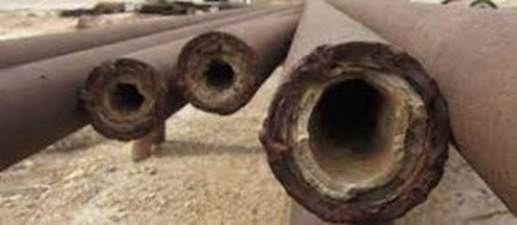
Figure 1. Sediment formation in the pipeline
Methodology: How did we measure corrosion?
For accurate comparison, the following tests were performed under standard conditions (temperature 25°C, static solution):
Tested materials:
- C1010 carbon steel
- Pure titanium metal
Test media:
- Cold mitreh solution at concentrations of 30%, 40%, 50% and 60%
- 20% hydrochloric acid solution (common concentration in industry)
Analysis methods:
1. Electrochemical impedance spectroscopy (EIS)
→ To measure corrosion resistance (Rct) without damaging the sample
2. Potentiodynamic polarization (TOFEL)
→ To calculate the actual corrosion rate (in mm/year)
All tests were performed with an Autolab 302N instrument and in a three-electrode cell (working electrode: metal sample, reference electrode: Ag/AgCl, auxiliary electrode: platinum).
Key Findings: How Safe is Cold Mitreh?
1. Electrochemical Impedance Spectroscopy (EIS) Results
- The charge transfer resistance (Rct) of cold Mitreh was on average 5 to 10 times higher than that of hydrochloric acid.
- Higher Rct = Less Corrosion
- Even at the highest concentration (60%), cold Mitreh still performed better than HCl.


Figure 2. Nyquist plot of electrochemical impedance spectroscopy test of C1010 steel and titanium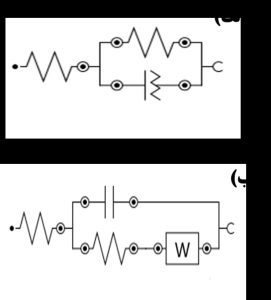
Figure 3. Equivalent circuits adapted to the results of electrochemical impedance spectroscopy test
Table 1. Results of electrochemical impedance spectroscopy test of C1010 steel
Solution | RS (Ω) | Rct (Ω) | CPE(Y₀) (Sⁿ/Ω·cm²) | N |
MDA0102 30% | 2.627 | 607.43 | 0.00014 | 0.774 |
MDA0102 40% | 2.869 | 480.7 | 0.000124 | 0.806 |
MDA0102 50% | 2.53 | 455.79 | 0.000172 | 0.767 |
MDA0102 60% | 2.484 | 118.22 | 0.000176 | 0.791 |
HCl 20% | 2.572 | 63.084 | 0.00017 | 0.811 |
Table 2. Results of electrochemical impedance spectroscopy test of titanium metal
Solution | RS (Ω) | Rct (Ω) | CPE (Y₀) (Sⁿ/Ω·cm²) | N | CP (µF) | W (Y₀) |
MDA0102 30% | 3.048 | 134400 | 0 | 0.900 | - | - |
MDA0102 40% | 2.384 | 94031 | 7.86×10⁻⁵ | 0.889 | - | - |
MDA0102 50% | 2.522 | 44444 | 0.00016 | 0.870 | - | - |
MDA0102 60% | 2.638 | 1156.1 | - | - | 301 | 0.0015 |
HCl 20% | 2.585 | 589.87 | - | - | 432 | 0.0054 |
2. Tafel polarization results
- Corrosion rate (C.R) for C1010 steel in 20% HCl: 2.490 mm/year
- Same rate in 30% cold mitreh: 0.266 mm/year → 89% corrosion reduction!
For titanium:
- 20% HCl: 4.276 mm/year
- 30% cold mitreh: 0.002 mm/year → 99.95% corrosion reduction!
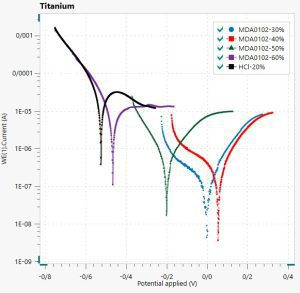
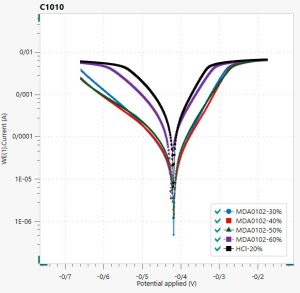
Figure 4. TOFEL diagram from potentiodynamic polarization test of C1010 steel and titanium metal
Table 3. Results of potentiodynamic polarization test of C1010 steel
Parameter Solution | Ecorr (V) | Icorr (A/cm2) | aβ (V/dec) | βc (V/dec) | C.R (mm/year) |
MDA0102 30% | -0/415 | 2/32×10-5 | 0/059 | 0/084 | 0/226 |
MDA0102 40% | -0/413 | 2/94×10-5 | 0/072 | 0/097 | 0/338 |
MDA0102 50% | -0/413 | 3/87×10-5 | 0/069 | 0/100 | 0/444 |
MDA0102 60% | -0/418 | 0/00015 | 0/077 | 0/088 | 1/667 |
HCl 20% | -0/412 | 0/00022 | 0/068 | 0/077 | 2/490 |
Table 4. Potentiodynamic polarization test results of titanium metal
Parameter Solution | Ecorr (V) | Icorr (A/cm2) | aβ (V/dec) | βc (V/dec) | C.R (mm/year) |
MDA0102 30% | 0.008 | 1.10×10⁻⁷ | 0.097 | 0.164 | 0.002 |
MDA0102 40% | 0.061 | 4.16×10⁻⁷ | 0.139 | 0.395 | 0.007 |
MDA0102 50% | -0.198 | 8.20×10⁻⁷ | 0.217 | 0.147 | 0.014 |
MDA0102 60% | -0.462 | 4.98×10⁻⁵ | 0.395 | 0.164 | 0.867 |
HCl 20% | -0.528 | 2.50×10⁻⁴ | 0.351 | 0.228 | 4.276 |
Discussion and Analysis: Why is this difference so significant?
The significant difference in corrosion rate is rooted in the clever chemical composition of cold mitreh:
- Presence of corrosion inhibitors in the formulation
- More balanced pH than mineral acids
- No production of hazardous gases (such as chlorine in HCl)
- Environmentally friendly and safe for operators
In contrast, hydrochloric acid, despite its effectiveness in removing unprotected scale, dissolves metal quickly and requires the addition of separate inhibitors, which itself increases cost and complexity.
Conclusion
Based on the findings of this study:
✅Cold mitreh (MDA0102) has a 20% lower corrosion rate than hydrochloric acid at all tested concentrations.
✅This difference was clearly observed for both materials — carbon steel and titanium.
✅Cold mitreh is not only safer, but it also significantly reduces repair and replacement costs by reducing damage to equipment.
Therefore, for the oil, gas, petrochemical, power plants and refrigeration industries, replacing hydrochloric acid with cold mitreh is a smart, economical and sustainable decision.
Resources
1) Crabtree, M., et al. (1999). *Fighting scale: removal and prevention*. Oilfield Review.
2) Olajire, A. A. (2015). *Oilfield scale management technology*. Journal of Petroleum Science and Engineering.
3) Kamal, M. S., et al. (2018). *Oilfield scale formation and chemical removal: A review*. JPSE.
4) Sholeh, M., Amiri, A. (1400). Field test performance of MED desalination scale removal with cold mitreh. 12th Heat Exchanger Conference.
5) Kajurimanesh, M. (1390). Investigation of the effect of a new non-corrosive scale removal solution in cooling facilities. 3rd International Heat Exchanger Conference.
6) Kelly, R. G., et al. (2002). *Electrochemical techniques in corrosion science*. CRC Press.
Pres
share :
MED Desalination Chemical Washing Steps — Implementation Guide
1404/12/02The three main enemies of cooling towers: scale, corrosion, biofouling
1404/11/29Can antifreeze also prevent the formation of deposits and corrosion?
1404/11/27What is a chiller and what are its types? A comprehensive guide to choosing the best cooling system
1404/11/20
Related Articles
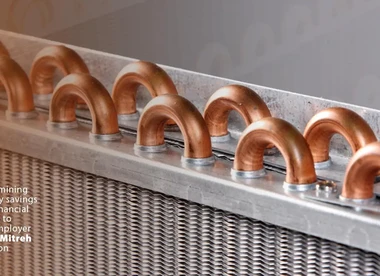
Determining energy savings and financial return to the employer using Mitreh solution
One of the most important points in a heat exchanger is the overall heat transfer coefficient. This coefficient is obtained in terms of the conduction and convection resistances between the fluids separated by flat walls and cylindrical shells, respectively. The layer of scale on the surfaces may increase the resistance to heat transfer between the two fluids to a large extent. This effect can be taken into account by introducing an additional thermal resistance, called the fouling coefficient (Rf), and its value depends on the operating temperature, fluid velocity, and the operating time of the exchanger.
The inhibition rate of industrial mitreh solution against corrosion of carbon steel and stainless steel in DM environment
The aim of this study was to determine the effectiveness of industrial mitreh solution in reducing the corrosion rate of commonly used metals exposed to industrial water environments. The results showed that using mitreh solution significantly reduces the corrosion of metals made of plain carbon steel and stainless steel in DM water.
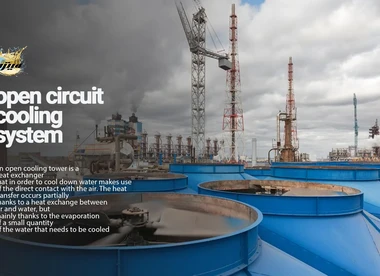
Efficiency of cold mitreh solution in removing scale from open circuit cooling systems
The purpose of this study was to investigate the effectiveness of Mitreh MDA0102 scale remover solution in industrial water environments according to NACE standards in two environments: calcium carbonate and calcium sulfate, and to compare it with acid washing. According to this study, this solution is a non-corrosive solution, unlike the solutions used in acid washing, which greatly increase corrosion. Also, the results of couponing indicated that the presence of Mitreh vector sediment solution will prevent further corrosion by forming a thin layer on the heat transfer surface.
The anti-fouling and corrosion effect of mitreh in heating and cooling systems
One of the main factors of scale in building installations is the presence of calcium carbonate in water, because the solubility of this compound in water is very low and if the conditions are right, it will precipitate quickly. One of the parts that provides these conditions is the surfaces in contact with water in heat exchangers in domestic gas-fired boilers (heat packages).
Industrial Mitreh (sediment remover and anti-corrosion)
Any system where temperature and water are the main elements for its operation inevitably requires the invention of Abrizan Company, called Industrial Mitreh, because wherever there is temperature and water, the formation of sediment is inevitable, unless a substance is used that suspends these sediments. This is the main function of an excellent anti-sediment solution.
Cold Mitreh
Cold Mitreh, a water-soluble solution with a high dissolution rate, is introduced as a powerful scale remover and an innovative product of Abrizan Company. Cold Mitreh was developed in response to the industry's need for an alternative solution to descalers. Descalers are scale removers based on hydrochloric acid and are highly dangerous, toxic, and corrosive.
Comparison of mitreh solution with DM
In order to compare DM and mitreh solution, it should be kept in mind that three different substances should be used for sediment removal, sediment prevention, and corrosion prevention, and in this regard, usually materials such as acids for sediment removal, DM for sediment removal, and in some cases Materials are also used to remove oxygen from water.
Anti-fouling mitreh
It has been about a decade since a new anti-scale solution entered the market, an anti-scale that plays an important role in protecting all types of heating and cooling systems from the formation of scale. This specialized product is called Mitreh and is a new invention of the Abrizan Company.
Submit your opinion
Your email address will not be published.