

MED Desalination Chemical Washing Steps — Implementation Guide
1404/12/02
The three main enemies of cooling towers: scale, corrosion, biofouling
1404/11/29
Can antifreeze also prevent the formation of deposits and corrosion?
1404/11/27
What is a chiller and what are its types? A comprehensive guide to choosing the best cooling system
1404/11/20
Cation and anion resins (ion exchange)

Ion exchange
The process of ion exchange has been used since ancient times. With the help of this process, Aristotle Thales brought salt water into contact with soil and produced fresh water.
In 1845, Thomson showed that whenever water containing ammonium sulfate passed through soil, calcium sulfate would be produced in the effluent.
(Calcium soil) NH4(2SO4 + CaZ) → NH4(2Z + CaSO4)
This discovery marked the beginning of the development of ion exchange science, and in the second half of the 19th century it was shown that compounds of alkaline earth metals, silica, and aluminum, called alum inosilicates,
(Al2O3 / mNa2O / xSiO2 / yH2O)
They are capable of ion exchange. The minerals with the highest ion exchange capacity were diatomaceous earth and a type of green sand called zeolite.
In 1930, the first ion exchangers were made from the reaction of anthracite and sulfuric acid, which became known as sulfonated coal. The maximum capacity of these ion exchangers is about 0.7eq kg-1. Then, polymer ion exchange resins were made from a combination of phenol or its derivatives with formaldehyde, which had a capacity of about 1.2eq kg-1. In the continuation of these studies, various resins were made, and finally in 1945, with the help of copolymerization of styrene and divinylbenzene, spherical weak and strong cationic and anionic resins were prepared, the capacity of these resins sometimes reaching several times that of previous types.
Ion exchange phenomenon
Ion exchange resins are water-insoluble solids that can be used to adsorb cations and anions by ion exchange. The ion exchange phenomenon is a combination of surface adsorption and diffusion processes, and the reaction rate is determined by the mass transfer operation that transports ions from the fluid to the resin surface or from the resin surface to the fluid.
Ion exchange is a chemical equilibrium and follows the principles governing equilibria. Ion exchange also occurs in electrolytes, but due to the homogeneity of the ions, in which the ion exchangers are both liquids, the effective factor is chemical kinetics, while in ion exchange, it is due to the presence of electrostatic forces, and the exchange power depends on these forces, the amount of which is shown based on stoichiometric calculations, and in such a way that the materials before and after ion exchange will be electrically neutral.
Some cationic resins have an active carboxyl group (─COOH) that only ion-exchanges with cations of weak acids. For example, if all the alkalinity of bicarbonate water is due to calcium and magnesium salts, then the ion exchange is shown as follows.
Ca(HCO3) + H2R → CaR + 2CO2 +2H2O
Mg(HCO3)2 + H2R → MgR + 2CO2 + 2H2O
CaSO4 + H2R → Ion exchange does not occur
MgCl2 + H2R → Ion exchange does not occur
The water produced has much lower hardness. The advantages of this type of resin are:
a) High capacity
b) Regeneration with less and more dilute acid
c) Less water required for rinsing
Cation and anion resins are used to produce ion-free water. These resins are produced in weak and strong types. Strong cation resins have the ability to remove all cations.
H2R + CaCl2 ↔ CaR + 2HCl
H2R + 2NH2NO3 ↔ (NH4)2R + 2HNO3
H2R + K2R + H2SO4 ↔ K2R + H2SO4
H2R + Na2SO4 ↔ Na2R + H2SO4
Strong anions present in water also exchange ions with anion exchange resins. The anion exchange process is shown below.
R(OH)2 + H2SO4 ↔ SO4R + 2H2O
R(OH)2 + 2HCl ↔ Cl2R + 2H2O
R(OH)2 + 2HNO3 ↔ (NO3)2R + 2H2O
Cationic resins
Cationic resins were prepared by reacting phenol or its derivatives with formaldehyde and then sulfonating them with sulfuric acid to form a mass that was crushed, sieved, and used. These resins were also prepared from the sulfonation of polystyrene.
Whenever a certain amount of divinylbenzene is added to the polymerization of styrene, a polymer with a network structure is produced, which, upon sulfonation, produces a strong cationic resin.
By changing the amount of divinylbenzene, the degree of cross-linking and, consequently, the porosity and stability of the resin are controlled. Increasing cross-linking reduces porosity and, consequently, increases the temperature resistance of the resin.
To produce spherical beads, the monomer must be suspended in water with the help of a mixer and copolymerization is carried out under these conditions. Strong cationic resins can exchange ions with all cations present in water.
When the sulfonic acid group is replaced by a carboxylic acid group (─COOH), weak cationic resins are produced, but a simpler method for preparing these resins is to combine methacrylic acid with divinylbenzene. Typically, the capacity of weak cationic resins is greater than that of strong types, sometimes reaching twice the capacity.
Anionic resins
Anionic resins have basic groups instead of acid groups. Basic groups are created from ammonia or an amine, and for better conditions, other compounds such as chloromethyl groups can be used and then the reaction is completed with ammonia or amine.
a) By reacting with ammonia, an anionic resin produces a primary amine.
b) By combining with a primary amine, a secondary amine resin is produced.
c) By reacting with a secondary amine, a tertiary amine resin is produced.
d) By reacting with a tertiary amine, an ammonium anion resin is produced.
Resins with primary, secondary, and tertiary amine basic groups are weak and have the ability to exchange ions with anions of salts or strong acids, but they do not exchange ions with anions of salts or weak acids.
SO42- + Weak anion resins ↔ Ion exchange takes place
NO3– + Weak anion resins ↔ Ion exchange takes place
Cl– + Weak anion resins ↔ Ion exchange takes place
HSiO3– + Weak anion resins ↔ Ion exchange takes place
HCO3– + Weak anion resins ↔ Ion exchange takes place
Ammonium resins are strong and have the ability to exchange ions with all anions, even carbonic acid-based and silicic acid-based.
HSiO3– + Strong anion resins ↔ Ion exchange takes place
HCO3– + Strong anion resins ↔ Ion exchange takes place
Weak anion resins are typically regenerated with sodium carbonate or caustic soda, but they can be regenerated with most alkalis.
RCl2 + Na2CO3 +H2O → R(OH)2 + 2NaCl + CO2
The regeneration of strong anion resins is done with sodium hydroxide.
RCl2 + 2NaOH → R(OH)2 + 2NaCl
Mixed bed columns ion-exchange resins
The removal of cations and anions in water is carried out simultaneously by a mixture of cationic and anionic ion exchange resins. In this process, the mixture of resins is placed in a column and the water passes through the resin bed, and the outlet water will have a very low T.D.S.
The regeneration of cationic and anionic resins is carried out in several stages. In the first stage, the resins are mechanically separated from each other, then the resins are regenerated, and in the final stage, the two cationic and anionic resins are mixed and used.
Advantages of the ion exchange method
Compared to other methods, the ion exchange method has the following advantages.
a) Ease of installation and operation.
b) High useful life of the resins (under proper operating conditions, the life of the resins is more than 15 years).
c) Ability to be implemented in different capacities.
d) No polluted wastewater for the environment.
Limitations of the ion exchange method
Along with the advantages of the ion exchange method, there are also some limitations as follows:
a) It is not cost-effective in the range of T.D.S. > 700 ppm.
b) This method is common for industrial units and is not usually used for drinking water.
c) The chemicals consumed are more than all methods and the produced water is more expensive.
d) The temperature of the ion exchange process should not be lower than 10 ◦C.
e) The maximum temperature of the ion exchange process is limited based on the type of resin and the coating of the ion exchange column.
c) Non-ionized substances are not capable of ion exchange.
f) The permissible limit of iron, manganese and heavy metals in total should be less than 0.1 ppm.
h) The water passing through the ion exchange resins should be free of suspended salts, colloidal substances, fat and organic matter.
h) The permissible limit of free chlorine (ClO–) in the passing water is 0.05 ppm.
d) The permissible turbidity limit is 5 A.P.H.A. Units.
share :
MED Desalination Chemical Washing Steps — Implementation Guide
1404/12/02The three main enemies of cooling towers: scale, corrosion, biofouling
1404/11/29Can antifreeze also prevent the formation of deposits and corrosion?
1404/11/27What is a chiller and what are its types? A comprehensive guide to choosing the best cooling system
1404/11/20
Related Articles
Membrane processes
Membrane processes refer to physical methods for separating a solvent from its dissolved salts using semipermeable membranes. These processes have made great progress in recent years. The history of using membranes for filtration dates back to the early 20th century.
Sedimentation water softening processes
Softening processes are used to reduce water hardness. Using chemicals, water hardness undergoes chemical reactions and precipitates. As a result, water hardness is reduced. Water hardness is due to the presence of carbonates, sulfates, chlorides, and nitrates of the metals calcium, magnesium, iron, and aluminum.
Types of water transfer systems
Water transmission systems include the channels necessary to transport water from one point to another. In most cases, it is necessary to transport water from its source to a treatment facility and from there to consumers. Pumping is used to provide the energy necessary to move the water from the beginning to the end of the transmission system. Pumping stations are usually located at the raw water intake, treatment plant and distribution network.
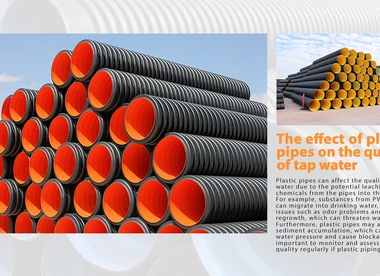
The effect of plastic pipes on the quality of tap water
The impact of plastic pipes on water quality in household plumbing and water distribution systems causes leakage of metals such as lead into drinking water. Lead, as the most widespread heavy and toxic element in the environment, is naturally present in river water at a level of 1 to 10 micrograms per liter. Lead compounds enter water sources as a result of mining, battery manufacturing, fossil fuel, paint, and glass and enamel industries.
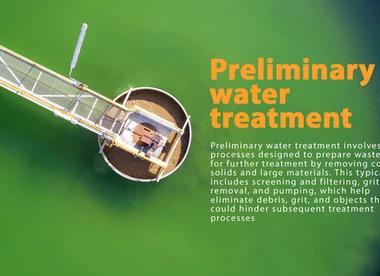
Preliminary water treatment for optimal use of membrane in reverse osmosis
Preliminary treatment is performed to optimize the use of membranes and increase membrane operating time. During this operation, water is prepared to pass through the membrane.
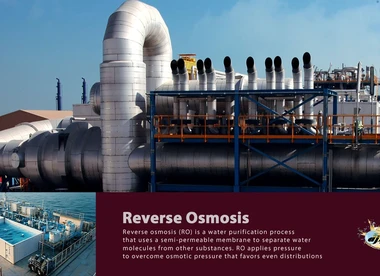
What is reverse osmosis and natural osmosis?
Osmosis is the movement of a solvent from a dilute solution to a concentrated solution through a semipermeable membrane. Reverse osmosis is a widely used separation technique with a variety of applications. Desalination of seawater and separation of organic and toxic substances from industrial wastewater are two important applications of this technology.

Earth's water reserves
Water is the source of life and the continuation of life for living organisms, as well as a fundamental factor in the emergence of human communities and civilizations. Today, the total volume of the Earth's water, which is the source of life for all organisms, has remained almost constant and unchanging since its formation. These water resources were created about 4.5 billion years ago.
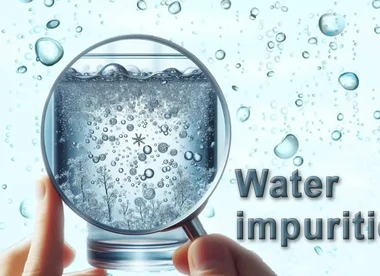
Impurities in water
Pure water does not exist in nature due to its high solubility and contains various impurities. Water impurities are classified into three general categories: dissolved solids, suspended and colloidal solids, and gases.
Submit your opinion
Your email address will not be published.