

Why do industrial systems require anti-freeze/coolant in the summer?
1405/03/02
Cooling Tower Chemical Cleaning Steps — Implementation Guide
1405/02/07
Types of sediments in RO systems and methods for identifying them
1405/02/05
Benefits of using specialized solutions from Abrizan Company for MED
1404/12/09
Raw water harvesting process before water treatment

The process of water entering a water intake before treatment
Raw water intakes draw water from various specified levels in a river, lake, or reservoir behind a dam. In order to protect the pumps and remove large objects from the water before it enters the pumping station, strainers are usually installed in the intake structure. Aeration is a process unit that removes gases and volatile organic compounds that cause taste and odor problems in the water supply system. Aeration is also used to oxidize certain soluble metals and convert them to insoluble forms. This process unit may be located within the intake structure or just before the treatment plant.
Raw Water Intake Structures
Raw water intake structures use surface water sources to control the withdrawal of raw water. Their primary goal is to withdraw water of the best quality and free of fish, floating matter, coarse sediment, and other undesirable suspended matter. These structures may be a simple submerged pipe or a complex tower-like structure with gates, strainers, control valves, pumps, chemical injectors, flow meters, office buildings, and maintenance workshops. This unit may be part of the dam or a separate structure at another location.
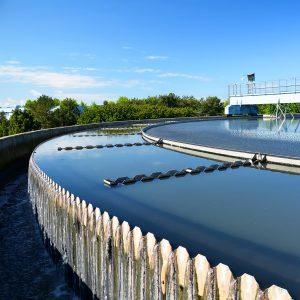
Types of water intake structures
Several different types of water intakes, including floating, submerged, tower, shore and pier intakes, are used in water supply systems. The choice of one of these structures depends on the nature of the water source and the quantity and quality of the water to be abstracted.
Floating intakes
Floating intakes are a relatively inexpensive method of abstracting water from existing lakes or reservoirs. These structures are particularly suitable for water sources with unfavorable geological conditions and where there is little variation in water level over time. This type of intake has a boat-like structure that floats on the water surface and holds pumps, strainers, valves, electrical switches and other equipment. The entire structure is supported by at least two concrete or steel columns. These columns are designed to allow the intake to be moved based on changes in water level. The structure is connected to the shore by a bridge over which water intake pipes and electrical cables pass, providing access to the intake.
Submerged intakes
Submerged intakes are used to collect water from rivers or lakes where the water level changes little throughout the year. These intakes are constructed as troughs or cones equipped with a debris trap. These structures may consist of a simple concrete box or a wooden trough filled with rocks to protect the intake pipe. The intake pipe discharges water either into a well near the shore where pumping equipment is installed, or into a gravity transfer system. The open top of the intake is covered by steel bars or screens. In sources with high silt deposits, the open top of the intake is extended to a height of about 1-2 meters above the bottom.
Tower intakes
Tower intakes are often built in large water supply schemes and on rivers or reservoirs with severe water level fluctuations. These water intakes may be built near the shore or at a relatively distant distance from it, where they can only be accessed by boat. To enable the best quality water intake, valves are provided at different heights in the water intake. There are two types of water intake towers: wet water intake towers and dry water intake towers.
1_ Wet water intake towers
Wet water intake towers are circular concrete chambers filled with water, the water level in them is level with the water level in the source, and they have an internal well that is connected to the intake pipe. There are openings on the outer wall of the concrete chamber and the wall of the inner well to receive water. The openings in the wall of the inner well are equipped with valves to control the flow of water. The purpose of the outer chamber filled with water is to create sufficient weight to balance the buoyancy force when the inner well is dry.
2_ Dry intake towers
In a dry intake tower, water enters the well through openings equipped with valves. Due to the lack of an outer chamber filled with water, these intakes must be constructed in such a way that they can withstand buoyancy forces. The advantage of dry towers over the wet type is the possibility of water withdrawal from different heights by installing appropriate valves.
Shore intakes
Coastal intake structures are used in rivers and lakes with a relatively constant water level or lakes and reservoirs with deep shorelines. These intakes are usually concrete structures open to the water. The structures may be constructed in such a way that a pumping station can be located in them.
Pier intakes
Pier intake structures are built on rivers and lakes where the water depth at the shore is very shallow and the use of a shore intake is not possible. This unit is also used when it is necessary to build a water intake in an existing water source. Quay intake structures consist of a steel beam or concrete slab mounted on steel or concrete foundations. These slabs support pumps, pipes, valves, electrical switches, and other equipment. The quay is connected to the shore by a bridge that provides easy access to the intake and protects the intake pipes.
Selecting an Intake Site
Engineers must carefully consider many factors when locating raw water intakes. These factors include water quality, current or wave velocity, foundation stability, accessibility, availability of electrical power, proximity to a treatment plant, hazard to shipping, and environmental impacts.
share :
Why do industrial systems require anti-freeze/coolant in the summer?
1405/03/02Cooling Tower Chemical Cleaning Steps — Implementation Guide
1405/02/07Types of sediments in RO systems and methods for identifying them
1405/02/05Benefits of using specialized solutions from Abrizan Company for MED
1404/12/09
Related articles
MED Desalination Chemical Washing Steps — Implementation Guide
A step-by-step guide to chemical flushing of MED desalination plants: from scale detection to safe and effective implementation. Preventing corrosion and increasing efficiency
International standards for maintaining and cleaning desalination plants
Do you know what international standards are required for the maintenance and cleaning of desalination plants? A complete guide to extending the life of equipment and preventing sedimentation.
Water Turbidity Measurement: A Comprehensive Guide for Industry and Drinking Water
What is water turbidity? Why is it vital to measure it? Read about measurement methods, standards, and ways to reduce turbidity in this complete guide.
Types of deposits and corrosion in MED desalination water
Types of deposits and corrosion in MED desalination plants — calcium carbonate, sulfate, silica, magnesium hydroxide, subsedimentary corrosion. Accurate detection methods with XRD, SEM, ICP. Specialized solutions for water treatment plants with (Mitreh brand).
Why is it important to control sedimentation and corrosion in desalination devices؟
Why is scale and corrosion control vital in desalination plants? A technical and economic analysis of the impact of scale and corrosion on equipment performance, cost, and life. Warning signs and preventive measures. Suitable for engineers and industrial managers

Comparison of RO, MED, MSF desalination water in terms of cost, energy consumption, chemical requirement of the industry
Detailed comparison of RO, MED, MSF in terms of cost, energy consumption and chemical requirements. Technical analysis, comparison table and decision-making guide. MED with recycled heat is cheaper than RO! Suitable for engineers and industrial managers
MVC desalination plant (Mechanical vapor compression)
MVC (Mechanical Vapor Compression) Desalination — Comprehensive Guide to Application, Advantages, Disadvantages and Chemical Solutions by Abrizan Company (Mitreh Brand). Evaporator Chemical Washing, Thermal Anti-Fouling, Laboratory Consulting. Increase Efficiency — Reduce Energy Costs
EDI desalination plant (Electrodialysis)
EDI (Electrodialysis) Desalination — A Comprehensive Guide to Technology, Applications, Advantages and Disadvantages. Ultrapure Water Production Without Regeneration Chemicals. Applications in Pharmaceutical, Semiconductor and Power Plants. Pretreatment Requirements and Technical Challenges
Submit your opinion
Your email address will not be published.