

Why do industrial systems require anti-freeze/coolant in the summer?
1405/03/02
Cooling Tower Chemical Cleaning Steps — Implementation Guide
1405/02/07
Benefits of using specialized solutions from Abrizan Company for MED
1404/12/09
Why is the use of general acids prohibited in boiler cleaning? (Danger of explosion and corrosion)
1404/12/06
Types of sediments in RO systems and methods for identifying them

Is your reverse osmosis (RO) system suddenly experiencing a drop in water production, increased pressure, or a loss of profile quality? These symptoms are usually a sign of scale or fouling on your RO membranes. But before you start cleaning, you need to know exactly what type of contaminant you’re dealing with—because calcium carbonate scaling solutions are completely different from biofilm or silica solutions. This article is a technical and practical guide for engineers and industry professionals to help them identify the types of scale and fouling common in RO systems and choose the right solution.
Main Types of Fouling in Industrial RO Systems
In the industry, the term “scaling” is often used interchangeably with “fouling,” but from a technical perspective, the two have different meanings:
- Scaling: The formation of hard, crystalline layers of poorly soluble salts (such as calcium carbonate or barium sulfate) on the membrane surface.
- Fouling: A broader concept that includes sediment, organic, colloidal and biological fouling.
In industrial RO systems (such as power plants, refineries and desalination plants), four main types of fouling occur:
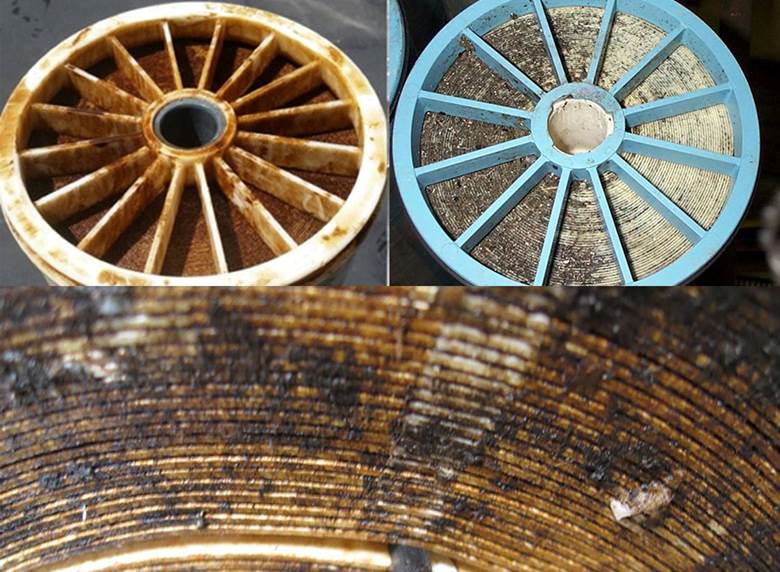
1. Mineral Scaling
This type of fouling occurs when the concentration of poorly soluble salts in the effluent water (Concentrate) exceeds the saturation point and precipitates as crystals on the membrane. The most important influencing factors: high pH, temperature, system efficiency and the chemical composition of the inlet water.
The most common mineral deposits:
- Calcium carbonate (CaCO₃)–the most common deposit in fresh and semi-brackish waters.
- Calcium sulfate (CaSO₄)–in brackish waters with high sulfate concentrations.
- Barium sulfate (BaSO₄)–very hard and resistant to acid; forms even at ppm concentrations.
- Strontium sulfate (SrSO₄)–similar to BaSO₄in terms of low solubility.
- Silica (SiO₂)–in amorphous or crystalline form; highly resistant to leaching.
- Calcium phosphate (Ca₃(PO₄)₂)–if phosphorus is present in the incoming water.
2. Organic Fouling
Soluted or suspended organic materials (natural or industrial) are adsorbed on the membrane as a sticky layer. This layer prevents water from passing through and becomes a substrate for the adsorption of other pollutants.
Main sources:
- Humic and fulvic acids (in surface waters)
- Oil, grease and industrial polymers
- Biological proteins and carbohydrates
3. Colloidal Fouling
Fine particles (1 to 1000 nm) such as colloidal silica, clay particles, iron or manganese hydroxide pass through pre-treatment filters and quickly block the pores of the membrane.
4. Biological Fouling
Growth of bacteria and formation of biofilm (a sticky layer of microorganisms and EPS) on the membrane surface. This type of fouling is very persistent and is usually accompanied by a gradual decrease in water production.
Contamination Identification Methods: From Operational Monitoring to Advanced Laboratory
Correct identification of the type of contamination is the key to selecting an effective solution. This process is carried out at two levels:
Level 1: Operational Monitoring and Trend Analysis (Field Monitoring)
By monitoring key system parameters, the initial type of contamination can be easily guessed:
Type of pollution | Operational indications |
Mineral deposit | Rapid increase in ΔP (terminal pressure), average decrease in water production |
Colloidal contamination | Very rapid increase in ΔP, severe reduction in water production |
Organic pollution | Gradual decrease in water production, less affected by ΔP |
Biofouling | Gradual decrease in water production, increased salt leakage, unresponsive to acid cleaning |
Key parameters to monitor:
- Normalized Permeate Flow (NPF): decrease >10% = need to be investigated.
- Normalized ΔP: increase >15% = strong warning of physical/colloidal contamination.
- Salt Rejection: decrease >10% = possible membrane or biofilm damage.
Technical tip: Always check parameters normalized to eliminate the effect of temperature and pressure changes.
Level 2: Advanced laboratory analysis
When operational monitoring confirms signs of contamination, it is time to take a membrane sample and perform a detailed analysis.
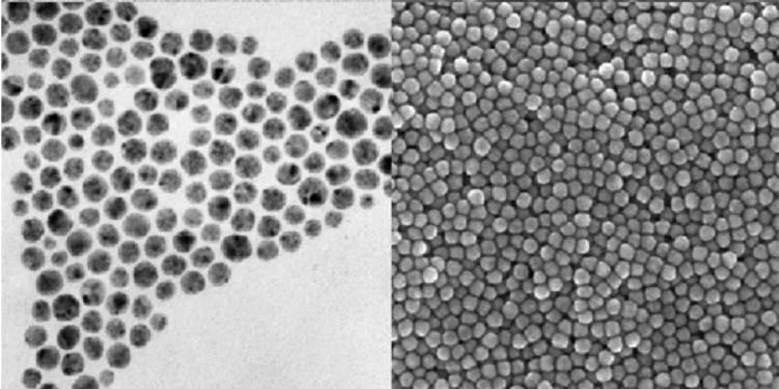
1. Scanning Electron Microscopy + EDS (SEM-EDS)
- Application: Surface morphology (crystal shape, biofilm texture) + elemental analysis (Ca, Ba, Si, Fe, etc.).
- Advantage: Simultaneous identification of physical structure and chemical composition.
- Example: Presence of Ca and C in EDS + hexagonal crystals in SEM = CaCO₃.
2. X-ray diffraction (XRD)
- Application: Identification of the crystalline phase of materials (e.g., differentiation of calcite from aragonite).
- Advantage: High accuracy in identifying mineral deposits.
- Limitations: Only for crystalline materials; useless for organic contamination or biofilm.
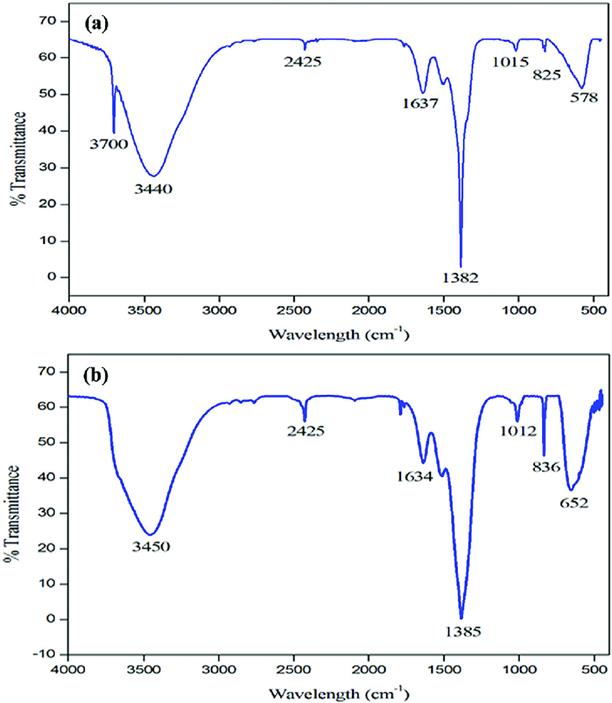
3. Infrared spectroscopy (FTIR)
- Application: Identification of organic functional groups (protein, polysaccharide, oil).
- Advantage: Accurate detection of organic and biological contamination.
- Example: Peak at 1650 cm⁻¹ = amide I→presence of protein.
4. Auxiliary methods:
- Rapid chemical tests: reaction with acid (dissolution of CaCO₃), oxidant (reaction with biofilm).
- TOC / AOC: to assess the potential for organic and biological contamination of the incoming water.
❓❓❓ Answers to frequently asked questions by engineers (FAQ) ❓❓❓
❓ How to understand that contamination is mixed?
Many cases of contamination are mixed. For example, an organic layer is formed first and then a mineral deposit grows on it. In this case, SEM-EDS + FTIR is the best combination to detect both types of contamination simultaneously.
❓ Is SDI still valid?
The Silt Density Index (SDI) is outdated and unstable. Instead, use MFI (Modified Fouling Index) or directly monitor normalized ΔP.
❓ When should chemical cleaning be used?
- NPF reduction > 10%
- ΔP increase > 15%
- Salt leakage increase > 10%
But before cleaning, identify the type of contamination—using acid for biofilm is not only useless, but may also damage the membrane.
Conclusion: Smart contamination management is the key to long membrane life
Effective management of industrial RO systems is not limited to “frequent cleaning”. Rather, it requires a comprehensive strategy that includes:
- Continuous monitoring of normalized parameters
- Early detection with online technologies (such as EIS)
- A detailed laboratory analysis before each chemical cleaning
- Choosing a detergent or antifoulant appropriate to the type of contamination
With this approach, not only will the life of the membranes be extended, but operating costs and chemical consumption will be significantly reduced.
If you need expert advice to identify the type of contamination or to select the optimal chemical, Abrizan Company specialists, with more than 20 years of experience in advanced laboratories, are ready to provide customized solutions to various industries.
share :
Why do industrial systems require anti-freeze/coolant in the summer?
1405/03/02Cooling Tower Chemical Cleaning Steps — Implementation Guide
1405/02/07Benefits of using specialized solutions from Abrizan Company for MED
1404/12/09Why is the use of general acids prohibited in boiler cleaning? (Danger of explosion and corrosion)
1404/12/06
Related articles
Smart non-stop oil exchanger cleaning: CIP pilot in Gachsaran
Reducing pressure drop from 4.5 to 0.5 bar with chemical cleaning in place (CIP). A smart solution for oil exchangers without the need to stop the unit.
Complete guide to chemical washing of industrial equipment Methods, detergents and safety tips
A comprehensive guide to chemical cleaning and descaling of industrial equipment — a variety of methods, detergents, safety tips, and an introduction to the MDA0102 cold miter as a safe, on-line solution. Increase efficiency, reduce costs, and protect equipment.
Physical and chemical descaling methods
In industries such as oil, gas and petrochemical, there is always an attempt to prevent the formation of deposits using different methods in equipment such as heat exchangers and boilers. In this field, a lot of money is spent on chemical materials and additives. But most industrial heat exchangers are exposed to sedimentation due to various reasons such as the low quality of water in different areas. These deposits are mostly formed in the pipes of the converters. In order to reduce the losses caused by sedimentation, the converter must be continuously monitored and cleaned.
Sediment formation in boilers
Boiler feed water should be free of hardness. Sometimes, due to the short or improper operation of the hardness device or the failure to regenerate the resins in time, some hardness enters the boiler feed water. Increasing the water temperature in the boiler reduces the solubility of water solutes. The water near the hot surfaces becomes saturated and the conditions for deposition of less soluble substances are provided and eventually sediment is formed.
Remove the sediment solution Mitreh
Mitreh is a superior solution for dealing with scale in various industries. Mitreh scale removal solution, a revolutionary product from Abrizan Industrial Research Company, is an efficient alternative to traditional scale removal methods. This product offers a comprehensive solution to the scale problem in various industries by overcoming the limitations of existing physical and chemical methods.
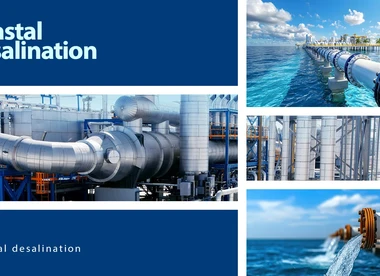
Coastal freshwater sediment removal (MED)
One of the methods of producing fresh water for industrial use is the use of multi-stage thermal desalination plants to desalinate seawater. Due to the high content of soluble and insoluble compounds in seawater and the high temperature shock in desalination packages, sedimentation in these packages is unavoidable. For this reason, periodic sediment removal from desalination plants should be performed.
Sediment and problems caused by it in facilities
When water is used as a thermal fluid, the salts and hardness in the water are separated due to the temperature shock and settle on the surfaces, forming deposits. These deposits are one of the most important factors of erosion and corrosion in heating and cooling installations.
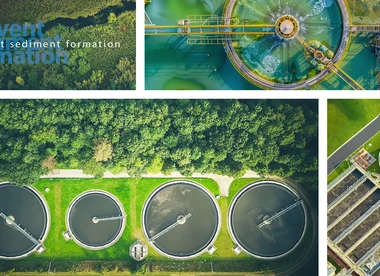
Methods to prevent sediment formation
The most important method for preventing sediment formation is to improve the quality of water used in various industries. This method is carried out in various forms such as sedimentation, filtration, deaeration, degreasing, using the under-water rinsing method, and softening the water used.
Submit your opinion
Your email address will not be published.