

Why do industrial systems require anti-freeze/coolant in the summer?
1405/03/02
Cooling Tower Chemical Cleaning Steps — Implementation Guide
1405/02/07
Types of sediments in RO systems and methods for identifying them
1405/02/05
Benefits of using specialized solutions from Abrizan Company for MED
1404/12/09
Iron and steel production

Iron and Steel Production
Iron and steel have both played an important role in the development of human civilization over several thousand years, and have been used in agriculture, construction, power generation and distribution, machinery and equipment, in the home, and in medicine. Along with coal and cotton, iron and steel were the raw materials on which the Industrial Revolution began. Technological developments from the early 18th century onwards led to significant increases in production, for example, by replacing charcoal with coal and coke and by developing the pudding process for converting hot metal into steel.
World steel production has increased significantly since 2000, and exceeded 1,000 million tonnes for the first time in 2004. In 2006, world steel production reached over 1,200 million tonnes (see Figure 1.1). This is mainly due to the fact that steel production in China increased from 127 million tonnes in 2006 to 421 million tonnes.
The EU's gross domestic product grew by 1.2% between 1985 and 1994. Growth was particularly strong in the last three years from 1986 to 1989 (7.3% per year). After that, production in the EU12 fell from 140 million tonnes to 132 million tonnes in 1992 and 1993, before rising to 139 million tonnes in 1994 and 143 million tonnes in 1995. The accession of Austria, Finland and Sweden to the EU increased Italy's crude steel production to 156 million tonnes in 1995. Since 2000, crude steel production has been increasing worldwide. In 2006, crude steel production in the EU was 198 million tonnes, compared with 120 million tonnes in Russia and 116, 99 and 421 million tonnes in Japan, the United States and China respectively.
Steel production process
[60, Hill et al. 1997] [200, Commission 2001]
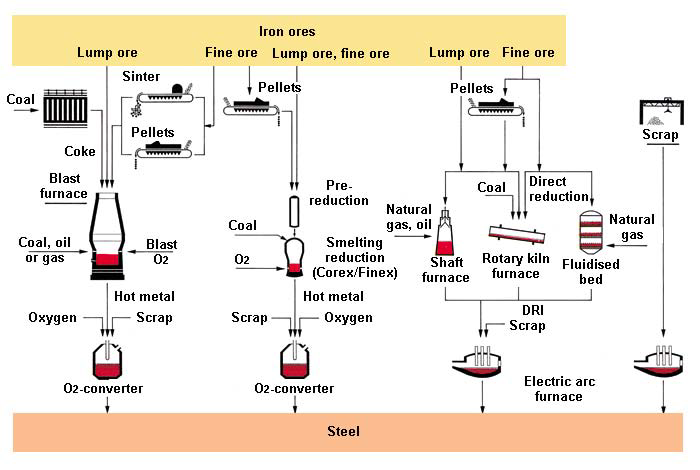
There are currently four ways to produce steel worldwide: classical blast furnace/basic oxygen furnace, direct scrap melting (EAF), molten reduction and direct reduction (see Figure 1.4).
In 2006, steel production in the EU-27 was based on the blast furnace/basic oxygen method (approximately 59.8%) and the electric arc furnace (EAF) method (approximately 40.2%). The percentage of world crude steel production by direct reduction (DR) in 2006 was about 6.8%, equivalent to 59.8 million tonnes of direct reduction iron (DRI). According to the planning of DRI industrial sites, annual production by direct reduction iron by 2010 will reach 80 million tonnes worldwide. In Europe, production by direct reduction iron was limited to 704,000 tonnes in 2006 (58,000 tonnes in Germany and 12,400 tonnes in Sweden), which is approximately 1.5% of world production. DRI consumption in EAF steel production in the European Union in 2006 was 1.523 million tonnes.
Process overview
The process pathways of a steelmaking plant considered in this BREF are shown in Figure 1.6. This figure provides an overview of the main material inputs and the related outputs of products and residues for each step of the process pathway.
In a steelmaking plant, the blast furnace is the main operating unit where the initial reduction of iron oxide ore occurs, resulting in the production of molten iron, called “hot metal”. Advanced high-quality blast furnaces require extensive physical and metallurgical preparation. The two iron ore preparation sections are the tailings and dross section and the pelletisation section. Pellets are almost always made from a specific iron ore ore or are concentrated at the mine and transported as such. In Europe, there is only one steelmaking plant that operates a pelletisation section itself. Slag and dross are generally produced in ironworks from pre-designed mixtures of ore, wastes and additives.
The main reducing agents in the blast furnace are coke and coal dust, which form carbon monoxide and hydrogen, which reduce the iron oxide. Coke and coal also act to some extent as a fuel.
Coke is produced from coal by dry distillation in a coke oven and has better physical and chemical properties than coal. In many cases, additional reducing agents/fuels are supplied by the injection of oil, natural gas and (in a few cases) plastics. A hot blast provides the oxygen necessary to form carbon monoxide (CO), which is the main agent for reducing the iron oxide.
The feedstock is added from the top into the blast furnace. These materials consist of alternating layers of coke and a mixture of alloy and/or pellets, ore and flux. In the furnace, the iron ore is gradually reduced, and the liquid iron and slag are collected at the bottom of the furnace, where they flow into the crucible.
Slag from the blast furnace is either granulated or pelletized, or is conveyed into slag pits. The slag granules or pellets are usually sold to cement companies. The slag in the pits can also be used in road construction.
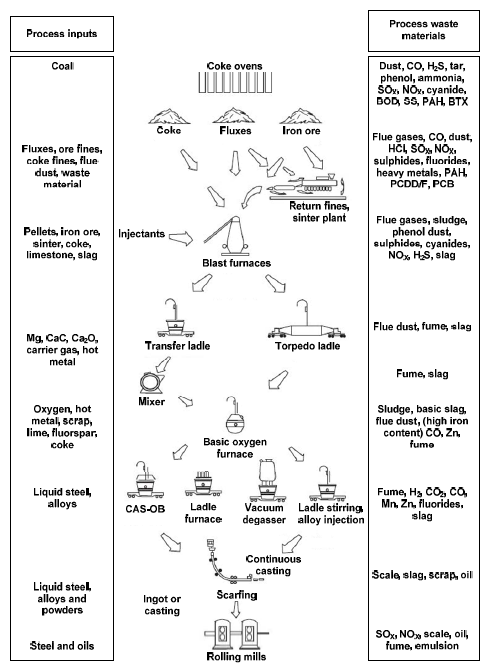
Molten iron from the blast furnace (hot metal) is transferred to an oxygen furnace, where the carbon content (approximately 4%) is reduced to less than 1%, resulting in the formation of steel. Upon exiting the oxygen furnace, the liquid steel is cast into ingots or cast by continuous casting. In some cases, vacuum degassing is used to improve the quality of the steel.
The cast products, including ingots, slabs, billets or billets, are then processed in rolling mills and production lines to prepare them for market.
share :
Why do industrial systems require anti-freeze/coolant in the summer?
1405/03/02Cooling Tower Chemical Cleaning Steps — Implementation Guide
1405/02/07Types of sediments in RO systems and methods for identifying them
1405/02/05Benefits of using specialized solutions from Abrizan Company for MED
1404/12/09
Related articles

Water used in steel factories and its types
Water is used in most parts of a steel plant. A steel plant cannot operate without water. Therefore, steel plants are typically built near abundant sources of fresh water to ensure the availability and quality of the water they require. However, today, special attention has been paid to the management of water resources available in the steel plant environment, especially in terms of its quality, quantity and how it is used.
Effective use of water resources in the steel industry
The steel industry uses large amounts of water. However, very little is consumed, as most of the water is reused or returned to the source. Water is used not only in cooling operations, but also in other processes such as scale removal and dust cleaning.
Submit your opinion
Your email address will not be published.