

Why do industrial systems require anti-freeze/coolant in the summer?
1405/03/02
Cooling Tower Chemical Cleaning Steps — Implementation Guide
1405/02/07
Types of sediments in RO systems and methods for identifying them
1405/02/05
Benefits of using specialized solutions from Abrizan Company for MED
1404/12/09
Methods of measuring solids dissolved in water

What is Total Dissolved Solids (TDS)?
TDS is the total dissolved solids in water, which is equal to the sum of the concentrations of all ions in water. Dissolved substances in water may be “organic” or “mineral” in nature. Total dissolved solids in water TDS cannot be considered as the main criterion for determining water quality and more determines the degree of transparency of water.
Undesirable substances dissolved in water
Many substances dissolved in water are undesirable. Minerals, gases and organic substances dissolved in water may cause undesirable color, taste and odor. Some chemical compounds may be toxic and some dissolved organic components have been proven to be carcinogenic. Of course, it should be noted that not all substances dissolved in water are undesirable. However, the amount of desirable dissolved substances in water is very small.
The unit of measurement of total dissolved solids in water TDS is milligrams per liter mg/L, which is referred to as ppm.
TDS Reduction Methods
- Electrodialysis Method
Electrodialysis method, also called ED, is a membrane separation method and is used for water with a TDS of less than 5000ppm.
- Ion exchange method
- Reverse osmosis (RO) method
Measurement of total dissolved solids in water TDS
1_ Classic TDS measurement method
To measure it, they first filter a hundred milliliter sample of water and then evaporate it to dryness. The remaining solids are placed at a temperature of 110 degrees Celsius until its weight reaches a constant value. Then it is dried in a desiccator and its weight is obtained.
2_ Instrumental TDS measurement method
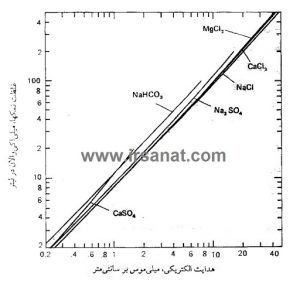
In this method, the TDS value is measured using a TDS meter, which is an easy and accurate method. EC vs TDS Relationship Because ions are the agents that conduct electricity in solutions and determine the electrical conductivity, there is a close relationship between electrical conductivity (EC) and total dissolved solids (TDS).
Relationship between total solutes and electrical conductivity
The relationship between total solutes and electrical conductivity can be expressed as the following diagram:
share :
Why do industrial systems require anti-freeze/coolant in the summer?
1405/03/02Cooling Tower Chemical Cleaning Steps — Implementation Guide
1405/02/07Types of sediments in RO systems and methods for identifying them
1405/02/05Benefits of using specialized solutions from Abrizan Company for MED
1404/12/09
Related articles
What is the Langelier Index? A Complete Guide to Predicting Water Sedimentation and Corrosion
Find out if your water is prone to scaling or corrosion with Langelier Index (LSI), Reisnar and Pocurius. A practical guide for industries and water systems
Measuring Carbonate and Bicarbonate in Water: A Complete Guide to Alkalinity Control
Learn why water alkalinity with carbonate and bicarbonate is important, how to measure it, and what solutions there are to prevent scaling.
Measuring Iron (Fe) in Water: Why Can This Common Metal Disable Industrial Equipment?
Why is iron in water dangerous? Fe measurement method, limits, impact on equipment and control solutions + accurate laboratory analysis.
Water Parameter Analysis: A Complete Guide to Water Quality Control in Industry and the Environment.
What is water parameter analysis? How to prevent scale and corrosion? Comprehensive physical, chemical and microbial guide + answers to common questions
Orthophosphate - phosphate
Orthophosphates, pyrophosphates, metaphosphates, and other polyphosphates and organophosphates are phosphorus in natural waters and wastewaters that occur as phosphates. They are found in solution, in particulate or powder form, or in the form of aquatic organisms.
The origin and importance of magnesium
Magnesium is an essential element in chlorophyll and in red blood cells. Some magnesium salts are toxic if ingested or inhaled. Concentrations above 125 mg/L can also have a laxative and diuretic effect.
The origin and importance of iron
The solubility of iron ions is controlled by the concentration of carbonate. Since groundwaters are often oxygen-deficient, soluble iron in groundwaters is usually in the form of iron salts. Upon exposure to air or the addition of oxidants, iron is oxidized to the ferrous state and can be hydrolyzed to produce the insoluble red hydrated iron oxide.
Copper and its importance
Copper exists in its elemental state, but is also found in many minerals, the most important of which include sulfide compounds (such as chalcopyrite), as well as oxides and carbonates. Copper is widely used in electrical wiring, roofing materials, various alloys, pigments, cookware, plumbing, and the chemical industry. Copper salts are used in water supply systems to control biological growth in tanks and distribution pipes and to catalyze the oxidation of manganese.
Submit your opinion
Your email address will not be published.