

Why do industrial systems require anti-freeze/coolant in the summer?
1405/03/02
Cooling Tower Chemical Cleaning Steps — Implementation Guide
1405/02/07
Types of sediments in RO systems and methods for identifying them
1405/02/05
Benefits of using specialized solutions from Abrizan Company for MED
1404/12/09
Water purification processes

Water Treatment
The main objective of a water treatment plant is to produce water that meets drinking water quality standards at a reasonable cost to the consumer. In a treatment plant, various processes are used to produce water of the desired quality. These processes are generally divided into two general categories: operational units and process units.
Operational water treatment unit
In the operational unit, the removal of contaminants is carried out by physical forces.
Process water treatment unit
In the process unit, the treatment of water is carried out by chemical and biological reactions.
Most of the terms operational units and process units are used interchangeably. This is because many processes are completed by a combination of operations. For example, the removal of turbidity in the coagulation process is carried out by a combination of chemical addition, mixing and dispersion, flocculation, and sedimentation.
The general arrangement of the various process and operational units is called the process chain, flow chart, general diagram, or general scheme of the treatment. The main considerations for developing an overall treatment pattern depend on the characteristics and seasonal variations of the raw water quality, legal restrictions, site characteristics, unit economics, and many other factors. The goal is to remove undesirable components from the water and to process the waste in a way that can be easily and properly disposed of or reused. The following is an overview of the various operational units and processes used for waste treatment and processing.
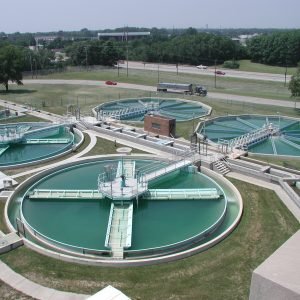
Raw Water Intake, Pumping, Conveying and Metering
Water treatment plants may use systems to ingest, pump, convey and meter raw water. Although these units do not perform any treatment, they are essential as part of the overall water treatment process.
Raw Water Intake
Raw water intakes are constructed to extract water from a river, lake or reservoir from a specified height. The structure of this unit can vary from a simple submerged intake pipe to complex tower-like units that house valves, strainers, control valves, pumps and chemical feeders. Intakes may be submerged, floating or tower-mounted.
Tower-mounted intakes are used in large projects and may be part of a dam or a separate structure at another location. Submerged or floating intakes are used for small water supply projects.
Raw Water Pumping
Raw water pumping stations are usually located in the intake building. The purpose of pumping is to raise water from the source to a height sufficient to allow it to flow by gravity. The pumping height of raw water is the sum of the static head, the pressure drop in the main pipeline, and any partial losses. Centrifugal pumps are most commonly used in water pumping. These pumps may be suspended, submerged, or dry sump.
Raw water conveyance
A raw water conveyance system is designed for the controlled movement of water from the intake to the treatment plant. Typically, the treatment plant is built near a city. Therefore, long lines are required to convey water from the source to the treatment plant. Topography, available elevation, construction materials, economics, and water quality are the primary considerations in selecting a suitable route and conduit. The conduit may be a canal, stream, tunnel, or pressurized pipeline, or a combination of these.
Flow measurement
Measurement of the flow rate of raw water and treated water is essential for operation, process control, billing, and data recording of the treatment plant. Flow measuring devices may be installed on the raw water transmission line, on the main distribution lines, or at other locations within a facility. Often, more than one measuring device is required in different facilities. In general, water flow in pressurized pipes is measured by mechanical height-measuring devices such as venturi meters, nozzles, or orifices. Flow in an open channel is measured by a weir or venturi-shaped flume such as a partial flume.
share :
Why do industrial systems require anti-freeze/coolant in the summer?
1405/03/02Cooling Tower Chemical Cleaning Steps — Implementation Guide
1405/02/07Types of sediments in RO systems and methods for identifying them
1405/02/05Benefits of using specialized solutions from Abrizan Company for MED
1404/12/09
Related articles
MED Desalination Chemical Washing Steps — Implementation Guide
A step-by-step guide to chemical flushing of MED desalination plants: from scale detection to safe and effective implementation. Preventing corrosion and increasing efficiency
International standards for maintaining and cleaning desalination plants
Do you know what international standards are required for the maintenance and cleaning of desalination plants? A complete guide to extending the life of equipment and preventing sedimentation.
Water Turbidity Measurement: A Comprehensive Guide for Industry and Drinking Water
What is water turbidity? Why is it vital to measure it? Read about measurement methods, standards, and ways to reduce turbidity in this complete guide.
Types of deposits and corrosion in MED desalination water
Types of deposits and corrosion in MED desalination plants — calcium carbonate, sulfate, silica, magnesium hydroxide, subsedimentary corrosion. Accurate detection methods with XRD, SEM, ICP. Specialized solutions for water treatment plants with (Mitreh brand).
Why is it important to control sedimentation and corrosion in desalination devices؟
Why is scale and corrosion control vital in desalination plants? A technical and economic analysis of the impact of scale and corrosion on equipment performance, cost, and life. Warning signs and preventive measures. Suitable for engineers and industrial managers

Comparison of RO, MED, MSF desalination water in terms of cost, energy consumption, chemical requirement of the industry
Detailed comparison of RO, MED, MSF in terms of cost, energy consumption and chemical requirements. Technical analysis, comparison table and decision-making guide. MED with recycled heat is cheaper than RO! Suitable for engineers and industrial managers
MVC desalination plant (Mechanical vapor compression)
MVC (Mechanical Vapor Compression) Desalination — Comprehensive Guide to Application, Advantages, Disadvantages and Chemical Solutions by Abrizan Company (Mitreh Brand). Evaporator Chemical Washing, Thermal Anti-Fouling, Laboratory Consulting. Increase Efficiency — Reduce Energy Costs
EDI desalination plant (Electrodialysis)
EDI (Electrodialysis) Desalination — A Comprehensive Guide to Technology, Applications, Advantages and Disadvantages. Ultrapure Water Production Without Regeneration Chemicals. Applications in Pharmaceutical, Semiconductor and Power Plants. Pretreatment Requirements and Technical Challenges
Submit your opinion
Your email address will not be published.