

Why do industrial systems require anti-freeze/coolant in the summer?
1405/03/02
Cooling Tower Chemical Cleaning Steps — Implementation Guide
1405/02/07
Types of sediments in RO systems and methods for identifying them
1405/02/05
Benefits of using specialized solutions from Abrizan Company for MED
1404/12/09
Chemical analysis of lithium bromide solution

Introduction
In order to properly test and evaluate the lithium bromide LiBr solution, it is necessary to take samples from different points in the system. For example, dilute lithium bromide can be sampled (after the solution absorbs water vapor and moves towards the steam generator).
Concentrated LiBr can also be sampled after the solution in the generator loses its water vapor and moves towards the absorber unit, or the solution may be transferred to parts of the pipes during repair and maintenance, which can also be sampled. It is better to take samples under the supervision of the device manufacturer so that the appropriate location, time and conditions are selected.
Lithium bromide is chemically unstable and these reactions occur continuously for 24 hours, even when there are no external factors such as air ingress into the system. The methods of lithium bromide decomposition are a common chemical test, with the difference that the tests performed on lithium bromide must be much more precise and important than those performed on boiler water or cooling tower water.
Lithium bromide is in a small closed system, and as a result, slight changes in the chemical composition of the water are very important. The test results must be such that they indicate the state of the solution without stating technical issues that will be meaningful only to experienced chemical personnel.
Lithium bromide solution can be examined chemically and physically through the following indicators.
Turbidity
The clarity or turbidity of the lithium bromide solution, so that if the solution is cloudy and dirty, it indicates corrosion and the presence of iron oxide in the system, because the new solution is clean and transparent.
Octyl Alcohol
Octyl alcohol added to the lithium bromide solution is used as a wetting agent and defoamer. Lithium bromide foams under vacuum conditions and the foam in the solution prevents heat exchange in the system, which octyl alcohol destroys this foam. The lithium bromide solution of the devices works with a certain amount of octyl alcohol, but due to improper use of the devices, the amount of octyl alcohol is increased to eliminate some of the problems, which is an unsuccessful attempt to hide the improper use of the chiller.
Suspended Solids (TSS)
Suspended solids in lithium bromide solution, which include micron-sized suspended particles or large pieces of iron and copper, are corrosion products of LiBr, which indicate corrosion in the system. These suspended solid particles cause blockage of the pipes or clogging of the nozzles, which disrupts the system's performance.
Specific Gravity or Density
Through the specific gravity or density, the concentration of the lithium bromide solution and some of the problems of the device can be determined. For example, a low specific gravity indicates water penetration into the lithium bromide solution from defective pipes in the system, meaning that the presence of cracks and seams in the system can be confirmed. For example, the cooling tower pipes passing through the absorber unit have holes that have caused a decrease in the specific gravity or density.
Lithium Bromide Alkalinity
pH and the alkalinity of a lithium bromide solution provide similar information. pH indicates the acidity or alkalinity of a solution. During an alkalinity test, the amount of excess acid and hydrogen in the solution is measured to determine the amount of inhibitor to be added to the system. LiBr is neutral on its own. In other words, it is neither acidic nor basic. However, the solution in the device is made somewhat alkaline to combat corrosion. Air penetration into the device causes oxygen to enter the system, which in turn increases the alkalinity of the solution. Therefore, one of the reasons for the increase in the alkalinity of the solution can be considered air penetration.
Dissolved Iron and Copper
Dissolved iron and copper in the lithium bromide solution indicate the level of corrosion within the chiller system. The amount of dissolved copper indicates the potential attack on copper. Attack on the copper part is much more common than attack on the steel and iron parts of the device. It should be noted that the concentration of dissolved iron in the solution is lower than the concentration of copper, which is also a result of the precipitation of iron oxide in the lithium bromide solution.
Inhibitors
Inhibitors are used to control corrosion and its subsequent effects. Lithium nitrate, chromate and molybdate compounds are among the most popular types of inhibitors used in lithium bromide solution to minimize system corrosion.
Conclusion
Lithium bromide chemical is widely used in absorption chillers. This chemical has a high moisture absorption capacity. For this reason, it is able to absorb the vapors in the system and, as a result, return it to the liquid phase. However, lithium bromide is highly corrosive and its concentration and some chemicals in the solution need to be continuously monitored in the absorption chiller system. Otherwise, various components of the system will corrode and maintenance costs will increase. In extreme cases, the entire system may become uneconomical to use due to the severity of the corrosion and the associated costs.
share :
Why do industrial systems require anti-freeze/coolant in the summer?
1405/03/02Cooling Tower Chemical Cleaning Steps — Implementation Guide
1405/02/07Types of sediments in RO systems and methods for identifying them
1405/02/05Benefits of using specialized solutions from Abrizan Company for MED
1404/12/09
Related articles
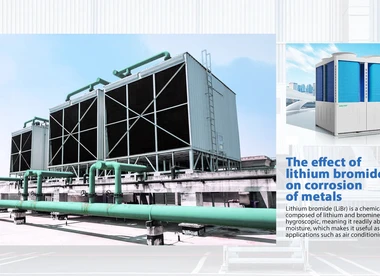
The effect of lithium bromide on corrosion of metals
The concentration of LiBr in solution can significantly affect the rate and severity of corrosion in metals. The concentration of lithium bromide can increase the corrosion rate, affect the pH of the solution, the formation of corrosion products, the solubility of oxygen, the effects of temperature, and also cause specific metal reactions.
Refrigeration cycles
As a refrigerant circulates through a system, it goes through a number of changes of state or conditions, each of which is called a transformation. The refrigerant starts from an initial state and returns to its initial state after going through a series of transformations called a cycle. Various refrigeration cycles are used to produce refrigeration, the most important of which are the compression refrigeration cycle, the absorption refrigeration cycle, and the thermoelectric refrigeration cycle.
Refrigeration and refrigerants
Any process in which heat is absorbed is called refrigeration. In general terms, a refrigerant is a substance that acts as a cooling agent by absorbing heat from a substance.
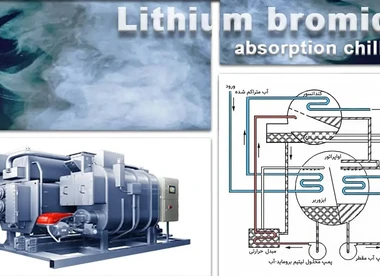
Working method of lithium bromide absorption chillers
Lithium bromide absorption chiller is one of the most common types of absorption chillers in which lithium bromide plays the role of absorbing water vapor to reduce the pressure in the evaporator chamber.
Submit your opinion
Your email address will not be published.