

Why do industrial systems require anti-freeze/coolant in the summer?
1405/03/02
Cooling Tower Chemical Cleaning Steps — Implementation Guide
1405/02/07
Types of sediments in RO systems and methods for identifying them
1405/02/05
Benefits of using specialized solutions from Abrizan Company for MED
1404/12/09
Cathodic protection method selection and system design

Factors affecting the design of a cathodic protection system:
The items that are important in designing a system and selecting a cathodic protection method and should be considered are:
- Potential size: Using the Evans curve, its potential is selected so that different metals in the cathodic area are protected.
- Circuit current: The current intensity (in amperes) required to reach the protective potential must be calculated.
- Anodic package distance: The greater the distance between the anodes and the part, the greater the current must be injected into the circuit to achieve more complete protection. Note: Too close to the anode to the part will prevent the current from reaching the entire surface (especially the back side of the part).
- The use of protective coatings and their effect on the design of the cathodic protection system should be considered.
- The size of the engineering part, length, width or diameter of the part, must be known in order to calculate the surface area and, as a result, the electrical resistance of the part.
- The type and type of soil are of particular importance in terms of chemical properties and determining its resistance.
- The possibility of stray currents, induced currents caused by high voltage current passing near the engineering component or the presence of transformers and other devices, must be considered.
Information required in the design of a cathodic protection system:
This information is divided into two main categories:
a) Site (area) information
b) Structure information
The above information is very necessary and essential for corrosion engineers, so we must become familiar with how to prepare each of these items.
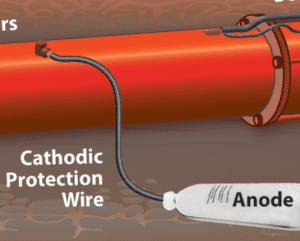
Site Information (Area):
A field survey to obtain site-related information should be conducted prior to design. This survey is divided into nine items according to the NACE-RPO169-96 standard, the most important of which is the soil electrical resistivity test. In the design of a cathodic protection system, information on the specific soil resistivity as an electrolyte is essential. The number and location of points where soil resistance should be measured depends on environmental conditions and soil type. Of course, economic and practical considerations limit the number of tests.
Structure Information:
The following information should be provided to the cathodic protection system designer by the engineers designing the piping system, pumping station, cooling tower, valves, etc.
- Size and length of underground pipes
- Location of change of status of pipes from underground to above ground
- Location and method of installation of valves and flanges
- Size and specifications of valves
- Working pressure and class of valves and other fittings
- How to install all pipelines such as: fire, gas pipes, cooling water, liquid fuels and determine the location of each intersection.
Factors affecting the selection of cathodic protection method:
The corrosion engineer or relevant technician must determine under different conditions which method to use for applying cathodic protection. The project manager must be able to compare the various factors affecting the two cathodic protection methods with each other and select the best one.
The following points are noteworthy from comparing the two cathodic protection methods considering the same conditions:
- Since sacrificial anodes have a certain current density depending on their type compared to the applied current method, applied current is used to protect large equipment under the same type of conditions.
- In the absence of access to electricity, sacrificial anodes that do not require a voltage source are used.
- In the applied current method, if there is insufficient accuracy, a reverse current may be created and corrosion may be intensified. However, this problem does not exist with the use of sacrificial anodes.
- In the applied current method, a specialist or a person familiar with the technical principles of the work is needed, while in the second method, it is sufficient to give the type of anode, its surface and their distances to a simple worker and there is no need for a specialist.
share :
Why do industrial systems require anti-freeze/coolant in the summer?
1405/03/02Cooling Tower Chemical Cleaning Steps — Implementation Guide
1405/02/07Types of sediments in RO systems and methods for identifying them
1405/02/05Benefits of using specialized solutions from Abrizan Company for MED
1404/12/09
Related articles
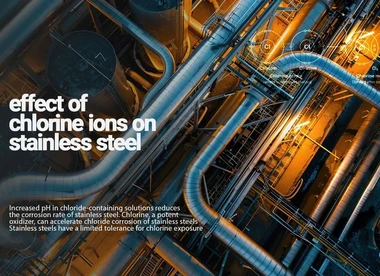
Effect of chlorine ions on stainless steels
The effect of chlorine and chloride parameters on the corrosion of stainless steels and the parameters affecting their corrosion rate, as well as the acceptable limits of chlorine ion levels in water and the differences in the effects of free chlorine and chloride on the corrosion of corrosion-resistant steels, are stated.
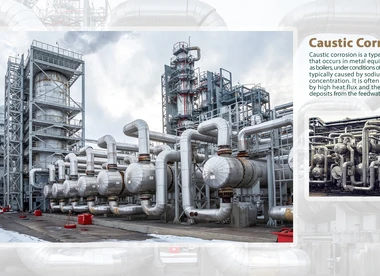
Caustic corrosion
Localized corrosion caused by the concentration of caustic or alkaline salts, which usually occurs under conditions of high evaporation or heat transfer. Caustic salt or caustic soda is one of the most widely used ionic compounds and is used in various industries including water treatment, cardboard and paper production, oil and refinery industries, aluminum production industries, food industries, alcohol production and glass.
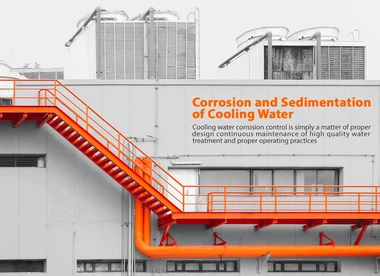
Corrosion and deposition of cooling water based on API 571
It refers to general or localized corrosion of carbon steels and other metals caused by dissolved salts, gases, organic compounds, or microbiological activity.

Microbial corrosion based on API 571
Microbial corrosion is a type of corrosion caused by living organisms such as bacteria, algae, or fungi. This type of corrosion is often associated with tubercles or slimy organic materials.
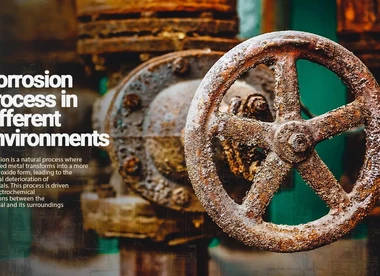
Corrosion process in different environments
Corrosion processes are divided into three groups in a more comprehensive classification: corrosion in aqueous solutions or environments, corrosion in molten salts and liquid metals, and corrosion in gases.
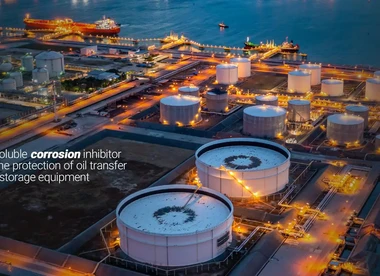
Oil-soluble corrosion inhibitor for the protection of oil transfer and storage equipment
Corrosion is a natural phenomenon that occurs as a result of the electrochemical reaction of metal with the surrounding environment. In the oil and gas industry, corrosion is one of the major problems that accounts for a huge amount of money annually. Part of these amounts are related to the corrosion of pipes or oil transmission lines. Effective ways to prevent corrosion of oil transmission and storage equipment are divided into two categories: physical and chemical solutions.

couponing
The coupon method or corrosion coupons is the simplest method of corrosion monitoring. Coupons are the oldest corrosion monitoring tool. Corrosion coupons are small pieces of metal or alloy of the material of interest that are immersed in the process medium and removed after a specified period of time and their weight or dimension loss is evaluated and examined.
Deaerators
Deaerators are mechanical devices that remove dissolved gases from the boiler feedwater. By reducing the concentration of oxygen and carbon dioxide in the solution, they minimize corrosion and protect the boiler from the effects of corrosive gases.
Submit your opinion
Your email address will not be published.