

Why do industrial systems require anti-freeze/coolant in the summer?
1405/03/02
Cooling Tower Chemical Cleaning Steps — Implementation Guide
1405/02/07
Types of sediments in RO systems and methods for identifying them
1405/02/05
Benefits of using specialized solutions from Abrizan Company for MED
1404/12/09
Drag reducing agent

Friction Reducer
In oil pipelines, the majority of the pressure drop is due to friction in the pipes. Friction in pipelines reduces flow rates and increases pumping and energy costs. This friction can be significantly reduced by injecting long-chain polymers (flow improvers). Pipeline flow improvers, or drag reducers, have been used in the petroleum industry for over 35 years.
The first application of friction reducers in the petroleum industry was to reduce downhole pressure drop while pumping fluids downhole into fracturing-resistant formations. One of the first large-scale pipeline applications was to increase crude oil throughput on the Trans-Alaska Pipeline in 1979. Drag reducers are useful in saving energy required for pumping because they reduce apparent viscosity. By reducing frictional pressure drop, drag reducers (DRAs) can increase throughput by over 90 percent of the pipeline’s mechanical capacity.
Uses of Strain Reducers
Stretch reducers are used in pipeline systems for the following purposes:
- Improving operational throughput
- Reducing pumping and energy costs
- Scheduled maintenance
- Increasing pipeline stability
- Easily transporting heavy crude oil
Reducing operating pressure
Mitreh Oil Lubricant (DRA)
Product Information:
This material is a white slurry liquid with a polymer base and an alcohol-like odor that is completely soluble in crude oil and is used to reduce friction in oil transmission pipelines, which leads to reduced flow rates and increased pumping and energy costs.
How is oil lubricant used?
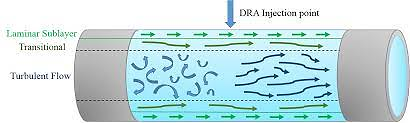
To use this chemical in the lines, a point on the pipe body is marked and by hot-tapping a hole in the pipe neck and installing a valve on it, DRA material is injected into the pipe through a hose at a certain pressure and due to the speed of action of the material dissolving in the fluids, the discharge is faster.
Due to its specific composition, DRA chemicals have no effect on oil and gas fluids.
This material is injected into the pipe immediately after the main pump of the line, and its injection pump must have a pressure higher than the pressure of the pipe line. If DRA passes through the main pump, usually due to high tension in the pump, the chains of DRA molecules are broken and lose their effects, so it is recommended to inject this material after the pump.
Drag reducing agent performance
The use of just a few parts per million of drag reducing agents helps reduce turbulence in the pipe. These materials, by affecting the rheological properties of the fluid, reduce the friction of fluids flowing in pipe beds. By using drag reducing agents, the amount of friction can be reduced by up to 60%, so the injection speed will increase with the use of these materials. Friction in pipelines leads to a decrease in flow rate and also increases pumping and energy costs. Adding various types of polymers embedded in pipelines to reduce friction during pumping operations of crude oil or other chemicals and derived products will make the pumping operation easier.
Of course, the degradation of polymers also occurs during flow. Due to the pressure and temperature on polymers, they are easier to decompose. For this reason, the friction reducing agent is injected again after points such as pumps and screws, where pressure and temperature can be very high. To protect against high temperature degradation, various types of drag reducing agents are sometimes used, such as polymers and surfactants. High molecular weight molecules are resistant to shear degradation, dissolve quickly in any pipe, and have little degradation in heat, light, chemicals, and biological environments.
Factors Affecting Friction
Other factors include pipe diameter, internal roughness, and pressure, which all contribute to friction. The smaller the pipe diameter, the greater the friction. The rougher the internal surface of the pipe, the greater the drag or friction, which is measured by the Reynolds number. Increasing pressure increases flow and reduces drag, but is limited by the maximum pressure rating of the pipe.
As can be seen in the figure, after adding DRA, the flow lines of the turbulent region became parallel, which led to ease in flow transfer.
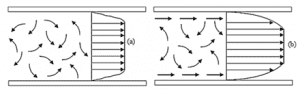
Figure (1): How DRA affects the lines of a turbulent flow before and after injection
share :
Why do industrial systems require anti-freeze/coolant in the summer?
1405/03/02Cooling Tower Chemical Cleaning Steps — Implementation Guide
1405/02/07Types of sediments in RO systems and methods for identifying them
1405/02/05Benefits of using specialized solutions from Abrizan Company for MED
1404/12/09
Submit your opinion
Your email address will not be published.