

Why do industrial systems require anti-freeze/coolant in the summer?
1405/03/02
Cooling Tower Chemical Cleaning Steps — Implementation Guide
1405/02/07
Types of sediments in RO systems and methods for identifying them
1405/02/05
Benefits of using specialized solutions from Abrizan Company for MED
1404/12/09
Galvanic or bimetallic corrosion

If two dissimilar metals (with different electrochemical potentials) are placed next to each other in an electrolyte so that an electrical connection is established between them, galvanic corrosion occurs.
In this case, the more active metal will corrode more intensely than if it were placed alone in the solution. However, the more noble metal is protected in this case and is not affected by corrosion.
The basis of galvanic corrosion is the formation of an electrochemical cell. Most alloys and metals, when in contact with a corrosive solution, form an electrochemical cell and an electric potential difference is created between the two metals that are in contact with each other in an electrolyte, which will cause an electric current to be generated between them. Compared to when the two metals are not connected to each other and corrode alone in the corrosive environment, their galvanic connection causes more corrosion in the metal with less resistance. In this situation, the metal with less resistance becomes the anode and the more resistant metal acts as the cathode.
Practical Examples of Galvanic Corrosion
One application of galvanic corrosion is in the cleaning of household silverware. Most tarnish on silverware is caused by silver sulfide. A simple electrochemical method involves placing the silver in an aluminum container containing water and baking soda (never use sodium chloride). The electric current produced by the contact of the silver and aluminum reduces the silver sulfide to pure silver. Sometimes, a magic metal is sold in stores that does the same thing. According to the instructions on the package, the magic metal must be attached to the silverware and placed in an enameled container containing a baking soda solution. The magic metal is actually a piece of aluminum or magnesium.
Connecting a new pipe to an old pipe of the same composition creates a galvanic cell, which causes severe corrosion of the new pipe. This occurs when a small section of old pipe has been replaced. In this case, the new tube corrodes more rapidly than the old tube.
In heat exchangers, thin-walled tubes made of corrosion-resistant metals such as copper or bronze are often connected to heavy steel tube sheets. In such heat exchangers, the steel is heavily corroded and protects the copper tubes from corrosion.
Factors Affecting Galvanic Corrosion
There are several factors that affect the galvanic corrosion of two metals in contact with each other, which can generally be divided into two categories: internal and external factors:
a) Internal factors
Internal factors affecting the rate of galvanic corrosion include: the type and nature of the two metals or alloys in contact, the structure, time, distance between the two metals, and the surfaces of the two metals in contact.
Metals with more active electrochemical potentials have a greater tendency to corrode than metals with more noble potentials.
Zinc and steel corrode alone in aqueous solutions, but when they form a galvanic cell, zinc becomes the anode and corrodes, and steel becomes the cathode and is protected.
Normally, tin metal is cathodic to steel, and it is expected that if they form a galvanic cell, the steel will corrode. But the interesting thing is that, in steel cans that have a tin coating, the tin in contact with acids from food produces tin complexes that are anodic to steel. Therefore, in food cans, when tin and steel form a galvanic cell, the tin will be responsible for protecting the steel. It is important to note that if this galvanic cell is formed in the atmosphere, tin will be cathodic to steel, and creating a scratch in the tin coating and exposing the base steel to the atmosphere will cause severe localized corrosion in the steel.
The structure of the alloy or metal has a significant effect on the corrosion rate. The chemical composition of adjacent grains, the orientation of the grains, and the type of grain boundaries are important structural factors in determining the severity of the corrosion rate.
In galvanic corrosion, the distance between the two metals is important. That is, the further away from the interface between the two metals, the less corrosion and its effects will occur, and the less galvanic corrosion will occur.
Another important factor in galvanic corrosion is the ratio of the cathode surface area to the anode surface area. If the cathode surface area is too large compared to the anode, severe localized corrosion will occur at the anode. The reason for this is that a small anode surface area must provide the current required to carry out the cathodic reaction on the large cathode surface area.
It should be noted that if the anode to cathode surface area ratio is too small, the corrosion rate may be 100 to 1000 times higher than when the anode and cathode surfaces are equal.
b) External factors
External factors are mostly limited to environmental phenomena and the effect of the electrolyte on the metal, which include: air humidity, ambient pH, electrolyte oxygen content, temperature and electrolyte turbulence.
One of the important effects of the electrolyte on galvanic corrosion is the ability to form a protective layer on the metal surface or its ability to destroy it. Usually, as a result of the reactions of the metal with the corrosive electrolyte, an insoluble layer of corrosion products is formed on the metal surface. This layer may play the role of dilute sulfuric acid due to the formation of a protective layer of lead sulfate on the lead surface, or similarly, it may protect iron against sodium hydroxide solution due to the formation of a protective layer of iron oxide.
Deposits such as potassium chromate that form a protective layer on the metal surface are called rusting agents. Such layers reduce the corrosion rate and ultimately protect the metal.
Some deposits (salts)
They cause the destruction of the protective layer, for example, halogenated compounds that, due to decomposition in solution, release chloride, bromide and iodide ions. These ions are able to destroy the protective layers formed on the surface of metals and accelerate the corrosion rate.
Changing the concentration of hydrogen ions in the solution (pH) is also very important in galvanic corrosion. By reducing the pH of the solution, the reaction of hydrogen gas production as the cathodic reaction can replace the cathodic reaction of oxygen reduction. As a rule, pH does not have a direct effect on anodic reactions. Because H+ and OH– ions do not participate directly in anodic reactions, but the indirect effect of pH includes changes in the solubility of corrosion products in the electrolyte or the ability to form a protective layer.
Methods of reducing or preventing galvanic corrosion
There are various methods to reduce or prevent galvanic corrosion. These methods are briefly explained below. In fact, to prevent this type of corrosion, sometimes it is sufficient to implement one method. While in some cases, two or more methods should be used simultaneously.
a) If it is necessary to use dissimilar metals, try to use metals that have a smaller distance from each other in the electrochemical series (emf) table.
b) Avoid using an unfavorable surface ratio between the anode and cathode, or in other words, avoid connecting a small anode to a large cathode. Small parts such as bolts and nuts or rivets are suitable for connecting more active metals to each other.
c) Insulate dissimilar metals to the extent that their direct contact is not possible.
d) If possible, appropriate inhibitors can be used to reduce the corrosiveness of the environment.
e) The anode sections should be designed in such a way that they can be easily replaced or selected thicker to have a longer life.
f) Connecting a third metal that is an anode to the two metals in contact (sacrificial anode).
g) For coating, we must cover the cathode because if we cover the anode, if the anode coating is destroyed, the ratio of the cathode surface to the anode surface will become very large and galvanic corrosion will increase.
h) Avoid connecting new metal to old metal.
share :
Why do industrial systems require anti-freeze/coolant in the summer?
1405/03/02Cooling Tower Chemical Cleaning Steps — Implementation Guide
1405/02/07Types of sediments in RO systems and methods for identifying them
1405/02/05Benefits of using specialized solutions from Abrizan Company for MED
1404/12/09
Related articles
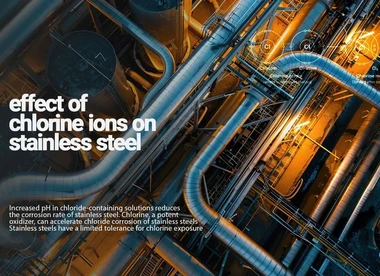
Effect of chlorine ions on stainless steels
The effect of chlorine and chloride parameters on the corrosion of stainless steels and the parameters affecting their corrosion rate, as well as the acceptable limits of chlorine ion levels in water and the differences in the effects of free chlorine and chloride on the corrosion of corrosion-resistant steels, are stated.
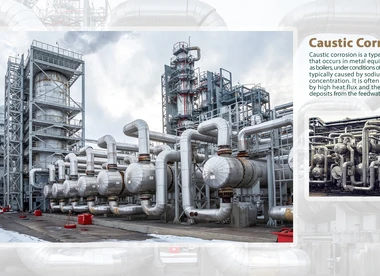
Caustic corrosion
Localized corrosion caused by the concentration of caustic or alkaline salts, which usually occurs under conditions of high evaporation or heat transfer. Caustic salt or caustic soda is one of the most widely used ionic compounds and is used in various industries including water treatment, cardboard and paper production, oil and refinery industries, aluminum production industries, food industries, alcohol production and glass.
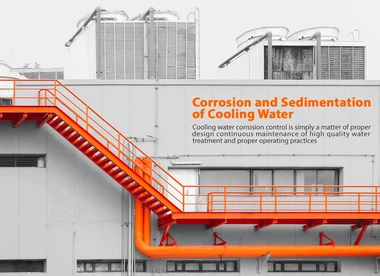
Corrosion and deposition of cooling water based on API 571
It refers to general or localized corrosion of carbon steels and other metals caused by dissolved salts, gases, organic compounds, or microbiological activity.

Microbial corrosion based on API 571
Microbial corrosion is a type of corrosion caused by living organisms such as bacteria, algae, or fungi. This type of corrosion is often associated with tubercles or slimy organic materials.
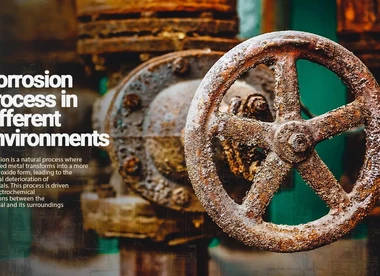
Corrosion process in different environments
Corrosion processes are divided into three groups in a more comprehensive classification: corrosion in aqueous solutions or environments, corrosion in molten salts and liquid metals, and corrosion in gases.
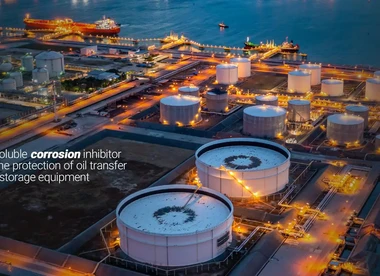
Oil-soluble corrosion inhibitor for the protection of oil transfer and storage equipment
Corrosion is a natural phenomenon that occurs as a result of the electrochemical reaction of metal with the surrounding environment. In the oil and gas industry, corrosion is one of the major problems that accounts for a huge amount of money annually. Part of these amounts are related to the corrosion of pipes or oil transmission lines. Effective ways to prevent corrosion of oil transmission and storage equipment are divided into two categories: physical and chemical solutions.

couponing
The coupon method or corrosion coupons is the simplest method of corrosion monitoring. Coupons are the oldest corrosion monitoring tool. Corrosion coupons are small pieces of metal or alloy of the material of interest that are immersed in the process medium and removed after a specified period of time and their weight or dimension loss is evaluated and examined.
Deaerators
Deaerators are mechanical devices that remove dissolved gases from the boiler feedwater. By reducing the concentration of oxygen and carbon dioxide in the solution, they minimize corrosion and protect the boiler from the effects of corrosive gases.
Submit your opinion
Your email address will not be published.