

Why do industrial systems require anti-freeze/coolant in the summer?
1405/03/02
Cooling Tower Chemical Cleaning Steps — Implementation Guide
1405/02/07
Types of sediments in RO systems and methods for identifying them
1405/02/05
Benefits of using specialized solutions from Abrizan Company for MED
1404/12/09
Pitting corrosion

Introduction
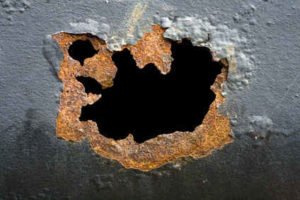
Pittling corrosion is a type of localized corrosion that causes holes in the metal, resulting in perforation and deterioration. This type of corrosion is much more dangerous than uniform corrosion, because it is difficult to detect and predict the occurrence of holes, and the holes are sometimes isolated and sometimes so close together that they cause a rough surface on the metal.
The main problem with this type of corrosion is that it cannot be detected by weight loss and surface inspection methods. While the weight loss from this type of corrosion is insignificant, the holes created can lead to expensive repairs of valuable equipment. A small, narrow hole with minimal metal loss can destroy an engineering system. Pitting corrosion occurs in various types of metals and alloys.
This type of corrosion occurs more often for metals that have a rust layer formed on their surface. In this way, if the layer is destroyed at one point, that point serves as the starting point of the hole and the hole will continue to grow there. In this type of corrosion, there are two stages of initiation and growth (diffusion). That is, initially, corrosion must start from a point and after this hole reaches a suitable depth, the growth stage begins. In the initial stage, any factor that causes inhomogeneity in the metal surface or corrosive environment can be a point for the initiation of the hole. It should be noted that not every hole will grow unless the conditions for the solution to be trapped in that hole exist.
Shape of the holes
Pores usually grow in the direction of gravity. Most holes are formed on horizontal surfaces, grow downwards, and a small number are formed on vertical surfaces. Holes rarely grow on surfaces above the corrosive environment.
The shape of the holes is very variable and depending on the metallurgy of the metal, alloy or the chemical composition of the corrosive environment, the holes may appear in the form of oval, round, prismatic, irregular, etc.
Usually, the shape of the holes for iron-based alloys such as stainless steel is plate-shaped, conical or hemispherical.
Most of the holes are difficult to see because they are small and sometimes covered by corrosion products.
Factors affecting pitting corrosion
This type of corrosion often occurs in metals that exhibit active-reactive behavior, such as stainless steel, aluminum, and titanium. Of course, in a general classification, stainless steels are more sensitive to pitting corrosion than other metals and alloys.
The most important factors affecting pitting corrosion
a) Metal type: Of all metals and alloys, stainless steels are among the most susceptible metals to corrosion.
b) Surface condition: The less surface heterogeneity of the alloy, the more resistant the protective layer that forms on it will be to corrosion.
The smoother the surface of the metal with the alloy, the greater the corrosion resistance, the fewer the holes, but usually the holes formed on smooth and polished surfaces are larger and penetrate more quickly.
c) Metallurgical structure: The metallurgical structure of a metal or alloy, grain boundaries, crystal defects, and alloying elements have a significant effect on the corrosion resistance of an alloy.
d) Velocity of the corrosive fluid: The movement of a solution over a metal surface often reduces pitting corrosion and may even prevent this type of corrosion. In other words, this corrosion occurs to a much lesser extent in moving solutions than in stagnant and stagnant solutions. For example, a stainless steel pump in seawater will not cause any problems as long as it is operated continuously, but if the same pump is not operated for a while, pitting corrosion will occur.
e) Solution composition: Most pitting corrosion is exacerbated by the presence of chloride ions, oxygen, and oxidizing salts such as copper and iron halides. In general, the critical pitting potential decreases with increasing halide ions in the solution.
The pH of the solution plays a decisive role in the occurrence of pitting corrosion. Pitting corrosion can occur over a wide pH range, meaning that as the pH increases, the critical pitting potential increases and the rate of pitting corrosion decreases. This can be attributed to the high power of OH– ions to pit the surface.
f) Temperature: One of the important factors affecting corrosion is temperature. Increasing temperature significantly reduces the critical pitting potential and increases the rate of pitting corrosion.
g) Mechanical factors: The most severe form of pitting corrosion occurs when the surface pitting layer of a metal in a corrosive solution is destroyed or broken by mechanical factors such as stress.
Methods for reducing or preventing pitting corrosion
Pitting corrosion and crevice corrosion are very close to each other, so the ways to prevent pitting corrosion are the same as the methods mentioned for preventing crevice corrosion. The following can prevent the development of corrosion to some extent:
- The system design should be such that complete drainage of the solution from all parts and the possibility of inspection and cleaning of other parts is possible when the system is immersed
- Selecting materials and using alloys that have relatively good resistance to corrosion in a corrosive environment. For example, by adding 2% molybdenum to type 304 stainless steel, type 316 steel is created, which has a very high resistance to pitting. For this purpose, stainless steel with 2% molybdenum can be used.
- Changing environmental conditions: reducing the concentration of chlorine ions, lowering the temperature, reducing the acid and reducing the concentration of the oxidant.
- Applying a cathodic protection system using the applied current method in solutions with low electrical conductivity using sacrificial anodes in the solutions
- With high electrical conductivity, it can be useful in controlling pitting corrosion of metals and alloys.
- Use of protective coatings: Organic coatings, zinc-rich paints, and zinc itself are often used.
- Proper use of inhibitors so that they can fully inhibit and control pitting corrosion. Otherwise, not only will it not reduce pitting corrosion, but it will also cause rapid corrosion increase.
share :
Why do industrial systems require anti-freeze/coolant in the summer?
1405/03/02Cooling Tower Chemical Cleaning Steps — Implementation Guide
1405/02/07Types of sediments in RO systems and methods for identifying them
1405/02/05Benefits of using specialized solutions from Abrizan Company for MED
1404/12/09
Related articles
Effect of chlorine ions on stainless steels
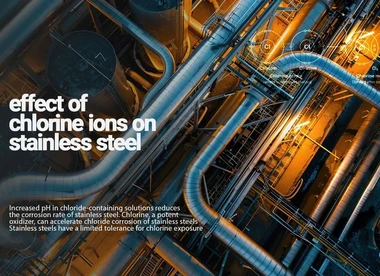
The effect of chlorine and chloride parameters on the corrosion of stainless steels and the parameters affecting their corrosion rate, as well as the acceptable limits of chlorine ion levels in water and the differences in the effects of free chlorine and chloride on the corrosion of corrosion-resistant steels, are stated.
Caustic corrosion
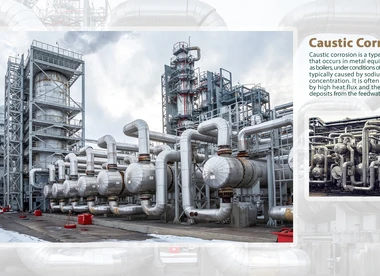
Localized corrosion caused by the concentration of caustic or alkaline salts, which usually occurs under conditions of high evaporation or heat transfer. Caustic salt or caustic soda is one of the most widely used ionic compounds and is used in various industries including water treatment, cardboard and paper production, oil and refinery industries, aluminum production industries, food industries, alcohol production and glass.
Corrosion and deposition of cooling water based on API 571
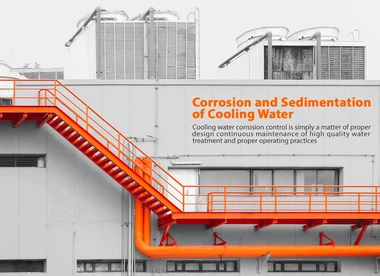
It refers to general or localized corrosion of carbon steels and other metals caused by dissolved salts, gases, organic compounds, or microbiological activity.
Microbial corrosion based on API 571
Microbial corrosion is a type of corrosion caused by living organisms such as bacteria, algae, or fungi. This type of corrosion is often associated with tubercles or slimy organic materials.
Corrosion process in different environments
Corrosion processes are divided into three groups in a more comprehensive classification: corrosion in aqueous solutions or environments, corrosion in molten salts and liquid metals, and corrosion in gases.
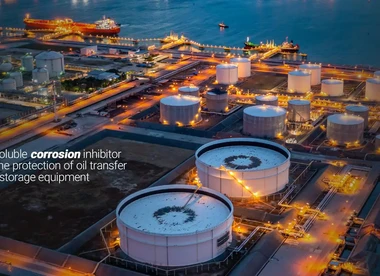
Oil-soluble corrosion inhibitor for the protection of oil transfer and storage equipment
Corrosion is a natural phenomenon that occurs as a result of the electrochemical reaction of metal with the surrounding environment. In the oil and gas industry, corrosion is one of the major problems that accounts for a huge amount of money annually. Part of these amounts are related to the corrosion of pipes or oil transmission lines. Effective ways to prevent corrosion of oil transmission and storage equipment are divided into two categories: physical and chemical solutions.

couponing
The coupon method or corrosion coupons is the simplest method of corrosion monitoring. Coupons are the oldest corrosion monitoring tool. Corrosion coupons are small pieces of metal or alloy of the material of interest that are immersed in the process medium and removed after a specified period of time and their weight or dimension loss is evaluated and examined.
Deaerators
Deaerators are mechanical devices that remove dissolved gases from the boiler feedwater. By reducing the concentration of oxygen and carbon dioxide in the solution, they minimize corrosion and protect the boiler from the effects of corrosive gases.
Submit your opinion
Your email address will not be published.