

Why do industrial systems require anti-freeze/coolant in the summer?
1405/03/02
Cooling Tower Chemical Cleaning Steps — Implementation Guide
1405/02/07
Types of sediments in RO systems and methods for identifying them
1405/02/05
Benefits of using specialized solutions from Abrizan Company for MED
1404/12/09
Polymers and their structure

Synthetic Materials (Polymers)
In an effort to achieve new materials, humans have achieved the production of synthetic materials using organic materials (mainly hydrocarbons) found in nature. These materials mainly contain the elements carbon, hydrogen, oxygen, nitrogen and sulfur and are known as polymeric materials. Polymers or synthetic materials have a wide range of applications, including in the manufacture of household appliances, toys, packaging, bags and suitcases, shoes, tables and chairs, hoses and water pipes, coating materials as paints for corrosion protection and decoration, car tires and finally as engineering polymers with high strength even at relatively high temperatures in the manufacture of machine components.
Advantages of polymers
Polymers have relatively good and useful physical and mechanical properties. They have a low specific gravity and good stability against chemicals. Some of them are transparent and can replace glass. Most polymers are electrical insulators. But there are also certain polymers that are electrically conductive to some extent. The insulation of polymers is related to the covalent bonds between atoms in molecular chains. However, research conducted in recent years has shown that it is possible to create electrical conductivity along the axis of the molecules. These types of polymers are basically composed of polystyrene.
Doping polymers
By infiltrating elements such as alkali metals or halogens (doping process) into the molecular chains of polystyrene, N- and P-type polymer semiconductors are obtained, respectively. Adding elements or doping allows electrons to move along the carbon atoms in the chain. Teflon is a polymer material that is used as a coating to prevent food from sticking to cooking utensils due to its low coefficient of friction.
Structure of polymers
Most common polymers are obtained from the polymerization of simple organic molecules called monomers. For example, polyethylene (PE) is a polymer that is obtained by polymerization by adding (combining) several ethylene molecules. Each ethylene molecule is called a monomer. With the right combination of heat, pressure, and catalyst, the double bond between the carbon atoms is broken and replaced by a single covalent bond. The two free ends of this monomer are now converted into free radicals, so that each carbon atom has a single electron that can be added to other free radicals. Therefore, there are two sites (related to the carbon atom) in ethylene where other molecules can be attached.
This reactive molecule is the building block of polymers and is called a (mer) or more repeating unit. The repeating unit is repeated many times along the chain of the polymer molecule. The average length of the polymer depends on the degree of polymerization, or the number of repeating units in the polymer molecule chain.
Therefore, the ratio of the molecular mass of the polymer to the molecular mass of the repeating unit is defined as (degree of polymerization). As the molecular chain becomes larger (if only intermolecular forces bind the molecules together), both the thermal resistance and tensile strength of the polymer materials increase.
Polymerization Process
In general, the polymerization process can be carried out in different ways such as additive, stepwise, etc. In additive polymerization, a number of repeating units are added to each other and produce a larger molecule called a polymer. In this type of polymerization, first in the first stage, free radicals are created by giving energy (thermal, light) to ethylene molecules with a double bond and breaking the double bond.
Then, free radicals are added to the repeating units to form active centers called initiators, and each of these centers is added to other repeating units and the growth of the polymer continues. Theoretically, the degree of addition polymerization can be unlimited, in which case a very long chain molecule is formed by connecting a large number of repeating units to each other.
However, in practice, chain growth does not occur indefinitely. The greater the number of active centers or initiators formed, the greater the number of chains and consequently the shorter the chain length, which is why the properties of polymers change. Of course, the growth rate also affects the length of the chains. When all the repeating units and chains are connected to each other, growth ends.
Another method of polymerization is step polymerization, in which monomers react chemically with each other to form linear polymers. In many step polymerization reactions, a small molecule is formed as a byproduct. This type of reaction is sometimes called condensation polymerization.
share :
Why do industrial systems require anti-freeze/coolant in the summer?
1405/03/02Cooling Tower Chemical Cleaning Steps — Implementation Guide
1405/02/07Types of sediments in RO systems and methods for identifying them
1405/02/05Benefits of using specialized solutions from Abrizan Company for MED
1404/12/09
Related articles
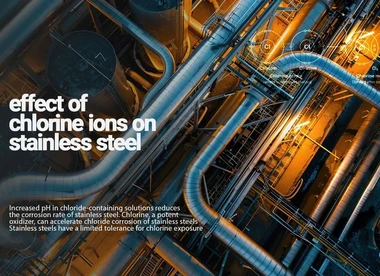
Effect of chlorine ions on stainless steels
The effect of chlorine and chloride parameters on the corrosion of stainless steels and the parameters affecting their corrosion rate, as well as the acceptable limits of chlorine ion levels in water and the differences in the effects of free chlorine and chloride on the corrosion of corrosion-resistant steels, are stated.
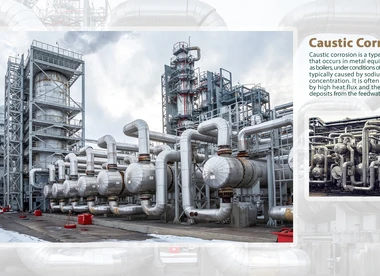
Caustic corrosion
Localized corrosion caused by the concentration of caustic or alkaline salts, which usually occurs under conditions of high evaporation or heat transfer. Caustic salt or caustic soda is one of the most widely used ionic compounds and is used in various industries including water treatment, cardboard and paper production, oil and refinery industries, aluminum production industries, food industries, alcohol production and glass.
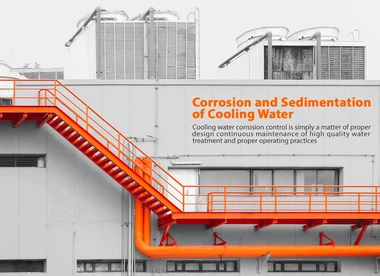
Corrosion and deposition of cooling water based on API 571
It refers to general or localized corrosion of carbon steels and other metals caused by dissolved salts, gases, organic compounds, or microbiological activity.
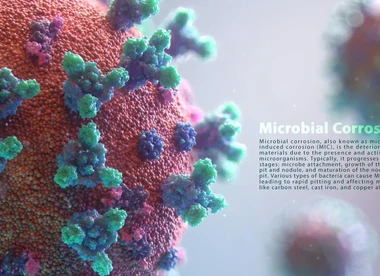
Microbial corrosion based on API 571
Microbial corrosion is a type of corrosion caused by living organisms such as bacteria, algae, or fungi. This type of corrosion is often associated with tubercles or slimy organic materials.
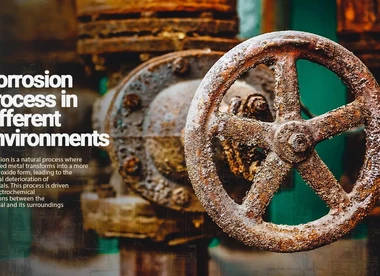
Corrosion process in different environments
Corrosion processes are divided into three groups in a more comprehensive classification: corrosion in aqueous solutions or environments, corrosion in molten salts and liquid metals, and corrosion in gases.
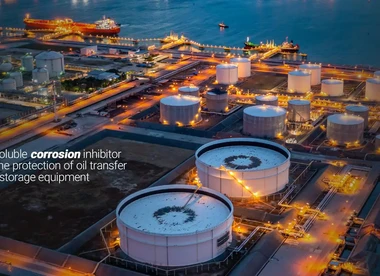
Oil-soluble corrosion inhibitor for the protection of oil transfer and storage equipment
Corrosion is a natural phenomenon that occurs as a result of the electrochemical reaction of metal with the surrounding environment. In the oil and gas industry, corrosion is one of the major problems that accounts for a huge amount of money annually. Part of these amounts are related to the corrosion of pipes or oil transmission lines. Effective ways to prevent corrosion of oil transmission and storage equipment are divided into two categories: physical and chemical solutions.

couponing
The coupon method or corrosion coupons is the simplest method of corrosion monitoring. Coupons are the oldest corrosion monitoring tool. Corrosion coupons are small pieces of metal or alloy of the material of interest that are immersed in the process medium and removed after a specified period of time and their weight or dimension loss is evaluated and examined.
Deaerators
Deaerators are mechanical devices that remove dissolved gases from the boiler feedwater. By reducing the concentration of oxygen and carbon dioxide in the solution, they minimize corrosion and protect the boiler from the effects of corrosive gases.
Submit your opinion
Your email address will not be published.