

Why do industrial systems require anti-freeze/coolant in the summer?
1405/03/02
Cooling Tower Chemical Cleaning Steps — Implementation Guide
1405/02/07
Types of sediments in RO systems and methods for identifying them
1405/02/05
Benefits of using specialized solutions from Abrizan Company for MED
1404/12/09
Power plant cooling system

Cooling in the Power Industry
In the United States, 90 percent of electricity is generated by thermal or thermoelectric power plants—coal, nuclear, natural gas, and oil—which require cooling. The remaining 10 percent is generated by hydroelectric and other renewable energy sources. Some renewable energy technologies also fall into the thermoelectric category, including certain types of solar, geothermal, and biomass power plants.
Why is cooling necessary?
A thermoelectric power plant boils water to create steam, which then spins turbines to generate electricity. The heat needed to boil the water can come from burning fuel, nuclear reactions, or directly from the sun or other sources, including geothermal energy underground. When the steam passes through a turbine, it must be cooled to water before it can be reused to generate more electricity. Colder water cools the steam more effectively and increases the efficiency of electrical energy generation.
Types of Cooling
Even though all thermoelectric power plants use water to produce steam and thus electricity, not all power plants use water as their cooling systems.
There are three main methods of cooling:
In once-through systems, water from a nearby source (such as a river, lake, aquifer, or ocean) is used, circulated through pipes to absorb heat from the steam in systems called exchangers, and the hot water is then discharged back into the same local source. Initially, once-through systems were the most popular due to their simplicity, low cost, and ability to locate plants in locations with abundant cooling water supplies. This type of system is now widespread in the eastern United States. Very few new power plants use once-through cooling systems, due to the disruption such systems cause to local ecosystems and due to the increasing restrictions on siting plants near existing water sources.
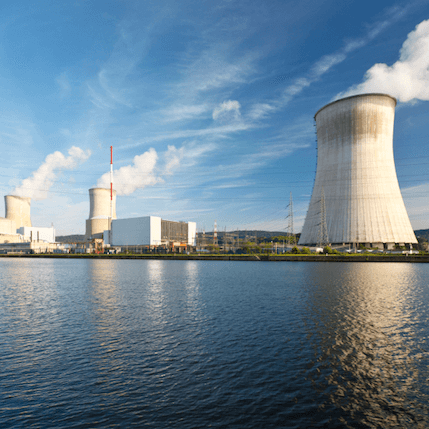
A recirculating or closed-loop cooling system reuses the cooling water in another stage before returning it to the main water source immediately after discharge. Most recirculating systems use cooling towers to add some moisture to the ambient air. Some of the water evaporates and the rest is then sent to the power plant's heat exchanger. Since in recirculating systems, water is only added to replace water lost through evaporation in the cooling towers, these systems require much less water than once-through systems, but they tend to use significantly more water. In the western United States, recirculating systems are dominant.
Dry cooling systems use air instead of water to cool the steam leaving the turbine. Dry cooling systems operate without water consumption and can reduce overall plant consumption by more than 90 percent. This water saving comes at the cost of higher operating costs and lower efficiency. In power plants, lower efficiency means that more fuel is needed to produce each unit of electricity, which in turn leads to air pollution and environmental impacts from the extraction, processing, and transportation of the fuel. In 2000, most dry-cooling installations in the United States were common in smaller power plants, particularly natural gas-fired combined-cycle power plants. About 43 percent of thermoelectric generators in the United States use once-pass cooling, 56 percent reflow cooling, and 1 percent dry cooling (2008 data). In 2008, about 30 percent of electricity generation was generated using once-pass cooling, 45 percent reflow cooling, and 2 percent dry cooling. In some cases, similar power plants also generate electricity using non-steam systems such as combustion turbines.
One-time pass | Rotary | Dry cooling | ||||
Consumer | Output | Consumer | Output | Consumer | Output | |
Regular (coal) | 100–317 | 20,000–50,000 | 480–1,100 | 500–1,200 | N/A | N/A |
Natural gas (combined cycle) | 20–100 | 7,500–20,000 | 130–300 | 150–283 | 0 – 4 | 0–4 |
Nuclear | 100–400 | 25,000–60,000 | 600–800 | 800–2,600 | N/A | N/A |
Solar thermal | N/A | N/A | 725–1,109 | 725–1,109 | 43 – 79 | 43–79 |
Water input and output for power plant cooling, in gallons of water required per megawatt hour of electricity generated.
Other key issues
Location: The geographic location of a power plant has a major impact on cooling technology options, water availability, the type of water used for cooling, and environmental impacts. For example, solar and geothermal power plants need to be located in areas with high solar radiation and high geothermal energy. These locations may be arid and remote from conventional natural resources. In this case, dry cooling may be an option, or alternative water sources may be available, but such choices can affect the performance of the power plants and the local environment.
Type of water: Although many power plants use freshwater for cooling, wastewater and saltwater are other options available, each with its own advantages and disadvantages. For example, saltwater is an obvious and abundant option for coastal power plants, but such plants face similar challenges to inland power plants in terms of damaging coastal aquatic ecosystems through over-extraction or thermal pollution.
Technologies that use cooling:
Conventional electricity
- Coal
- Nuclear
- Natural gas
- Oil
Renewable electricity
- Concentrated solar (solar thermal power)
- Geothermal
- Biomass
share :
Why do industrial systems require anti-freeze/coolant in the summer?
1405/03/02Cooling Tower Chemical Cleaning Steps — Implementation Guide
1405/02/07Types of sediments in RO systems and methods for identifying them
1405/02/05Benefits of using specialized solutions from Abrizan Company for MED
1404/12/09
Related articles

Cooling Tower Chemical Cleaning Steps — Implementation Guide
Step-by-step guide to cooling tower chemical flushing. From preparation to restart. Restore system efficiency.

The three main enemies of cooling towers: scale, corrosion, biofouling
A comprehensive guide to identifying and controlling the three main cooling tower problems: scaling, corrosion, and biofouling. Increase system efficiency

What is a chiller and what are its types? A comprehensive guide to choosing the best cooling system
Comprehensive guide to chiller selection: Comparison of Water-Cooled, Air-Cooled, Absorption, Scroll, Screw and their applications in hospitals, petrochemicals and the food industry.

Lithium Bromide Absorption Chillers: Application, Performance, and Maintenance Challenges
How do lithium bromide absorption chillers work? Why are they suitable for air conditioning systems? A comprehensive guide to their performance, benefits, limitations, and chemical maintenance.

What is an absorption chiller? A comprehensive guide to the operation, benefits and challenges of thermal cooling systems
How does an absorption chiller produce cold with heat? Differences from a compression chiller, chemical challenges and maintenance solutions + analysis of lithium bromide solution.

Signs of the need for cooling tower chemical clean?
Is your cooling tower losing efficiency? Increasing temperatures? Bad odors? In this technical guide, learn 10 surefire signs your cooling tower needs chemical flushing — before irreparable damage occurs.

Types of cooling towers in terms of airflow | natural, mechanical, forced, induced, mixed
With a complete introduction to the 5 types of cooling towers in terms of airflow (natural, mechanical, forced, induced, mixed) and how each operates, choose the best chemical maintenance method to increase the efficiency and life of your equipment.

What is a chiller?
Chiller is derived from the Latin word Chill, meaning to cool. Various cycles are used to create refrigeration, the most important of which are the compression refrigeration cycle, the absorption refrigeration cycle, and the thermoelectric refrigeration cycle.
Submit your opinion
Your email address will not be published.