

Why do industrial systems require anti-freeze/coolant in the summer?
1405/03/02
Cooling Tower Chemical Cleaning Steps — Implementation Guide
1405/02/07
Types of sediments in RO systems and methods for identifying them
1405/02/05
Benefits of using specialized solutions from Abrizan Company for MED
1404/12/09
Crisis management and securing industries and mines

A Look at Crisis Management in Industry
Today, industrial accidents and crises caused by natural disasters threaten human life and health much more widely and severely than in the past. Experience has shown that any society that has made efforts to deal with such accidents, has thought of solutions, and has widely educated people about observing safety principles before the accident occurs, has not been surprised when faced with accidents and has significantly reduced the amount of human injuries and financial losses, and has provided greater security for people's lives and property.
There is much evidence that even in many industries and mines that have succeeded in obtaining international certifications, including ISO14001 and OHSAS18001, the issue of preparedness to deal with crises and making workshops safe has not been taken seriously, and has been satisfied with the superficial aspects of the issue, such as holding a few training courses and installing a few signs and signs.
This is while crisis management in industries requires the presence of various elements such as facilities, equipment, and numerous resources, and along with these, training is considered the most important element of preparedness. It is recalled that preventive measures begin with decisions made by senior management and must be supported and guided by middle management and workshop supervisors. However, coping and implementation of operations depend on the skills and readiness of "all employees".
Crisis Management
Today's world has become alarmingly vulnerable to the occurrence of natural crises and industrial disasters and their consequences. A crisis is an incident that imposes significant human, financial and environmental losses on society in a short period of time, such that eliminating the effects of these events requires taking fundamental and extraordinary measures.
Crisis management is an applied science that systematically observes and analyzes crises in search of tools that can prevent crises from occurring or prepare for them in order to provide rapid relief and normalize the situation in the event of a crisis.
Crisis management in an industrial unit includes a comprehensive system in which all elements of the organization play a role in a “more or less”, “weak or effective” way. Because the decisions that each small element of the organization makes simultaneously in an emergency situation are somehow effective in crisis management. In other words, a comprehensive crisis management system will be successful when all decisions and actions taken in an emergency situation are organized in advance with training and planning mechanisms.
The necessity of crisis management
It is necessary to consider crisis management in industries and mines for the following reasons:
- Incorrect insight and attitude regarding the causes of occupational accidents and emergencies
- Incomplete compliance with safety principles in some industries and mines
- The majority of employees do not have sufficient safety knowledge
- Inattention to safety points when constructing factories
- Creating industrial cities and towns and the proximity of various factories without considering safety standards
- The proximity of some factories with high risk potential to residential areas
- The possibility of natural disasters
- Problems related to incoordination between various relief organizations outside the workplace
- International requirements such as ISO 14001, OHSAS 18001 and HSE_MS
The emergence of crises in industrial centers is usually accompanied by the following losses:
- Direct damage to the organization's largest capital, namely human resources
- Damage to assets and capital
- Many problems in delivering goods on time and losing customers
- Waste of resources to Purpose of compensation
- Serious damage to the environment
- Payment of legal offenses
- Damage to public trust and reduction in stock value
Preparation for earthquakes and floods
Earthquakes are a natural phenomenon and their occurrence is inevitable. Human knowledge has not yet succeeded in predicting the exact time of an earthquake. Therefore, it is necessary to think of special measures to prepare for this devastating phenomenon.
Our country is significantly earthquake-prone due to its location on the "Alps-Himalayan" earthquake belt. Out of 678 cities in the country, 660 cities are located on the earthquake line and 24 cities are located in the earthquake-prone area. On average, an earthquake of magnitude 6 occurs in Iran every year and an earthquake of magnitude 7 occurs every 10 years. In this regard, earthquake engineering training and retraining courses are the most important tool for updating the information of managers, supervisors and engineers so that they can have a more correct understanding of the concepts and terms discussed in this regard by increasing their knowledge, information and skills in the field of earthquakes. The following topics should be considered in training courses:
- Methods for retrofitting workshops, warehouses, strategic facilities, tanks, boilers, etc.
- Methods for preventing fires, explosions, and material leaks
- Methods for retrofitting the crisis management center, emergency, safety, and firefighting
- Methods for reducing casualties, financial, and environmental losses
- Exercises and maneuvers
It is necessary to conduct audits at various stages to control the effectiveness of earthquake management. This audit is conducted to identify the factory's capacity in terms of earthquake preparedness and facilities for responding to the effects and consequences of an earthquake. By preparing and developing an audit checklist and developing it, senior managers can assess the level of preparedness of their department regarding earthquakes, given the nature of their work.
Although most cities and many factories and mines in the country are always exposed to flood damage and suffer great losses every year due to floods, unfortunately, apart from some scattered relief and rescue measures, and that too after the flood and local and temporary measures, no comprehensive plan has been developed to equip factories and other industrial centers against flood hazards. Some of the
The costs of flooding are as follows:
- Damage related to destruction and damage to buildings
- Cost of stopping the production line and reducing income
- Cost of cleaning buildings, devices, facilities and factory premises
- Cost of loss of documents and records in the office
- Cost of equipment and furniture in office buildings being unused
- Damage to water supply, sewage, telecommunications networks, etc.
- Cost of purchasing machines and equipment
- Cost of loss of public spaces and green spaces
- Cost of rescue, emergency and firefighting
Fire
Fire is an important destructive factor that, if safety precautions are not followed, causes great loss of life and property, and is unfortunately associated with many natural disasters and work-related accidents.
Fires that occur following earthquakes, floods, storms, lightning or occupational accidents often result in more injuries and destruction than the initial event. Also, war and enemy attacks today cause more widespread fires in factories than in the past.
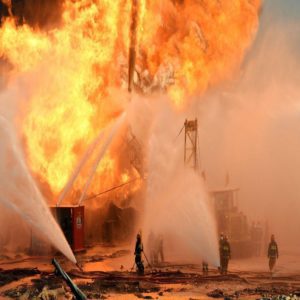
The main causes of human casualties in fires are:
- Smoke
- Gases and vapors
- High heat
Smoke is produced in all fires. If the smoke is dense, it prevents the observation of any signs and guides and even hides the main source of the fire from view. The most important gases and vapors that are usually emitted in fires include carbon oxides, acetic acid, acrolein, acetaldehydes and hydrogen sulfide. The gases produced by fires are very diverse and can be divided into three categories: suffocating gases, irritating gases and toxic gases. In addition, if the body tissues are exposed to heat higher than normal body temperature, damage will occur to humans depending on the level of heat.
Contractors
In addition to all official company employees, contractor employees must also complete the training courses provided in the field of crisis management and participate in exercises so that they can perform their duties in an emergency. There should be a necessary proportion between the company and the contractors at the time of signing the contract in order to create coordination between the company's emergency response instructions and the contractors' instructions so that in an emergency, the response operations can be started and continued in complete coordination without interfering with tasks and parallel work.
Also, when signing the contract, the person responsible for providing the necessary tools and equipment to deal with the crisis should be clearly stated. These tools include drills, cutting machines, gas meters, flashlights, ropes, stretchers, first aid kits, safety helmets and shoes, and breathing masks.
The contract should be structured in such a way that it requires the contractor to report any defects, deficiencies, potential hazards, and abnormal conditions as soon as possible. The documentation and reporting method should be agreed upon by the company and the contractor. In abnormal and emergency conditions, the contractor's employees are required to strictly implement the orders of the crisis response operations commander. The contractor must introduce a person to the company along with his/her successor for crisis response operations.
Psychological and emotional stress
Without a doubt, the consequences of occupational accidents and natural disasters have a profound impact on the psyche of individuals, especially observers, victims, and rescuers. An impact that sometimes stays with these people for the rest of their lives. This is why some experts believe that the greatest impact of such accidents is their profound psychological and emotional effects.
In addition to those who are directly affected by such disasters, people who have lost their loved ones, property, and social status also suffer from various psychological states. Of course, in the post-disaster phase, more cases of psychological stress and trauma occur, some of which are related to the disaster itself and some of which are seemingly unrelated to the disaster, but simply emerge at this time. For example, legal issues can be raised, such as who should pay for damages or financial assistance. Why did this disaster occur in the first place? Issues such as these, and anger over broken promises and bureaucratic red tape, combine to make this phase a stronger factor in creating post-disaster psychological stress.
Source:
Toosi, Mohammad Reza, Crisis Management and Securing Industries and Mines, Iran Industrial Education and Research Center, Tehran, 2005.
share :
Why do industrial systems require anti-freeze/coolant in the summer?
1405/03/02Cooling Tower Chemical Cleaning Steps — Implementation Guide
1405/02/07Types of sediments in RO systems and methods for identifying them
1405/02/05Benefits of using specialized solutions from Abrizan Company for MED
1404/12/09
Related articles
What is RCFA? A comprehensive guide to investigating the root causes of damage in industry + benefits and implementation steps
Are recurring failures causing heavy costs in your industrial unit? In this comprehensive article, learn about the RCFA (Root Cause Analysis) method, implementation steps, benefits, and real-world examples, and learn how to prevent failures from recurring.

Process units in oil refineries and petrochemical industries
An oil refinery consists of several operating units and process units. An operating unit is a fundamental step in a process. Like the evolution of the planet, life, and technology, the oil refining industry has been developing with increasing complexity since its founding in 1859. An operating unit consists of physical and chemical processes. The main purpose of refinery units is to extract useful substances from crude oil.

Water management in refineries
Feedwaters to a refinery are usually treated before being used in various processes. The type of treatment depends on the quality of the source water and its end use in the refinery. Turbidity, sediment, and hardness are examples of source water characteristics that may require treatment.
Submit your opinion
Your email address will not be published.