

Why do industrial systems require anti-freeze/coolant in the summer?
1405/03/02
Cooling Tower Chemical Cleaning Steps — Implementation Guide
1405/02/07
Types of sediments in RO systems and methods for identifying them
1405/02/05
Benefits of using specialized solutions from Abrizan Company for MED
1404/12/09

Descaling of marine equipment

Chemical descaling of cooling box systems of ships, tugboats and various vessels
Systems in the operation lines of various industries such as power plants, refineries, petrochemicals, drilling and acidizing operations of oil wells, etc., which operate in aqueous and humid environments. Under various conditions such as pressure, temperature and purity of the process water, after a while, deposits form on the inner wall of the layers, which are most often iron oxide layers or adhered carbonate and silicate deposits. The heat transfer surfaces are the hottest point that the cooling water reaches.
The solubility of calcium carbonate present in the device is inversely related to temperature, as a result, the possibility of calcium carbonate settling and precipitation occurs on the heat transfer surfaces. The accumulation of calcium carbonate sediment layers reduces heat transfer, which causes corrosion and creates hot spots that themselves cause thermal stress. All of these will affect the efficiency and life of the device, which will cause a decrease in device efficiency. Therefore, considering the above, the purpose of this article is to select the appropriate corrosion inhibitor.
Seawater is used to cool equipment and heat exchangers in ships. Seawater contains significant amounts of mineral salts, including sulfate, chloride, and carbonate. These substances cause sediment in the exchangers over time. In addition to mineral salts, seawater is a huge source of microorganisms.
Which, upon entering the cooling heat exchangers and considering the appropriate ambient temperature (about 30 to 35 degrees Celsius), which is very suitable for the growth of bacteria and other microorganisms, quickly grow and multiply on the surfaces of the exchanger. The thermal resistance of a biofilm layer with a certain thickness is greater than a layer of silica sediments with the same thickness. Therefore, the growth of biofilm in seawater systems is the main factor in reducing the efficiency of the exchanger and heat transfer. Ship sedimentation
Sedimentation leads to lower thermal efficiency and pressure drop. Which may also lead to corrosion and cause the exchangers to fail. Most heat exchangers in ships are subject to fouling due to non-compliance with operating instructions or due to poor water quality.
In the event of fouling, fouling should be removed to design conditions close to zero point and achieve the necessary efficiency.
Two types of fouling are proposed, each with its own advantages and disadvantages.
Descaling without stopping the water circulation system
Mechanical descaling requires stopping the system and opening and closing the equipment, resulting in a long stoppage of the ship, which entails costs and possible damages from dismantling the exchangers, tube bundles and ancillary equipment, and a long time, which is almost obsolete or will entail many problems.
The second method is modern chemical fouling, which was invented and used by Abrizan Company.
In this type of operation, the solution produced by Abrizan Industrial Research Company under the trade name Mitreh Kashti is used in a closed system for engines and diesel generators of ships by injecting a sediment removal agent. Sediment removal of cooling box systems or heat exchangers in an open system that have direct contact with seawater is carried out chemically on the dock. In this case, sediment removal operations have been carried out on several ships located in Bandar Abbas, Shahid Rajaee Pier and Bandar Imam Mahshahr.
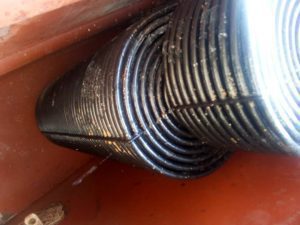
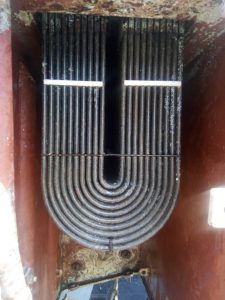
Pictures before sediment removal operations:
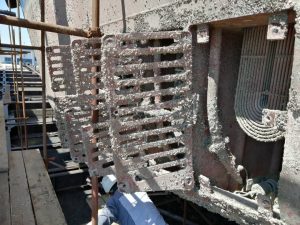
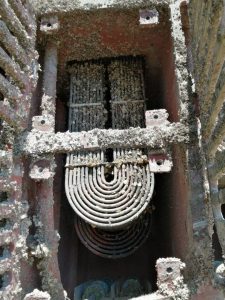
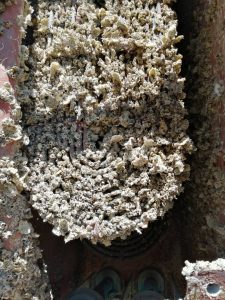
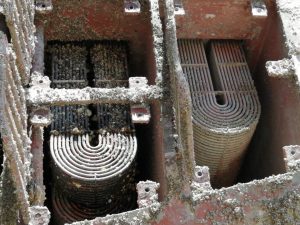
Pictures after sediment removal operation with ship's miter saw:
Conclusion
Deposits on marine equipment, which are mostly calcium and magnesium, act as an insulator between the metal surface and the water and increase the temperature of the metal, resulting in reduced engine cooling. Descaling of marine equipment plays a significant role in reducing costs, including fuel consumption, equipment maintenance, washing, etc. Descaling methods for marine equipment, like other devices, are possible in electronic, mechanical, and chemical forms.
share :
Why do industrial systems require anti-freeze/coolant in the summer?
1405/03/02Cooling Tower Chemical Cleaning Steps — Implementation Guide
1405/02/07Types of sediments in RO systems and methods for identifying them
1405/02/05Benefits of using specialized solutions from Abrizan Company for MED
1404/12/09
Related articles
Types of sediments in RO systems and methods for identifying them
Technical guide for engineers: Accurately diagnose RO deposits (calcium carbonate, silica, biofilm) and select an effective cleaning solution.
Smart non-stop oil exchanger cleaning: CIP pilot in Gachsaran
Reducing pressure drop from 4.5 to 0.5 bar with chemical cleaning in place (CIP). A smart solution for oil exchangers without the need to stop the unit.
Complete guide to chemical washing of industrial equipment Methods, detergents and safety tips
A comprehensive guide to chemical cleaning and descaling of industrial equipment — a variety of methods, detergents, safety tips, and an introduction to the MDA0102 cold miter as a safe, on-line solution. Increase efficiency, reduce costs, and protect equipment.
Physical and chemical descaling methods
In industries such as oil, gas and petrochemical, there is always an attempt to prevent the formation of deposits using different methods in equipment such as heat exchangers and boilers. In this field, a lot of money is spent on chemical materials and additives. But most industrial heat exchangers are exposed to sedimentation due to various reasons such as the low quality of water in different areas. These deposits are mostly formed in the pipes of the converters. In order to reduce the losses caused by sedimentation, the converter must be continuously monitored and cleaned.
Sediment formation in boilers
Boiler feed water should be free of hardness. Sometimes, due to the short or improper operation of the hardness device or the failure to regenerate the resins in time, some hardness enters the boiler feed water. Increasing the water temperature in the boiler reduces the solubility of water solutes. The water near the hot surfaces becomes saturated and the conditions for deposition of less soluble substances are provided and eventually sediment is formed.
Remove the sediment solution Mitreh
Mitreh is a superior solution for dealing with scale in various industries. Mitreh scale removal solution, a revolutionary product from Abrizan Industrial Research Company, is an efficient alternative to traditional scale removal methods. This product offers a comprehensive solution to the scale problem in various industries by overcoming the limitations of existing physical and chemical methods.
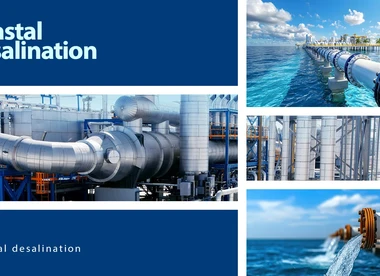
Coastal freshwater sediment removal (MED)
One of the methods of producing fresh water for industrial use is the use of multi-stage thermal desalination plants to desalinate seawater. Due to the high content of soluble and insoluble compounds in seawater and the high temperature shock in desalination packages, sedimentation in these packages is unavoidable. For this reason, periodic sediment removal from desalination plants should be performed.
Sediment and problems caused by it in facilities
When water is used as a thermal fluid, the salts and hardness in the water are separated due to the temperature shock and settle on the surfaces, forming deposits. These deposits are one of the most important factors of erosion and corrosion in heating and cooling installations.
Submit your opinion
Your email address will not be published.