
Mitreh solution
Fire Tube Boilers
A complete review of fire tube boilers, their types, advantages and disadvantages, useful life, scale formation, and preventive maintenance solutions using specialized chemicals is available.
The role of feed water in the performance of desalination and its optimization solutions
Feedwater, the water entering the system, if not properly pre-treated or if it contains high concentrations of minerals, silica, iron, or biological contaminants, will quickly lead to scale formation in the heater, condenser, and demister tubes. These scales not only reduce water production efficiency, but also increase energy consumption and shorten the useful life of the equipment.
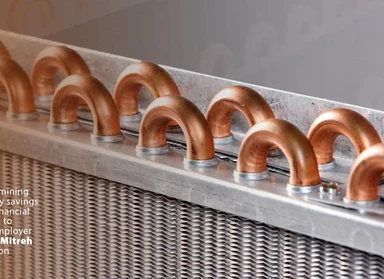
Determining energy savings and financial return to the employer using Mitreh solution
One of the most important points in a heat exchanger is the overall heat transfer coefficient. This coefficient is obtained in terms of the conduction and convection resistances between the fluids separated by flat walls and cylindrical shells, respectively. The layer of scale on the surfaces may increase the resistance to heat transfer between the two fluids to a large extent. This effect can be taken into account by introducing an additional thermal resistance, called the fouling coefficient (Rf), and its value depends on the operating temperature, fluid velocity, and the operating time of the exchanger.
Magnetic anti-fouling
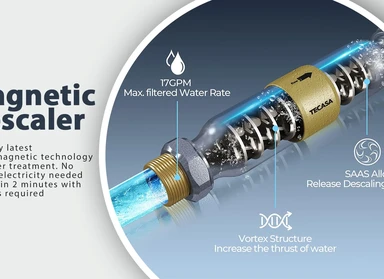
Magnetic anti-scale is a device that works in heating systems by preventing calcium-containing deposits from settling. In this way, in systems that work with water, calcium crystals are neutralized and removed from the system. Of course, as mentioned above, there are drawbacks that cause magnetic anti-scale to have advantages over chemical anti-scale prevention, but also disadvantages that cause it to be ranked lower than anti-scale products such as Mitreh.